Guides
Roadside building cost planning: how to keep a clean evidence record
Roadside building cost planning for 2027 helps U.S. readers document project amounts, sources, dates, scopes, and funding limits without price advice.
Roadside building cost planning for 2027 should begin with a boundary. An old grant award, a public project budget, a provider's quote, and a completed invoice are not interchangeable. Each record answers a different question. Using them as generic repair prices can mislead readers and businesses alike.
What to take away
- Keep the amount, source, date, scope, and project stage together.
- A grant award is evidence of an award, not a current price or completed project.
- Preserve a provider quote as a dated provider statement with its stated limits.
- Do not compare figures from different projects as though they measure the same work.
- Separate historical funding context from current purchasing decisions.
What this guide covers
This guide is about editorial handling of cost-related information. It does not estimate repairs, tell a property owner what work is needed, or recommend a contractor. Readers who need a technical assessment, code guidance, or a current proposal should work with the responsible property contact and a qualified professional.
For a publisher, the useful question is simpler: what can this record prove? A public announcement may prove that a named applicant received a stated award for a stated scope. It may not prove what the work cost in the end, whether other funds were used, or whether a similar building needs the same budget.
Build a cost evidence record
Every figure should have a short evidence record. The record makes later editing easier and stops a number from becoming detached from its original purpose.
| Field | What to record | Why it matters |
|---|
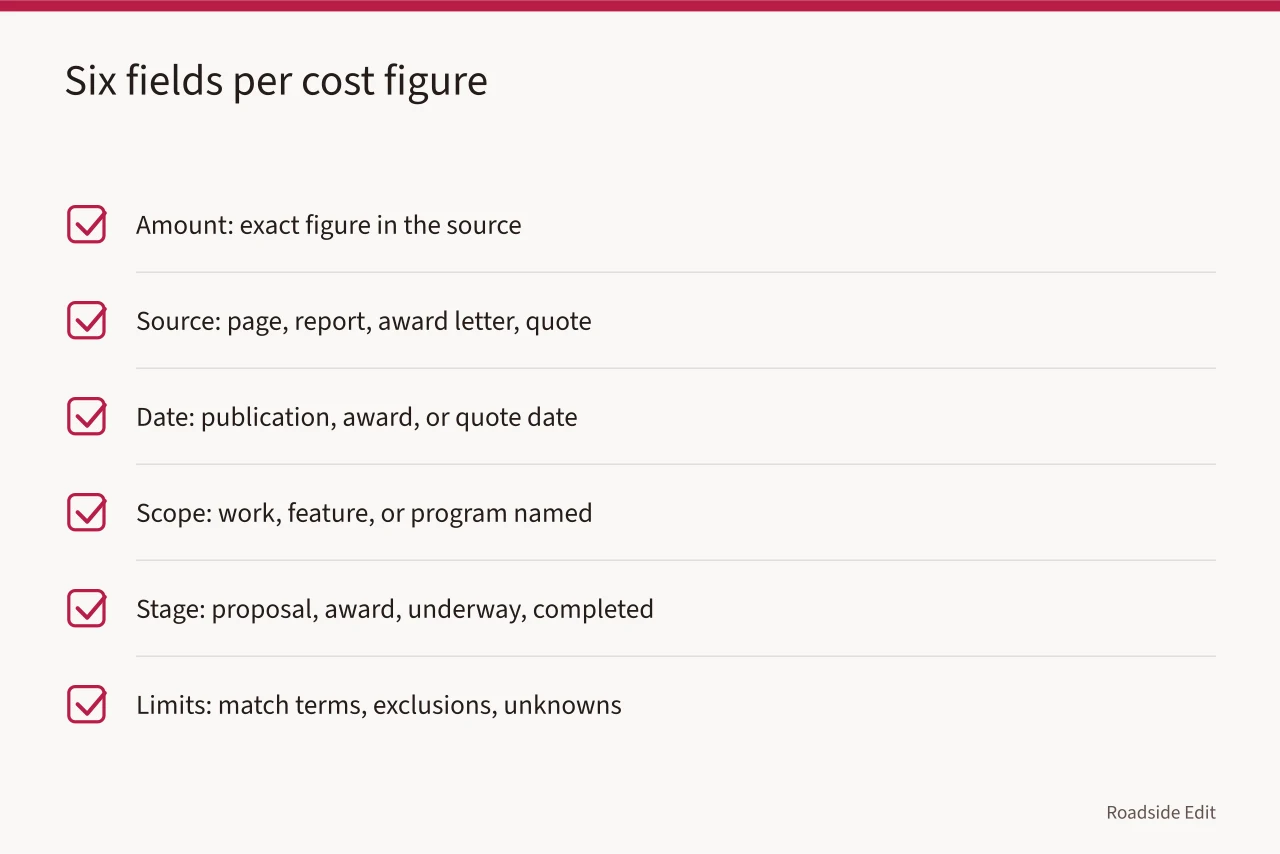
Do not store only a number. For example, "$20,000" means very little without a project description. It could refer to a grant share, a match, a planned phase, a sign, a survey, a building feature, or a complete project budget. The surrounding fields are what make the record understandable.
Understand the difference between funding and cost
Funding describes where money was awarded, pledged, or spent. Cost describes the amount required for a defined scope at a defined time. They often overlap, but they are not the same statement.
A grant can be part of a project's funding. It may require a match. It may cover one phase only. It may be awarded before bids are finalized or while other work remains outside the award. An article should state the relationship the source gives and no more.
The National Park Service's 2022 Route 66 cost-share grant announcement gives project-specific grant and matching amounts for preservation, research, and education projects. Those entries are examples of why scope matters. The amounts are connected to named projects and dates, not a current price list for roadside buildings.
Keep project phases separate
Projects commonly move through research, planning, stabilization, design, permits, procurement, construction, and closeout. A source may describe one of those stages. It is misleading to write that a building was restored because an early phase received funds.
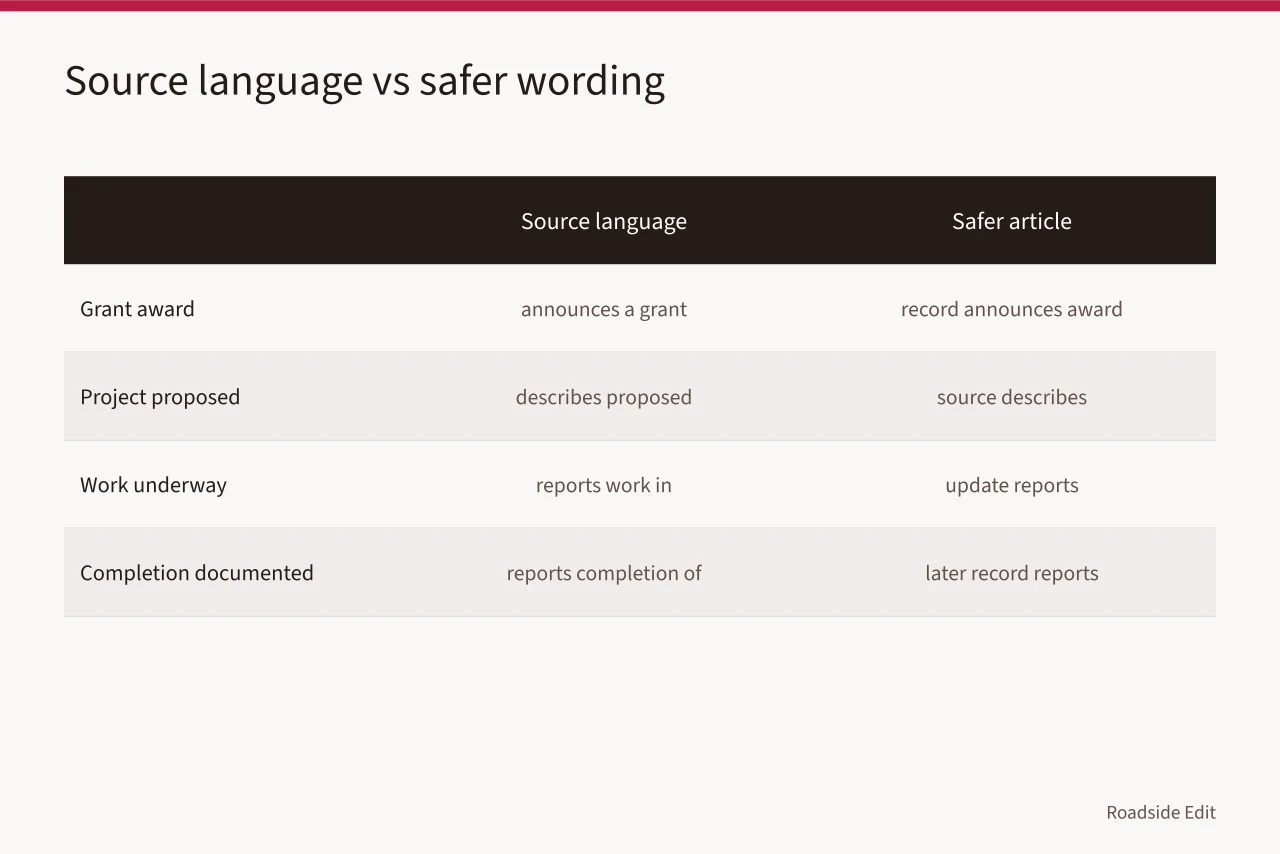
Use stage-specific wording:
| Source language | Safer article wording |
|---|---|
| Grant award | "The record announces a grant award for..." |
| Project proposed | "The source describes proposed work..." |
| Work underway | "The update reports work in progress..." |
| Completion documented | "A later record reports completion of..." |
Avoid words that leap across stages. "Restored," "fixed," and "saved" may sound natural, but each implies an outcome. Use them only when a source supports that outcome. If the documentation stops at an award, the article should stop there too.
Compare records only after matching their scope
Two figures can look comparable because they share a subject, such as a motel sign or a roadside facade. They may still concern different materials, labor conditions, access, project dates, grant rules, or levels of documentation. A comparison is sound only when the records describe enough of the same work to justify it.
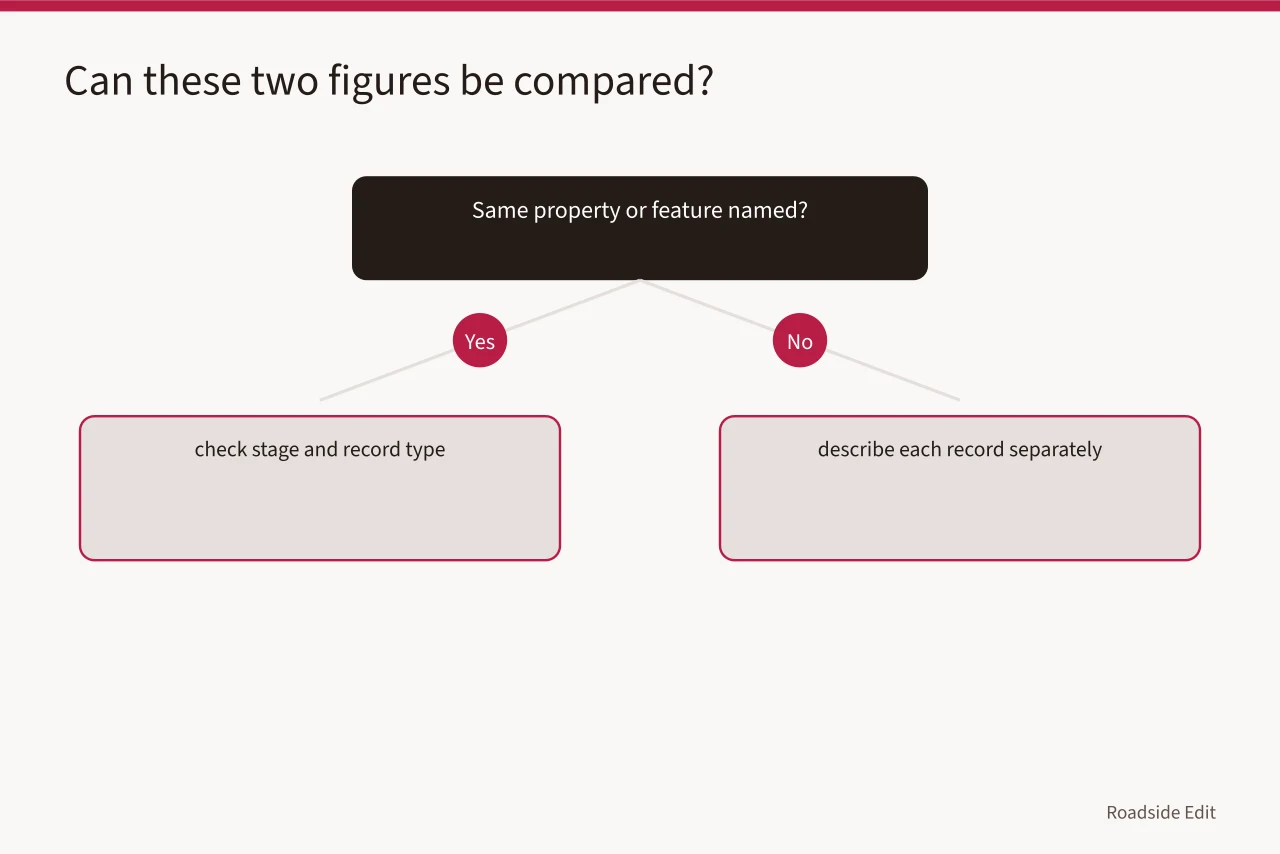
Before comparing two amounts, check these questions:
- Do the sources name the same property or feature?
- Do they cover the same stage of work?
- Are both amounts grants, total budgets, invoices, or provider quotes?
- Are their dates close enough for the comparison's stated purpose?
- Do either source list matching requirements or exclusions?
If any answer is unclear, do not calculate a difference, average, or typical price. Describe each record separately. Readers can see the documented context without being given a false benchmark.
Handle provider quotes with disclosure
Businesses may send quotes, service ranges, or paid placement information. The publication can use that material when it is clearly attributed and dated. Retain the original message and record the provider name, quote date, scope, exclusions, and expiration terms when supplied.
Do not recast a submitted quote as a tested market rate. The article has not compared every provider, inspected the property, or confirmed that another reader has the same circumstances. If the website later accepts advertising or paid placement, label the arrangement according to its disclosure policy and keep it separate from editorial claims.
Preserve historical figures without making them useless
An older funding record can still add context. It may show how a public program described a project at a particular time.
Use it with a date and a narrow sentence, as in: "In 2022, the award announcement listed a grant and match for the project's stated scope."
That wording tells readers what the record is and what it is not.
Avoid present-tense shortcuts such as "costs $20,000" unless there is a current source for that exact statement. Historic dollars do not become current pricing merely because the article is published today.
Plan updates and corrections
Cost information often changes. A project can receive additional funding, revise its scope, or finish for a different amount than its initial budget. Keep a correction log with the old wording, new wording, source, and date of the edit.
When an update arrives, identify which claim it changes. A new owner statement about an upcoming project does not erase an earlier award record. Both can remain in the file if they are clearly dated and attributed. The article should explain the newer information without rewriting history.
Keep the budget discussion useful to readers
Readers may want a number to compare projects or consider a service. The responsible answer shows the kind of record behind the number, not a shortcut that looks more certain than the evidence.
A scoped, dated public record can help a reader understand a past project. It cannot substitute for a current assessment of another location.
That distinction also protects businesses. A provider's price can depend on access, travel, materials, site conditions, permits, lead time, and the work requested. A directory article can list a provider's submitted information with attribution. It should not collapse those variables into a generic promise about what readers will pay.
When the available evidence is incomplete, say so plainly. An article can remain helpful by explaining what documentation is present, what follow-up source would answer the open question, and why the missing detail changes the meaning of the figure.
Source image
The Library of Congress catalog identifies the former Americana Motel and gas station image as a 2020 Albuquerque view.
The image record supports the caption's documented scene. It does not establish a repair need, a current property value, or a present operating status.
A final prepublication check
Read every sentence containing a dollar sign, price word, or funding claim with its source open. Then ask whether the source supports the amount, scope, date, and stage together. If any part is missing, narrow the sentence or remove the figure.
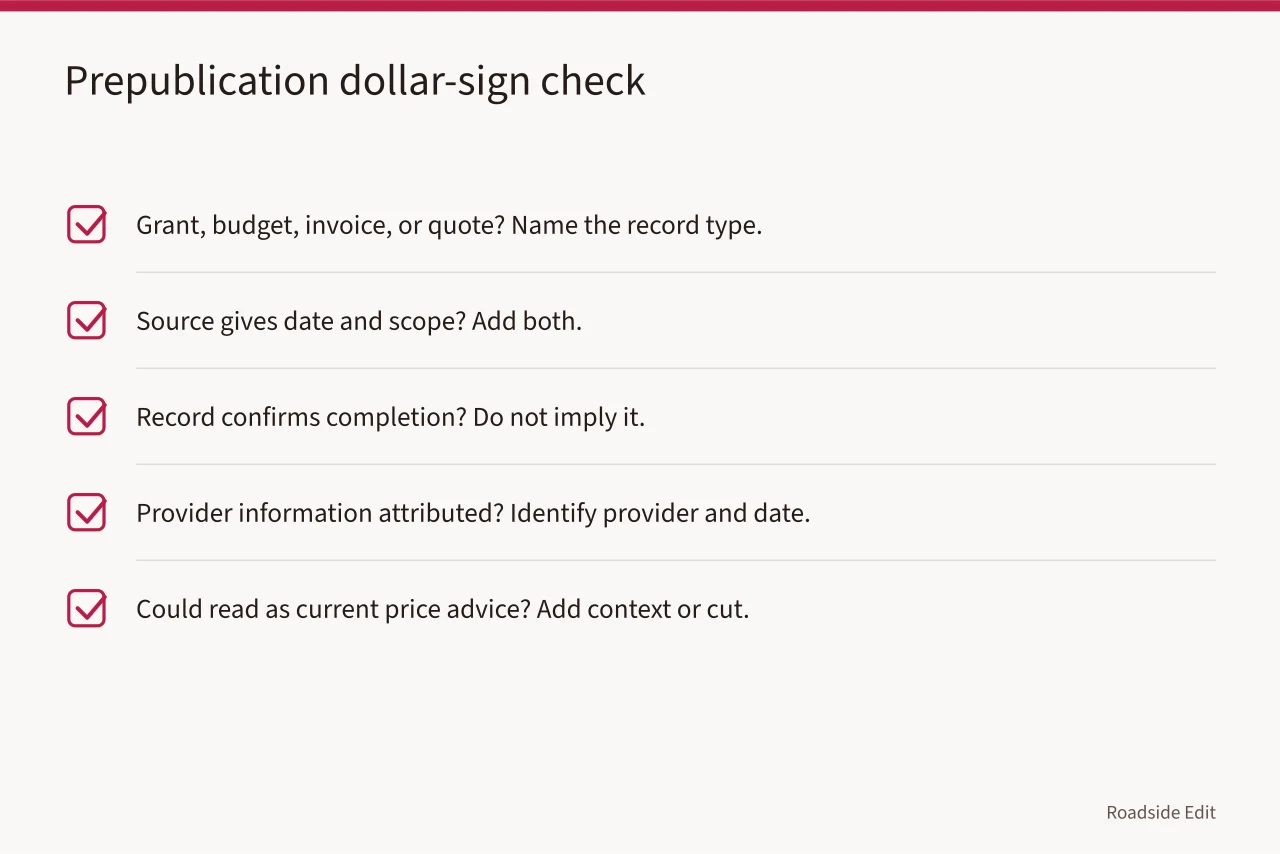
| Review question | Editorial action |
|---|---|
| Is this a grant, a budget, an invoice, or a quote? | Name the record type. |
| Does the source give a date and scope? | Add both next to the figure. |
| Does the record confirm completion? | Do not imply it if it does not. |
| Is provider information attributed? | Identify the provider and date. |
| Could a reader mistake this for current price advice? | Add context or cut the comparison. |
Build a cost evidence record
Give every number its own record. Retain the source page, title, date, amount, scope, project stage, funding condition, and what the record does not say. A grant award, estimate, proposal, contract, invoice, and final report all describe different stages. Do not use one as a substitute for another.
| Record type | What it can support | What it cannot prove alone |
|---|---|---|
| Award | Funding for a stated scope | Final cost or completion |
| Quote | Provider's stated offer at a date | Authorization or outcome |
| Invoice | Amount billed for described work | Full project history |
| Project report | Status stated by its author | Every cost outside that report |
The National Park Service announced Route 66 cost-share awards for named projects and scopes. Read the NPS 2022 Route 66 cost-share awards. An award notice does not establish the final amount spent or a current price for another roadside building.
The Government Accountability Office describes a reliable estimate as having a defined purpose, documented data, and stated assumptions. Read the GAO cost-estimating guide. This federal guide does not price a local project. It supports keeping purpose, data, and assumptions together with a number.
Compare scope before totals
Two figures can share a dollar sign while describing different work. Before comparing, list the feature, access conditions, evidence base, materials, exclusions, date, and project stage. A lower figure may cover less work. A larger award may include a matching requirement or a different phase. State the difference rather than calculating a false benchmark.
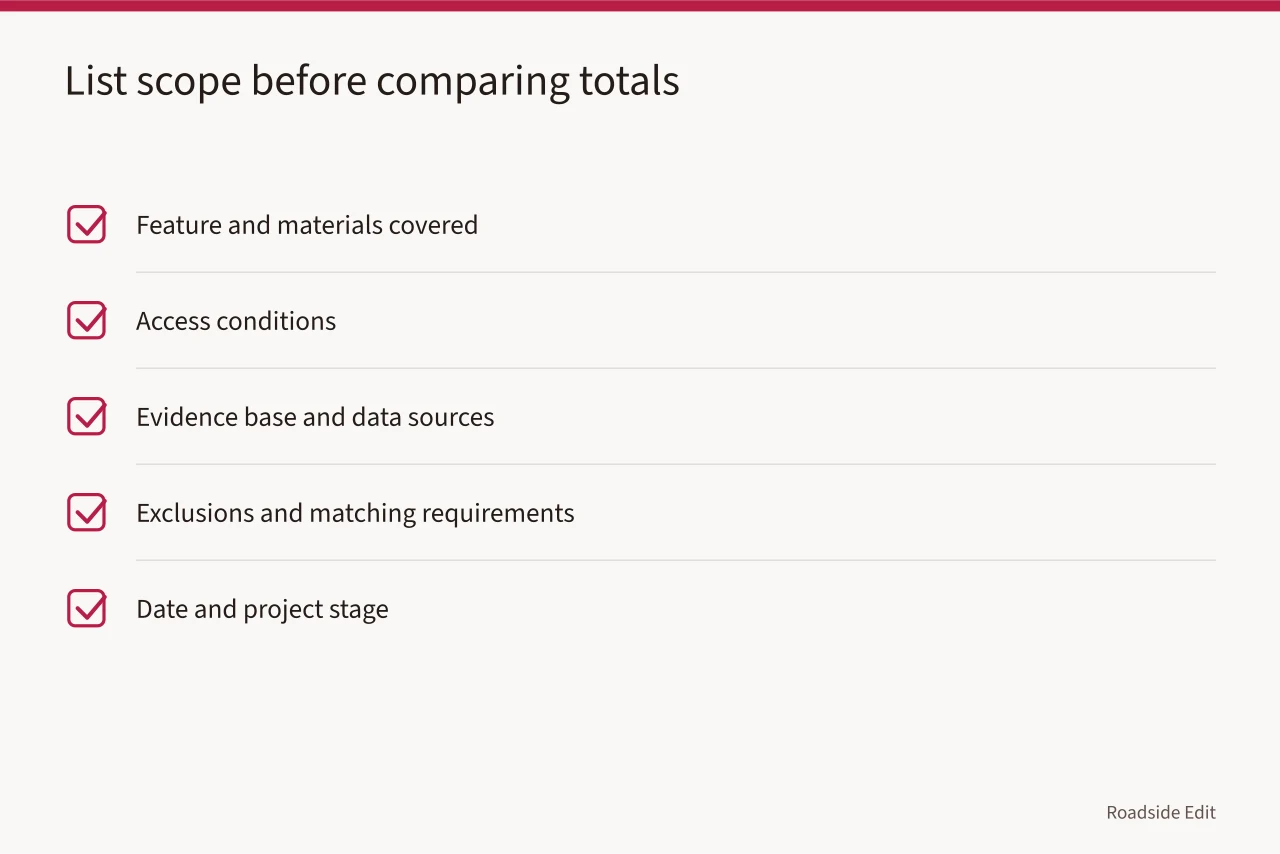
The National Park Service cost-estimating checklist calls for a basis of estimate, identified data sources, assumptions, and attention to changes from earlier versions. Review the NPS cost-estimating checklist. It applies to NPS work, not every property. It supports reading an amount with the scope it describes.
Record changes and commercial claims
Keep a dated change log. If access, materials, owner information, or a project decision changes the scope, retain the old record and add the new source. Do not silently replace a quote or award description. Provider statements and paid listings must remain attributed. They can explain an offer, but they are not independent proof of property condition, approval, or outcome.
The Federal Acquisition Regulation discusses factors used to determine contract type in federal purchasing. See FAR guidance on contract type. It does not govern editorial work or ordinary private projects. It supports the limited point that amounts need to be read with their terms and allocation of uncertainty.
A responsible handoff
Before publication, ask whether the article identifies the source, date, scope, project stage, assumptions, and open questions for every amount. If not, do not present it as a comparison. A useful article may simply say that two documented records cannot be merged into a shared price claim. That protects readers and businesses from an attractive but unsupported number.
The image is illustrative. It does not establish current cost, ownership, safety, or project status.
Common questions
Can a grant award be used as a current repair estimate?
No. Report it as a dated award for the scope named in the source.
What belongs beside a provider quote?
Include the provider, quote date, scope, stated exclusions, and expiration terms when available.
Does funding prove that a project was finished?
No. Use a later source that specifically reports completion.
Can an article compare two historic project amounts?
Only if the article explains the different dates, scopes, record types, and limits. Otherwise, present the records separately.
In this guide
- Roadside building cost questions to ask before comparing quotesRoadside building cost questions for 2027 help U.S. readers compare scope, timing, evidence, assumptions, and project stages without false benchmarks.