Reviews
Part of Roadside building cost planning: how to keep a clean evidence record
Roadside building cost questions to ask before comparing quotes
Roadside building cost questions for 2027 help U.S. readers compare scope, timing, evidence, assumptions, and project stages without false benchmarks.
Roadside building cost questions for 2027 are useful when an editor has two records that look similar but may mean different things. The purpose is not to create a price range. It is to decide whether a comparison would be fair, or whether each record needs its own context.
What to take away
- Compare records only after checking scope, date, and project stage.
- Keep grant awards separate from total budgets, invoices, and provider quotes.
- State when the evidence is incomplete instead of filling the gap with an estimate.
- Preserve matching requirements beside an award amount.
Start with four comparison questions
Ask these questions before putting two amounts in the same sentence.
| Question | What a matching answer looks like | What to do when it does not match |
|---|
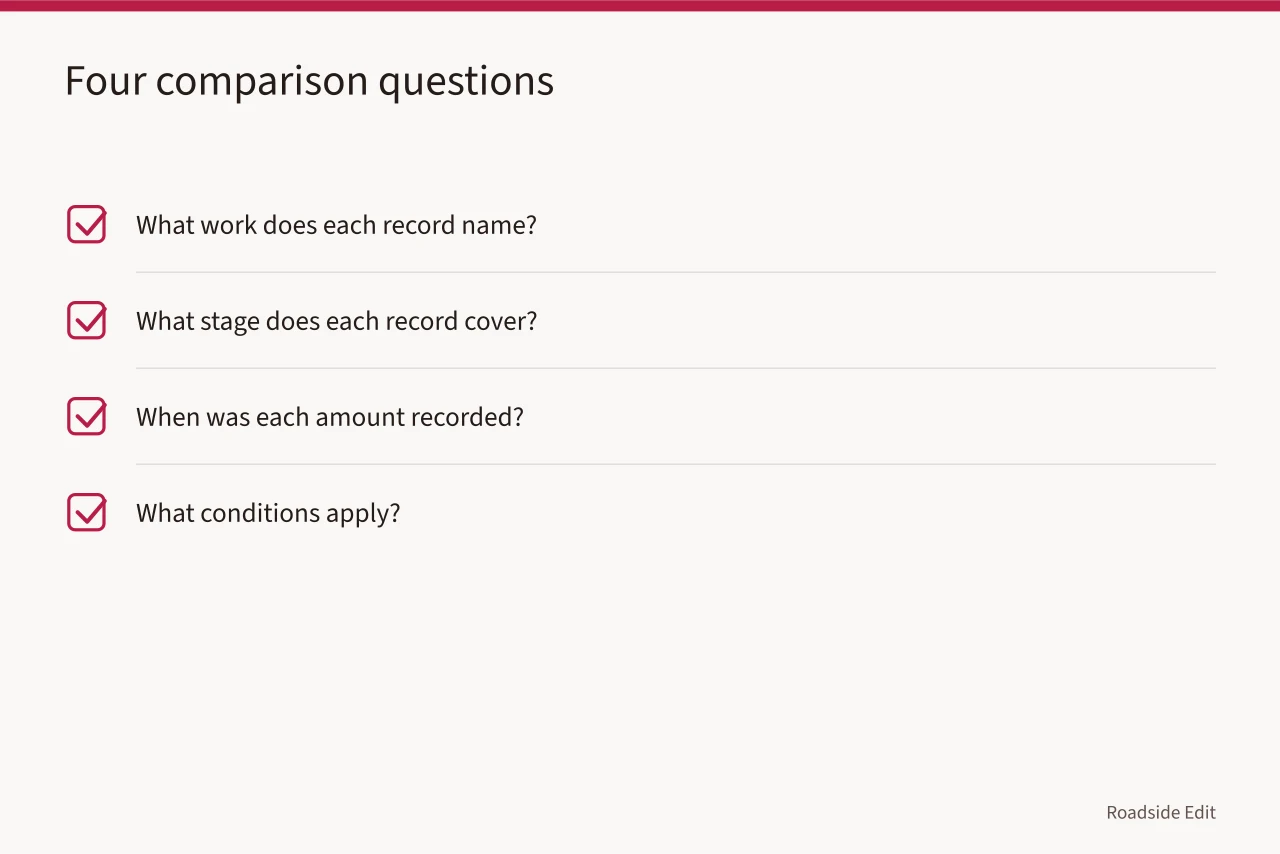
These questions are basic, but they prevent a common error: a reader sees two dollar figures and assumes they measure the same thing. A grant award can show public funding for a named project. It does not automatically show the whole project cost, the final invoice, or a current price for another property.
Treat a match as a condition, not an extra detail
The National Park Service describes its Route 66 Cost-Share Grant Program as assistance for preservation, research, planning, oral history, and education work. Its program page says applicants must provide at least a 50% (1:1) cost-share match. Check the NPS Route 66 cost-share program requirements. That requirement belongs next to an award amount because it affects what the amount can prove.
For example, a record may identify a grant and a required match but omit the final amount spent. In that case, write about the award and its terms. Do not present the entry as a completed project total. If a source names a phase, retain that phase in the article instead of broadening it to a full building rehabilitation.
Use a comparison note when records cannot be merged
A short note can keep the article clear:
These records concern different project scopes and dates. They are included as documented examples, not as a shared price benchmark.
The note is appropriate when one entry is a public award and the other is a submitted provider quote, or when one source covers research while the other concerns construction. It also gives businesses a fairer presentation: their supplied information stays tied to the work they described.
Ask what evidence supports a number
An amount can attach to a proposal, preliminary estimate, award, or contract. The same applies to an invoice, change request, or completed project report; record the document type before describing the amount.
A building photo does not establish materials, access conditions, permit costs, hidden work, or final scope. A provider statement can explain its own offer but stays attributed unless an independent record confirms the fact.
The Government Accountability Office describes reliable cost estimates as having a defined purpose, documented data, and stated assumptions. Read the GAO cost-estimating guide. Federal guidance does not calculate a price for a roadside building. It supports keeping the purpose, data, and assumptions beside every number.
The National Park Service cost-estimating quality-assurance checklist calls for a clear basis of estimate, identified data sources, assumptions, allowances, and attention to changes from earlier versions. Review the NPS cost-estimating checklist. It applies to NPS projects, not every property. It supports comparing documents on what they actually describe rather than on their totals alone.
Keep quotes, approvals, and completed work distinct
A submitted quote is not an authorization. An award is not an invoice. A permit or public notice is not proof that every part of work was completed. Use a timeline to label the record's stage, date, scope, exclusions, and any stated conditions. When an amount changes, retain the earlier version and add a new dated note explaining why.
The Federal Acquisition Regulation discusses factors used to determine contract type in federal purchasing. See FAR guidance on contract type. It does not govern an editorial comparison. It supports the narrower idea that a number must be read with the terms and allocation of uncertainty that accompany it.
A responsible cost-record handoff
Before publishing, retain the specific source page, document date, amount, currency, scope, assumptions, exclusions, and project stage. State whether the material is public, owner-supplied, or provider-submitted. If two records differ, describe the difference. Do not manufacture an average. A clear limit is more useful than a tempting number that readers might mistake for a current quote.
The image is illustrative. It does not establish a current cost, ownership, safety, or project result.
Common questions
Can an article compare a grant with a provider quote?
Only as different records. Label the grant and the quote, retain their dates and scope, and do not turn them into a single price range.
Does a required match reveal the final project cost?
No. It describes a funding condition. Use a source that states a final total before reporting one.
What if a record does not explain its scope?
Do not compare it with a more detailed figure. State the limit or leave the amount out.