Guides
Part of How to run a modern roadside design case study method for 2027 records
Roadside case study checklist: how to test every claim before you write
Roadside case study checklist for 2027 helps U.S. writers collect dated sources, observations, captions, decisions, disclosures, and clear evidence limitations.
Use this checklist before writing about a roadside place, design effort, business profile, or documented project. It prevents a case study from filling gaps with a preferred narrative. It does not assess a site or approve claims about a project's performance.
What to take away
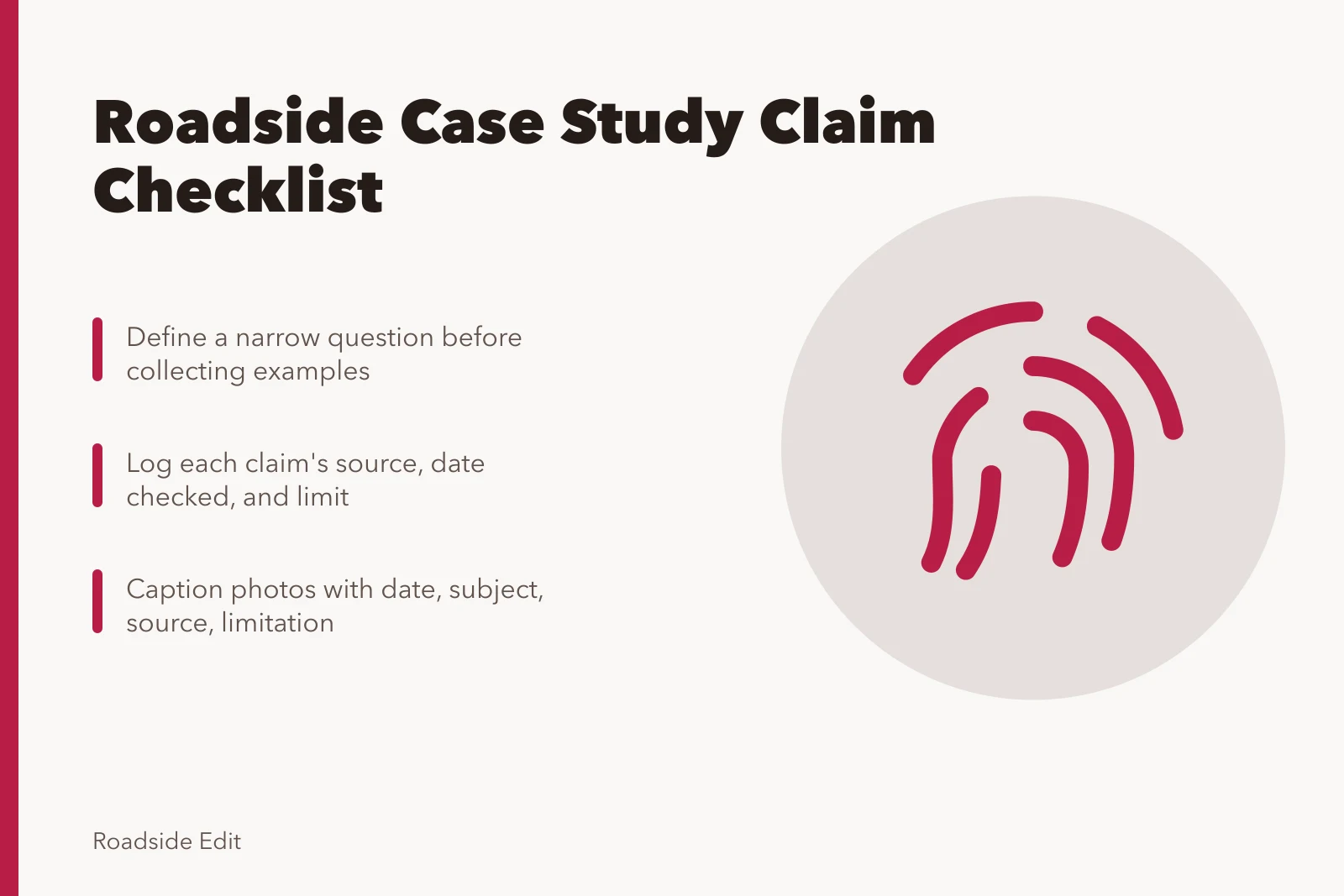
- Define the question before collecting attractive examples.
- Keep original records with their date, source, and limitation.
- Label observations, reported statements, decisions, and interpretation separately.
- Write the disclosure and update path before publication.
Assemble the evidence packet
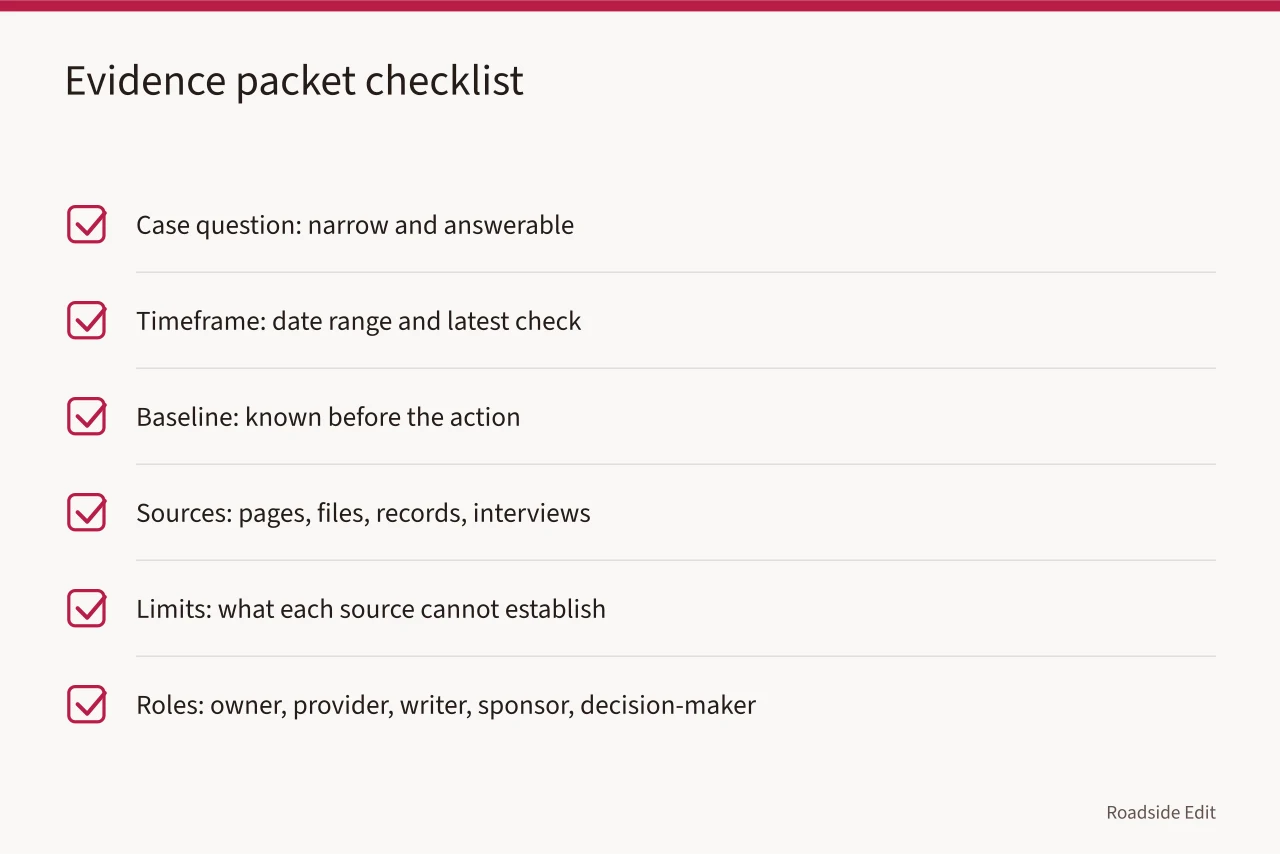
| Check | Record needed |
|---|---|
| Case question | A narrow question that available records can answer |
| Timeframe | The date range covered and the latest source check |
| Baseline | What is visibly or documentably known before the action |
| Sources | Specific pages, original files, public records, or attributed interviews |
| Limits | What each source does not establish |
| Roles | Owner, provider, writer, sponsor, and decision-maker where relevant |
The National Park Service describes the HABS/HAER/HALS Collection as containing drawings, photographs, written data, and original field notes. Its collection overview concerns a formal national archive, not the required format for an online article. The useful editorial lesson is that a strong record can include several kinds of evidence rather than relying on one image or claim.
Test every statement before writing
For each material statement, ask four questions:
- Is this a direct observation, an attributed report, a documented decision, or an interpretation?
- What source supports it, and when was that source created or checked?
- Does the source cover this place and question, or only provide background?
- What limitation should the reader know at the same point in the article?
Use a photo caption to state its date, subject, source, and limitation. Do not ask a photo to prove ownership, safety, approval, durability, or a result outside what it visibly shows. Treat provider-provided material as a provider statement unless independently documented.
Check the source before repeating a claim
Open the exact page, report, record, or image page behind each important sentence. A search result, a summary written by another publisher, or an unattributed social post can be a lead. It is not enough support for a factual claim in the finished study. Note the date you checked the material and the part of the claim it supports.
The National Archives guidance on agency recordkeeping describes federal requirements for records that document activities and decisions. Those rules do not govern an independent article. They support the practical discipline of retaining the record that explains a material editorial decision, rather than relying on a summary made later.
For a documented historic feature, ask whether a source describes the feature itself or only gives general background. The National Park Service documentation standards and guidelines address methods for recording historic properties. They do not verify a particular roadside claim. They are useful support for recording a source's origin, date, scope, and limitation.
Use a claim log while drafting
Create a simple claim log before publishing. Give each material statement a short label, source, date checked, category, and limit. The categories can be observation, attributed statement, public record, or analysis. The limit is just as useful as the source. It tells the editor what the item cannot establish.
| Claim category | Example note | Publication treatment |
|---|---|---|
| Observation | Sign visible in a dated photo | Describe only what the image visibly shows |
| Attributed statement | Owner stated a change was made | Name the speaker and date; do not treat it as independent proof |
| Public record | Agency document identifies a review | Link the specific record and describe its scope |
| Analysis | Writer compares two documented versions | Mark it as an interpretation and show the basis |
The Federal Trade Commission's endorsement guides explain federal principles for endorsements and testimonials in advertising. They are not a general fact-checking manual. They do support treating a paid relationship, endorsement, or testimonial as information a reader may need to evaluate the presentation.
Prepare the publication record
Save the brief, source register, approved quotes, original files, article date, correction log, and disclosure text together. If a sponsor funded the article or paid for a listing, label that relationship clearly. If an item cannot be publicly shared, keep it in the private record and do not use it as hidden support for a public claim.
Common questions
What is the most important case-study file?
The source register, because it connects each material statement to a dated record and its limitation.
Can an interview be used as evidence?
Yes, if it is attributed, dated, used within its scope, and not presented as proof of a claim the speaker cannot establish.
Why keep a correction log?
It preserves the article's update history and makes a later revision more transparent.