Guides
How to run a modern roadside design case study method for 2027 records
Modern roadside design case study method for 2027 helps U.S. writers document evidence, scope, decisions, limits, and updates without overstating outcomes.
A useful roadside-design case study makes its evidence visible. It does not turn a polished photo, a provider's statement, or a post-project announcement into proof of a broad result. The article should tell readers what was observed, what source supports each material fact, what the project team decided, and what remains outside the record.
This method is for publishing a responsible account of a U.S. roadside place, feature, communication project, or research effort. It does not determine property ownership, safety, permits, accessibility, engineering performance, historical significance, or professional responsibility. Those questions need current, site-specific information and the appropriate authority.
What to take away
- Begin with a narrow question, not a desired success story.
- Preserve original records and state their date, scope, and limitations.
- Separate observations, source-backed facts, interpretation, and decisions.
- Define the provider's or sponsor's role without turning it into a performance claim.
- End with open questions and an update date so readers know what the article does not establish.
Start with a question a record can answer
The first sentence of a case study should identify a bounded question. Ask how a team documented existing visitor-orientation issues before preparing a communication concept.
What records were reviewed before a roadside business profile was updated? Which alternatives were compared within a stated budget or editorial scope? "How did this project transform the area?" is too broad unless the article shows what changed, compared with what, over what period, and through which evidence.
Avoid beginning with a label such as successful, resilient, restored, safe, accessible, low-maintenance, or award-winning. Such words may be true in a particular context, but they need a source and a defined meaning. If the record only shows that a feature was installed or an article was published, say that. A limited statement remains useful when it is accurate.
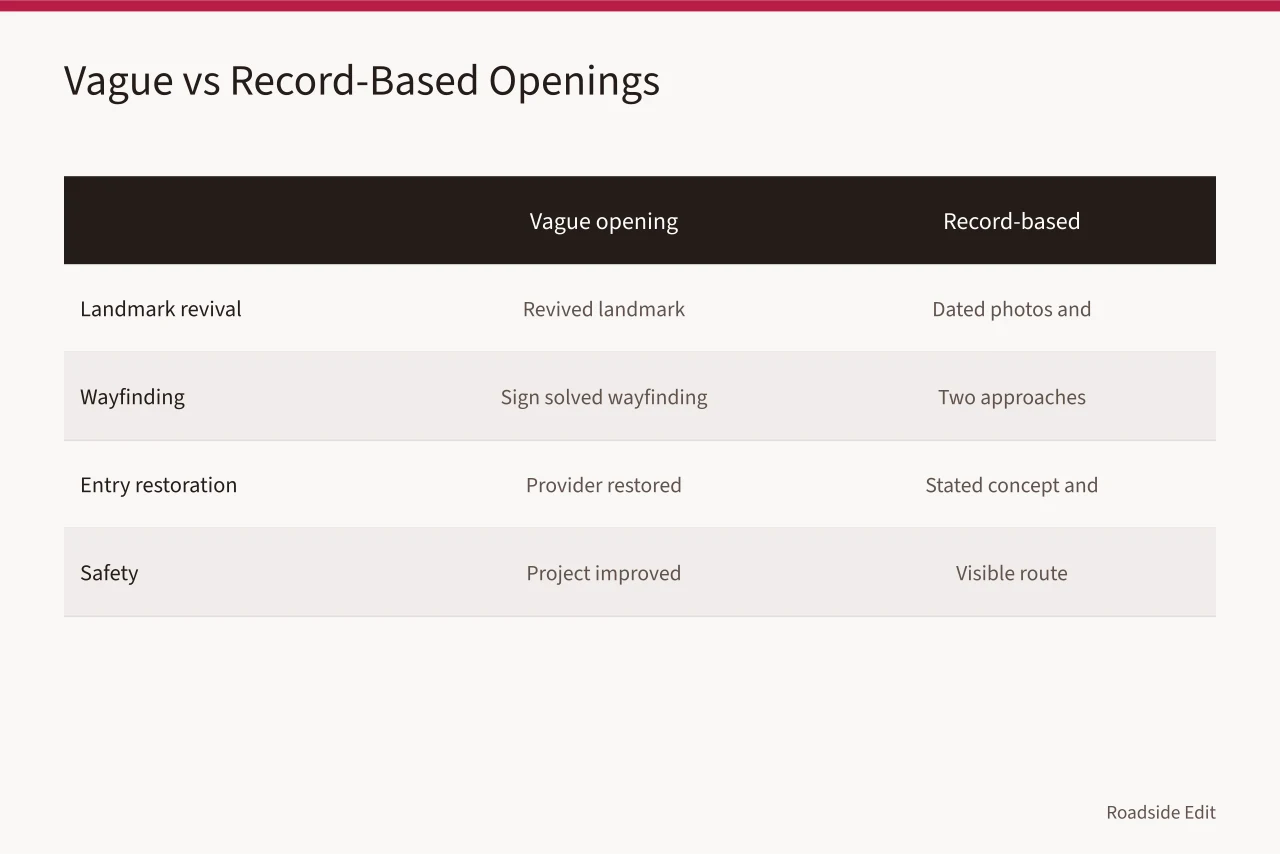
| Vague opening | Record-based opening |
|---|---|
| A roadside landmark was revived | The article documents a dated set of photographs, published records, and a stated communication project |
| The new sign solved wayfinding | The team compared two orientation approaches and recorded its selected message format |
| A provider restored the entry | The provider's stated scope covered a documented concept and handoff files; other decisions were outside the record |
| The project improved safety | The article describes visible route questions but does not make a safety determination |
Build an evidence packet before drafting
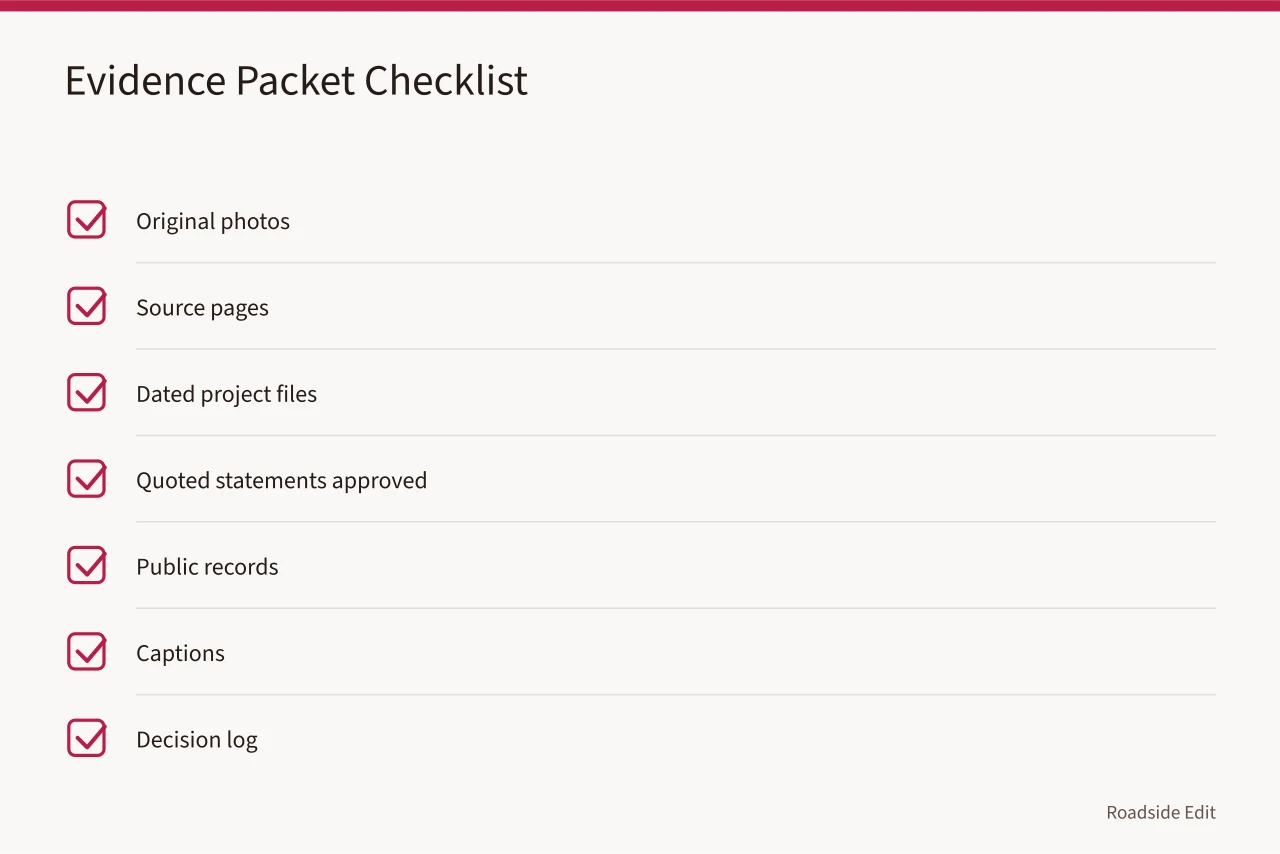
Collect the records that answer the narrow question. An evidence packet can include original photos, source pages, dated project files, quoted statements approved for use, public records, captions, and a decision log. For every item, write the date, creator or source, what it directly shows, what it does not show, and whether it can be used publicly.
National Park Service documentation guidelines describe formal heritage-documentation work that can use drawings, photographs, and written historical reports. A general content article does not need to follow that formal process. The limited editorial lesson is useful: different records serve different purposes, and an article should not pretend that one image or file answers every question.
Use a basic evidence register:
| Item | Direct support | Limitation | Use in article |
|---|---|---|---|
| Dated photo | Visible appearance at a stated time | Does not prove ownership, condition behind the image, or future result | Captioned observation |
| Public source page | A specific published claim or record | May not apply to this location or date | Attributed background |
| Project brief | Intended scope and decision | Does not prove the final outcome | Scope statement |
| Interview note | A person's reported account | Needs attribution and date | Clearly identified perspective |
The National Archives guidance on agency recordkeeping describes federal requirements for records that document activities and decisions. It does not establish a private publisher's process. It supports retaining the dated record that explains why a material claim or edit was made.
Keep four kinds of statements apart
Readers should be able to distinguish an observation from a conclusion. Labeling this difference reduces accidental overclaiming and makes later updates much easier.
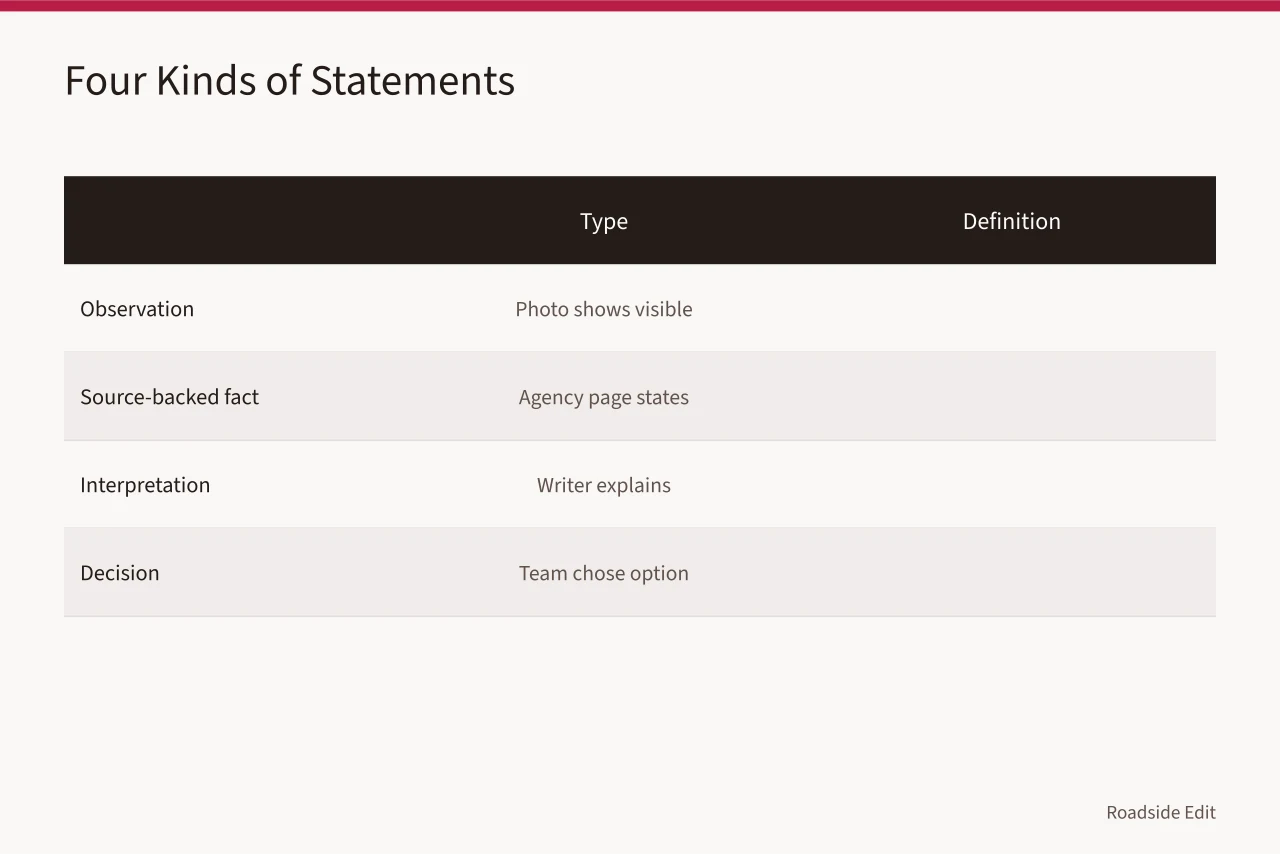
An observation can be direct without being complete. An interpretation can be helpful without becoming a site determination. A decision can be important without proving a long-term outcome. Use language that preserves those boundaries: "the project record states," "the photo shows," "the team selected," and "the article does not establish."
Describe the baseline before the action
Without a baseline, a case study can make ordinary change sound like proof of impact. Describe the available starting record before presenting the option or action. The baseline may be sparse. If it contains only several photos and a dated source page, acknowledge that limitation. Do not invent a before-and-after measure because an article needs a stronger narrative.
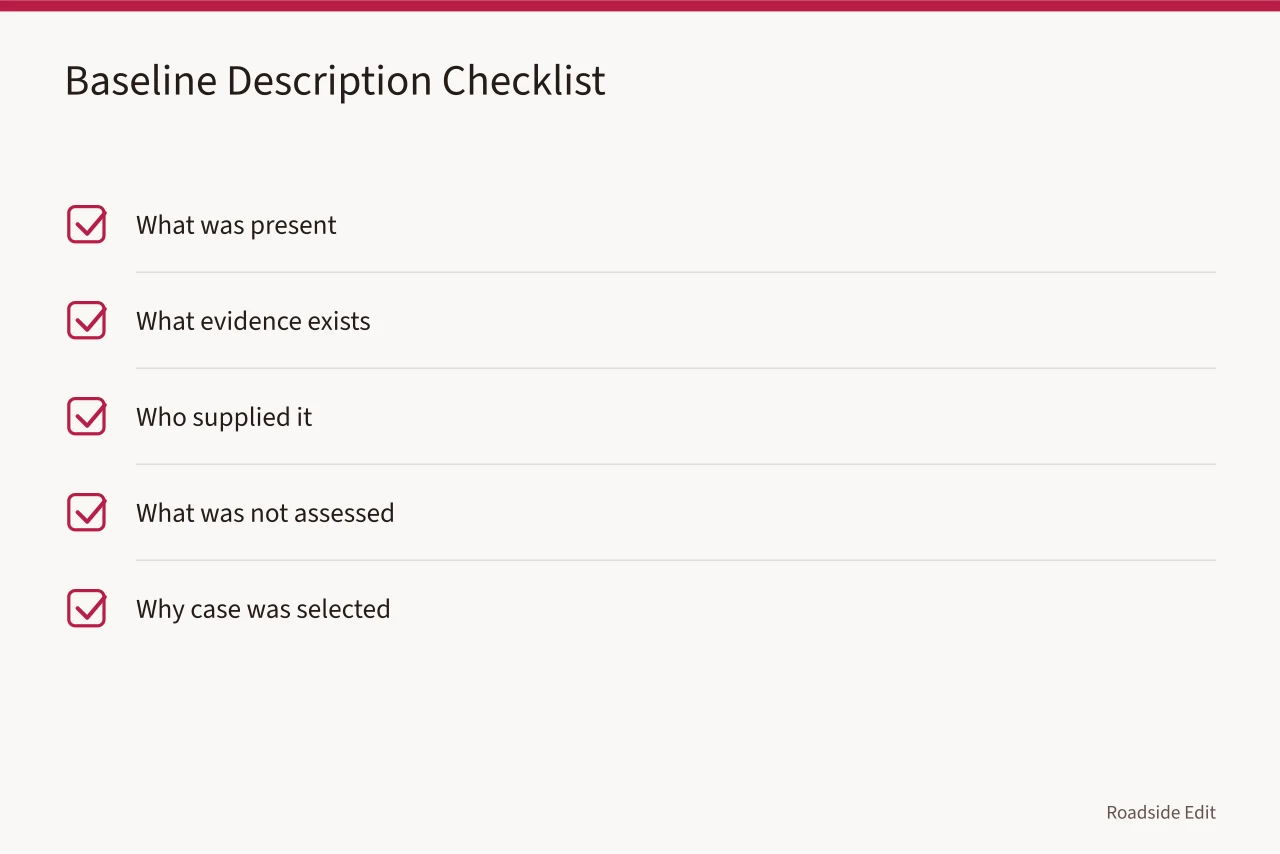
The baseline should identify what was present, what evidence exists, who supplied it, and what was not assessed. It can also state why the case was selected. Selection may be editorial, historical, illustrative, sponsored, or based on a public record. The reason should be visible, especially when the example is not representative of all roadside places or projects.
Explain roles without creating endorsements
Case studies often involve owners, local managers, designers, fabricators, photographers. Writers, sponsors, public agencies.
Name each role only as the record permits.
A provider may have produced a design concept, but that does not mean it approved a route, managed construction, or guaranteed results; a sponsor may have paid for a listing, but that does not make it an independent source.
Use a role table to avoid ambiguity:
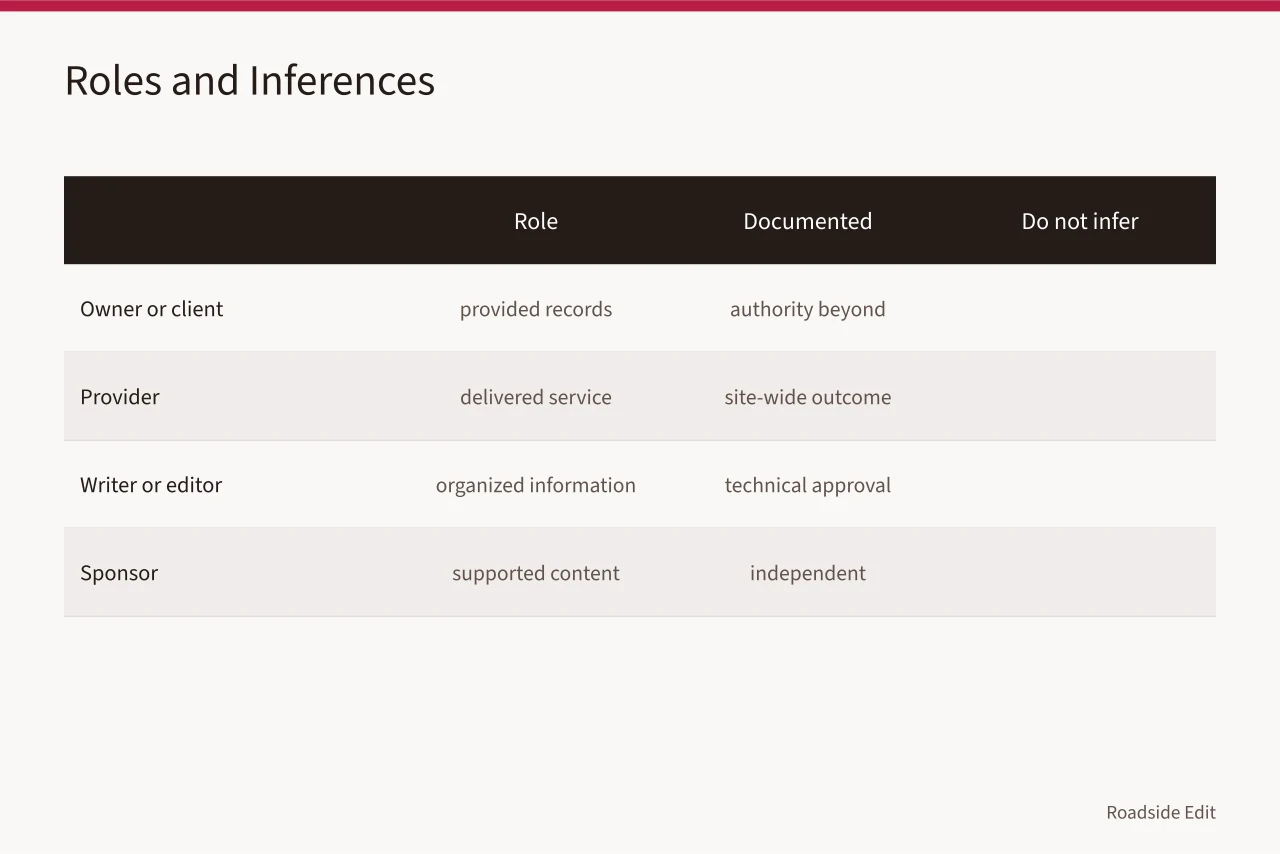
If the relationship is paid, disclose it plainly. If the writer received information from a provider, say that the material was provider-supplied. Clear labels protect readers and allow agencies or businesses to participate without distorting the factual narrative.
The Federal Trade Commission's endorsement guides address endorsements and testimonials in advertising. They are not a case-study research method. They are relevant when a case study includes a paid relationship, a testimonial, or another commercial message that readers may need to evaluate.
Report alternatives and change points
A good case study does not need to expose every private disagreement. It should, however, explain meaningful alternatives and why the recorded decision was made. Describe each option using the same boundary: available records, expected deliverable, stated constraints, maintenance or update responsibility, and any unresolved question.
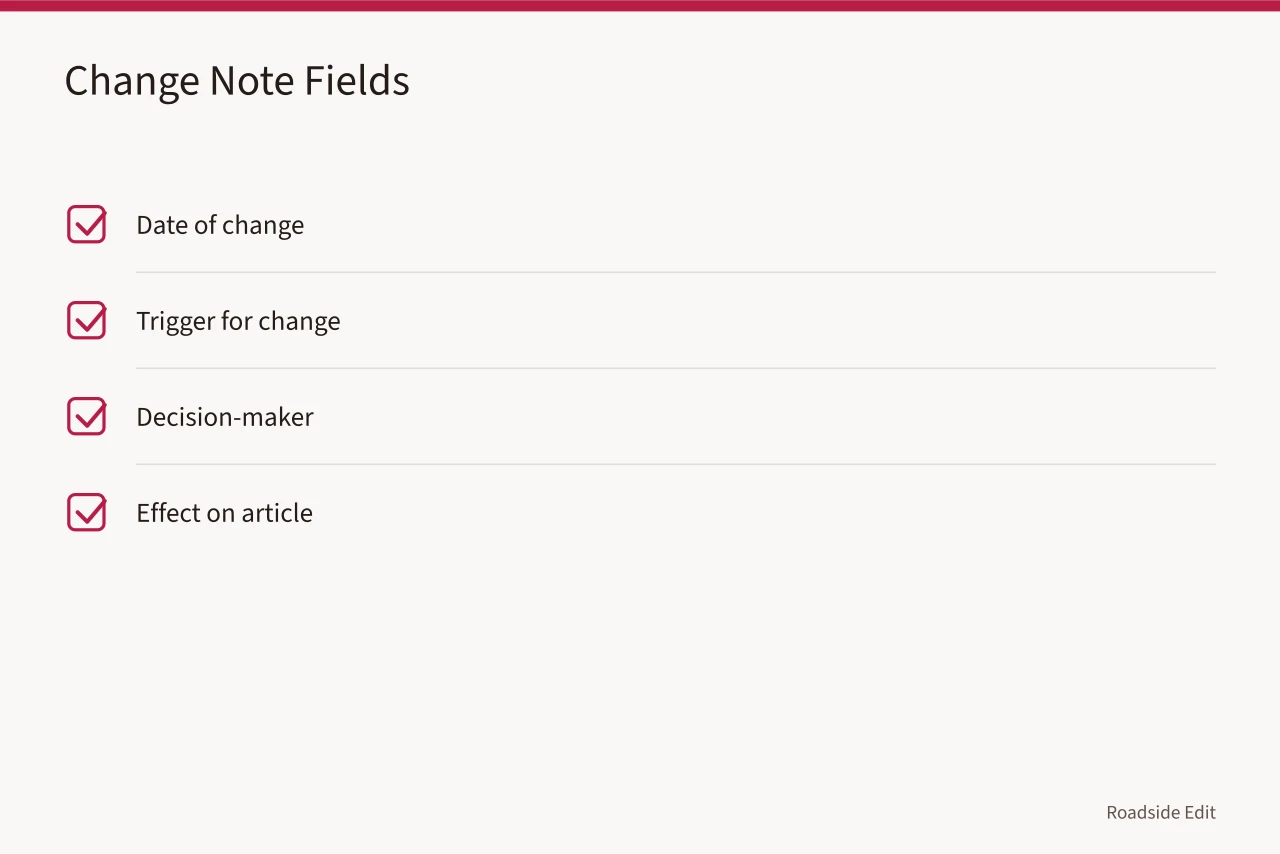
A change may come from new evidence, a client request, a budget limit, a permission issue, or an editorial decision. Do not portray change as failure, but keep the history accurate.
State limitations at the point they matter
Limitations should appear alongside the relevant claim rather than being buried in a final disclaimer. If a photo is illustrative, say so in the caption. If a provider's statement has not been independently tested, label it as a statement. If the article has no outcome measure, do not imply one through words such as proven or successful.
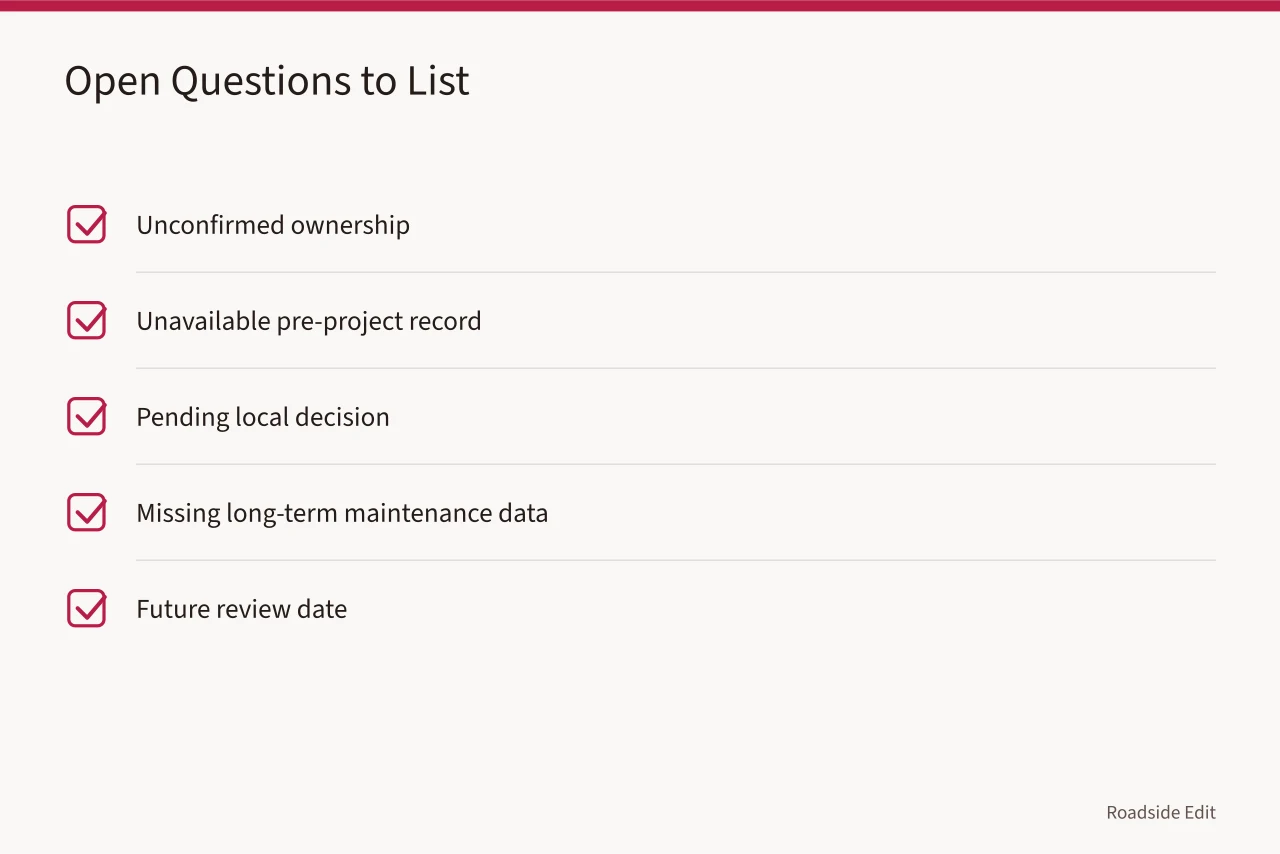
At the end of the article, list the most important open questions. These might include unconfirmed ownership, an unavailable pre-project record, a pending local decision, missing long-term maintenance data, or a future review date. This makes the article more credible because it tells a future editor exactly what to update.
For photographs, the Library of Congress guide to photographic evidence recommends considering date, place, and observed context while seeking original records. It does not determine a project's status. It supports a caption that says what an image visibly shows and avoids treating it as proof of an unseen condition or later outcome.
Use a closeout that supports future updates
Before publication, save the working brief, source register, final captions, approved quotations, disclosures, dated article copy, and a log of later corrections. The closeout should also identify who can answer a future update request. Keep sensitive files out of public folders and remove information that is not needed to support the published account.
The result is an article that can age honestly. It gives readers a traceable account of what happened within a limited record and gives potential contributors a clear standard for supplying evidence, corrections, and paid-placement disclosures.
Before calling the article complete, ask one final question: could a reader trace its most important claim back to a dated source without guessing who made the decision or what remains unknown? If not, narrow the statement or add the missing record.
Common questions
What is the first step in a case study?
Define a narrow question that the available records can answer, then list what evidence is needed before writing begins.
Can a photo prove that a project worked?
No. A photo can show visible appearance at a particular time. It does not by itself establish ownership, quality, performance, approval, or a long-term outcome.
How should paid placements appear in a case study?
They should be clearly disclosed and kept separate from statements that claim an independently verified outcome.