Guides
Motel exterior cost planning: 7 steps before you ask for a 2027 estimate
Motel exterior cost planning for 2027 helps U.S. readers define scope, record assumptions, compare estimates, and avoid presenting a general guide as a quote.
Cost planning for a motel exterior starts with a boundary, not a number. A general article cannot know a property's condition, local labor market, access limitations, permissions, design requirements, or construction details. It should not pretend to quote a project. What it can do is show readers how to organize the information a responsible estimate will need.
This guide is for U.S. readers creating a planning record. It is not an estimate, bid, appraisal, engineering opinion, permit determination, or recommendation of a provider.
What to take away
- Define the exact exterior decision before requesting a number.
- Keep visible observations separate from technical conclusions.
- Compare estimates only when their scope and assumptions can be read side by side.
- Record exclusions, unknowns, and decision owners with every planning number.
- Disclose submitted or paid business information rather than treating it as independent evidence.
What cost planning can and cannot answer
Early planning can identify the questions that affect cost. It cannot make unknown conditions disappear. A dated photo may document a facade, sign, parking area, or visible drainage path. It does not prove materials behind a surface, structural capacity, electrical condition, property rights, code compliance, or a suitable treatment.
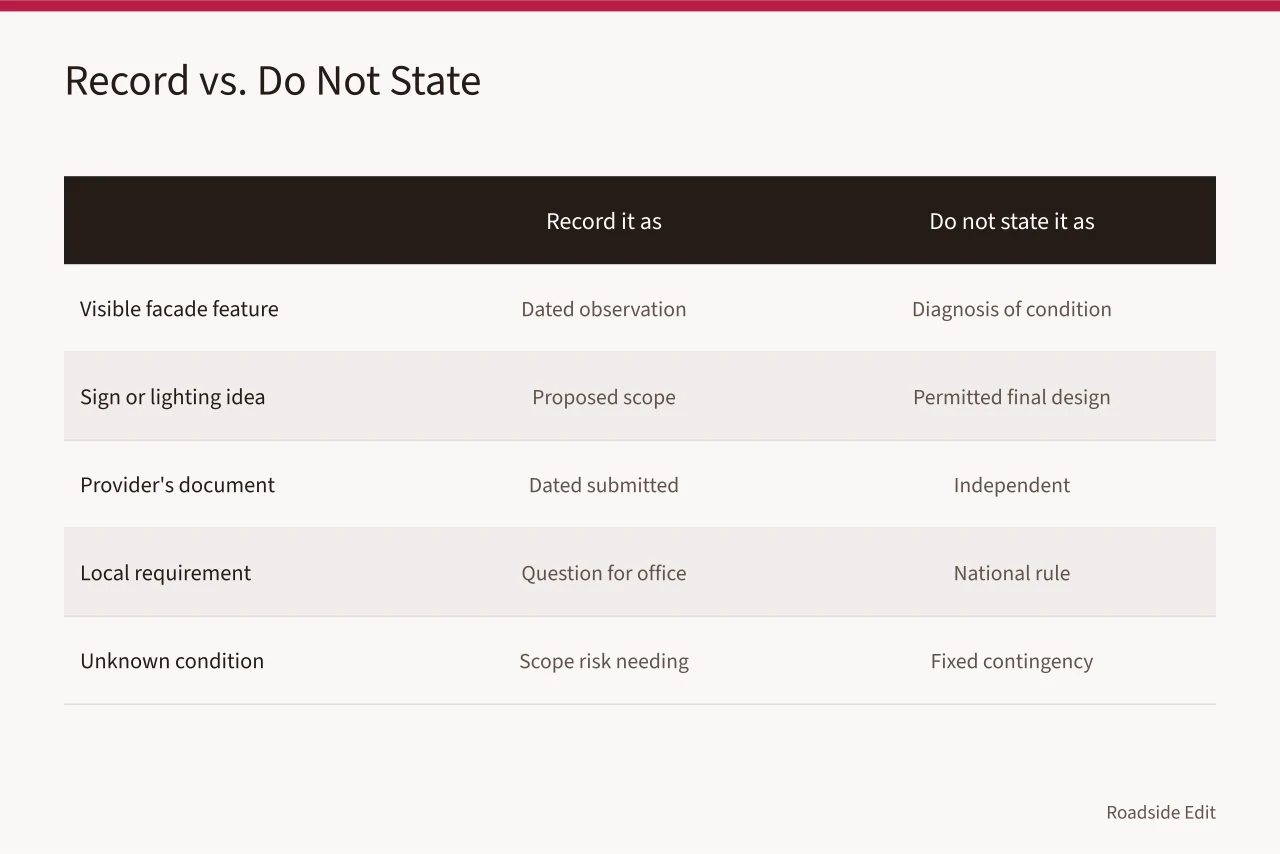
Use a planning note to state what is known and what is not. That note gives an owner or qualified professional a clearer starting point than a list of generic prices. It also prevents a reader from confusing an editorial guide with a commitment from a contractor or public authority.
| Planning item | Record it as | Do not state it as |
|---|---|---|
| Visible facade feature | Dated observation with a viewpoint | A diagnosis of condition |
| Sign or lighting idea | A proposed scope question | A permitted final design |
| Provider's document | A dated submitted estimate | Independent confirmation of value |
| Local requirement | A question for the responsible office | A national rule for every location |
| Unknown condition | A scope risk needing review | A fixed contingency amount |
Step 1: Write a cost question that has a boundary
Avoid asking, "How much does a motel exterior cost?" The phrase may refer to cleaning, repair, accessibility work, lighting, signage, landscaping, water management, paint, paving, security, or a complete redesign. Each has a different evidence base and decision path.
Instead, write a bounded question: "What information is needed to compare approaches for the east-facing entry canopy?" Or: "What records should accompany a request to evaluate the visible sign and its mounting area?"
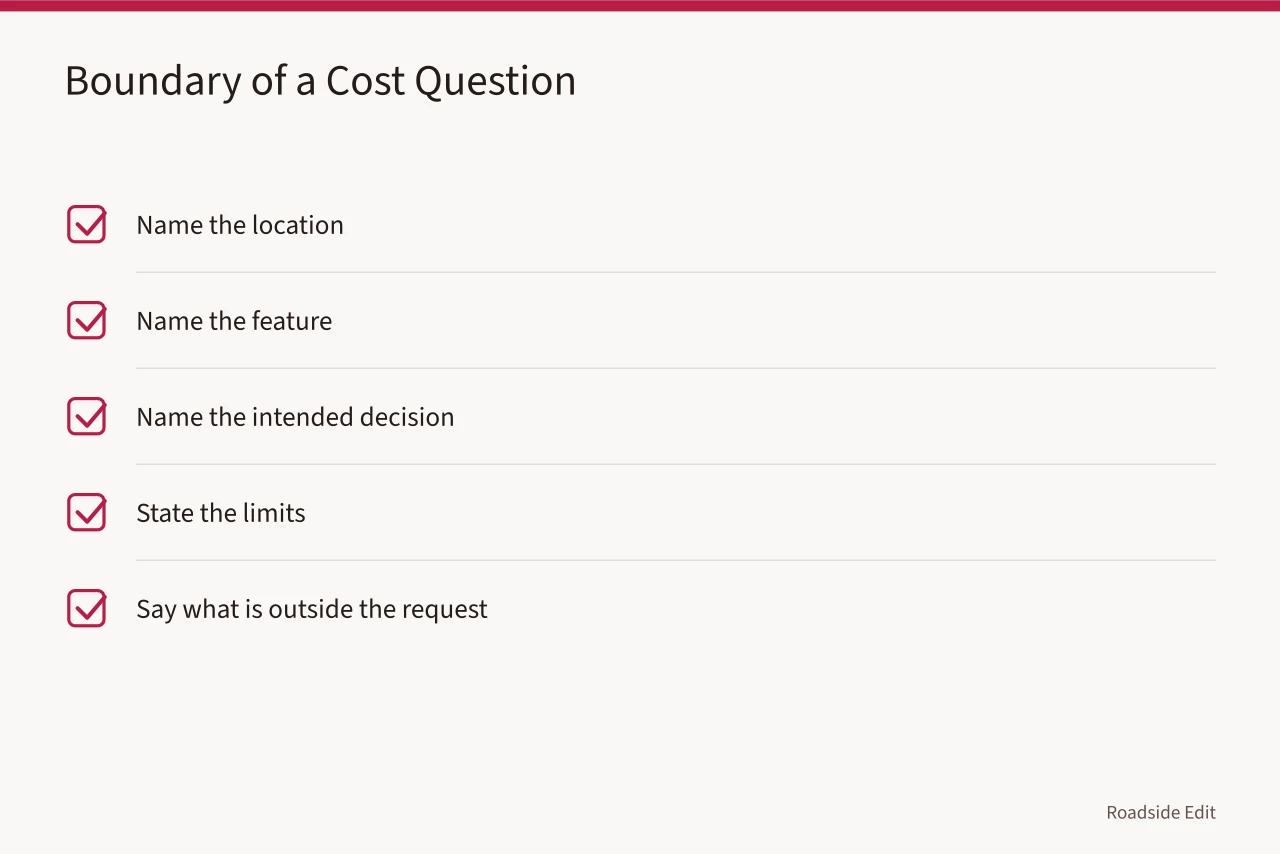
A good question names location, feature, intended decision, limits.
The boundary should also say what is outside the request. If no site-specific review has occurred, say so. If access is unconfirmed, record that. Clear limits do not weaken a cost note. They keep it honest.
Step 2: Build the evidence file before the estimate file
Create a simple existing-conditions record before anyone begins comparing figures. For each image or public record, retain the source page, date, location description, and a narrow caption. Preserve images in their original form where possible. A caption should say what can be seen, not what the author assumes caused it.
Useful evidence-file fields include:
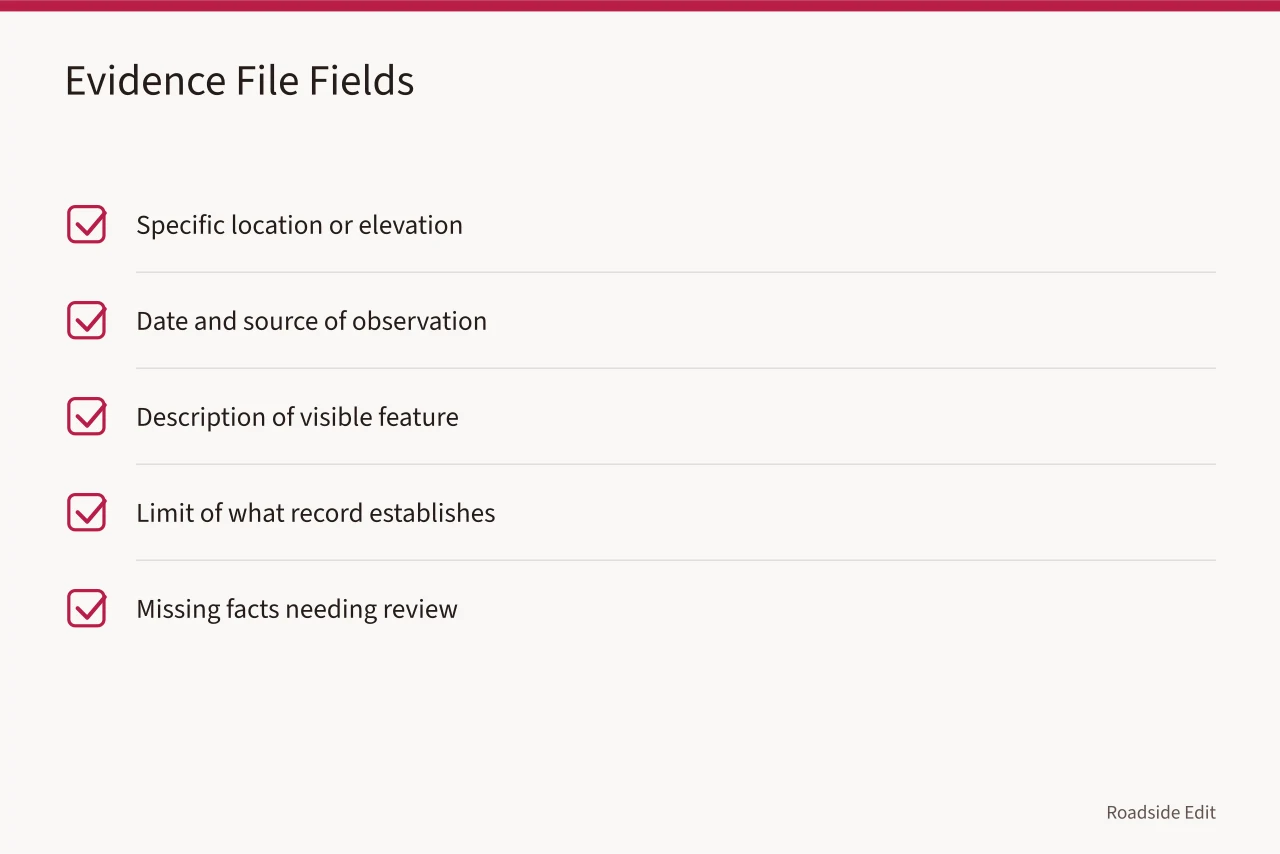
- A specific location or elevation.
- The date and source of each observation.
- A description of the visible feature.
- The limit of what the record establishes.
- The missing facts that need authorized access or qualified review.
If an older photograph is relevant, label it as historic context. Do not use it to establish a current condition. If a business submits current images, identify them as submitted material and preserve the sender and date.
Step 3: Turn the question into a scope card
The scope card is the bridge between a vague idea and a comparable estimate. Give every possible work area its own card. One card may be about documentation, another about a sign concept, and another about an access or drainage question. Do not combine unrelated work simply because it all sits outside the building.
The National Park Service cost-estimating handbook says to check the relationship among a project statement, scope, and estimate, including changes to scope and cost. Read the NPS cost-estimating handbook.
It is a federal project resource, not a pricing guide for private motel work. Its useful principle: an estimate must be read with the scope it describes and revised when that scope changes.
The Government Accountability Office describes a reliable estimate as one with a defined purpose, documented data, and stated assumptions. Read the GAO cost-estimating guide. This federal guide does not calculate a private motel project price. It supports the need to record why a number exists and which information it relies upon.
Step 4: Compare documents, not just totals
Two estimates are not directly comparable because they share a dollar sign. Before comparing them, check whether each one names the same area, work items, assumptions, exclusions, schedule basis, access conditions, and decision owner. A lower total may simply omit an item the other document includes.
Use a neutral comparison sheet rather than an editorial ranking. The sheet can list whether each submitted document addresses the defined scope, whether it explains its assumptions, and what questions it leaves open. It should not make quality, safety, compliance, or outcome claims the documents do not support.
Federal Acquisition Regulation guidance explains that contract type should reflect factors such as price risk and the parties' responsibilities. See FAR guidance on contract type. Federal rules do not control ordinary motel work. The link supports a limited planning lesson: a figure should be read with the terms and risk assumptions that accompany it.
Step 5: Treat unknowns as questions, not hidden math
An unknown condition belongs in the record as an unknown. Do not give it a made-up price simply to make a planning table look complete. The right next step may be a records search, an authorized site observation, a local-office inquiry, or a project-specific professional assessment.
This approach is especially important for exterior conditions. A public image can reveal a visible feature, but it cannot replace access, testing, drawings, or responsible review. If an article states that a particular repair is needed, it must have evidence that supports that project-specific conclusion. Otherwise it should ask the question and identify the appropriate reviewer.
Step 6: Separate editorial content from commercial content
Paid placements and provider submissions can appear on a future site, but they must be labeled and handled separately. A provider may accurately describe its services. That description is still not an independent source for a property condition, eligibility decision, or expected result.
For a listicle or directory, publish the selection method. It might be geographic coverage, a disclosed submission, a public directory, or editorial research. Do not say a business is "best," "approved," "fully vetted," or "right for your project" unless the site has a transparent, factual basis for that exact claim.
Keep a record of the submitted text, payment disclosure, date, and any editorial changes. That preserves the separation between a commercial relationship and factual editorial work.
The Federal Trade Commission advises consumers to check a contractor's license with state or county government, request proof of insurance, use a written contract, and avoid full payment before work is complete. Read the FTC contractor-scam consumer alert.
This consumer guidance is not a universal contracting rule. It supports keeping transaction claims and key documents available for appropriate checking.
Step 7: Create a change log
Cost planning changes as information improves. A later record can correct an image caption, narrow a boundary, identify a different authority, or show that a proposed item needs more investigation. Add a brief change-log entry instead of silently overwriting the earlier record.
Each entry needs five things: the date, the item changed, the reason, the source or decision owner, and the effect on scope.
For example, a dated correction might note a public image came from a different viewpoint than first described, so the related condition claim was removed. The log makes the correction visible without treating the old claim as current.
Step 8: End every cost note with a responsible next action
A general article should end with the next smallest defensible task, not a purchase decision. That might be collecting a dated exterior record, locating a property-specific document, clarifying access, asking the responsible local office about a review path, or requesting a scope explanation from the document's author.
This discipline helps both readers and future advertisers. It creates room for useful listings and services without turning a planning article into an unsupported endorsement.
Common cost-planning mistakes
Publishing a generic number as if it were a quote
An average found online does not account for property-specific scope, location, access, timing, approvals, or unknown conditions. Use it only if the original source, date, definition, and limitations are clear. Do not represent it as a current project price.
Letting a proposal look like an approval
A sketch, submitted estimate, or article is not a permit, consent, or final design. Use terms such as "proposed," "submitted," or "for review" when that is what the record shows.
Ignoring exclusions
An excluded item can change the meaning of a total. Preserve exclusions as written and ask for clarification where the scope card cannot be matched to the document.
Treating a photo as a condition assessment
An image is evidence of a view at a time. It should never be stretched into a conclusion about unseen conditions or a specific treatment.
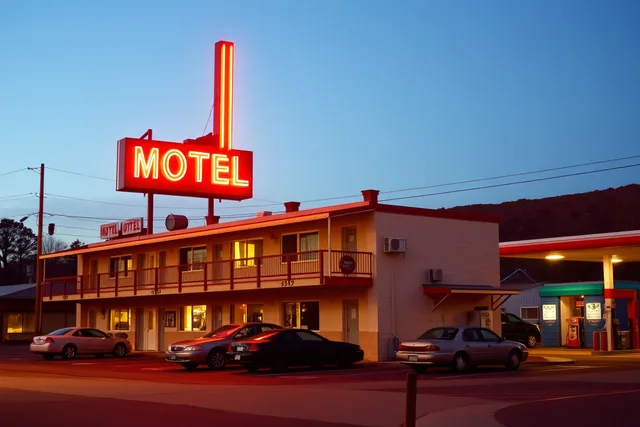
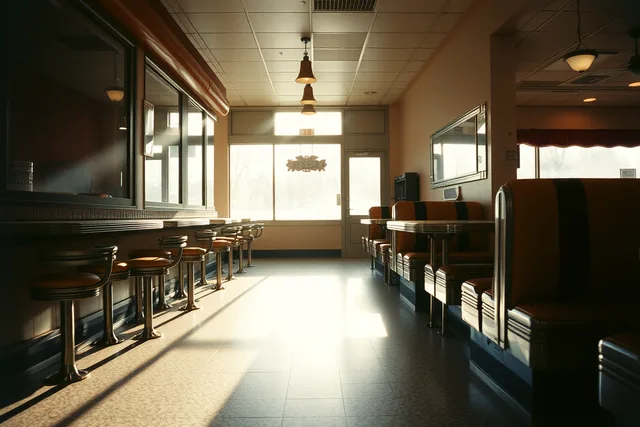
The image is illustrative. It does not establish current cost, condition, ownership, safety, or a project result.
Common questions
Can this guide tell me what my motel exterior will cost?
No. A reliable project figure needs a defined scope, current local information, and the appropriate project-specific review.
Should I publish estimates from businesses in a directory?
Only with accurate attribution and disclosure. A submitted estimate should not be presented as independent editorial verification.
What is the first record to make?
Start with a one-sentence decision question, a dated existing-conditions record, and a list of facts that remain unknown.
In this guide
- Motel exterior cost checklist: 2027 line items to budget before you request bidsA 2027 motel exterior checklist with painting, signage, lighting, masonry, roofing, and permit ranges, plus scope steps to take before you request bids.
- Motel exterior cost planning: 7 questions to ask before comparing 2027 bidsMotel exterior cost questions for 2027 help owners compare scope, assumptions, evidence, and change records before treating an estimate as a decision.
- How to write motel exterior cost budget notes before bids go outMotel exterior cost budget notes for 2027 show U.S. readers how to record assumptions, exclusions, data sources, and changes without publishing a project quote.
- Motel exterior cost records: how to keep estimate versions honest for 2027Motel exterior cost records for 2027: retain scope versions, estimate assumptions, source notes, commercial submissions, and correction history clearly.