Guides
Part of Motel exterior mistake prevention: 8 errors to avoid in 2027
Motel exterior mistakes checklist: 7 errors to catch before you publish
Motel exterior mistakes checklist for 2027 helps U.S. owners avoid evidence gaps, unsafe assumptions, misleading claims, weak captions, and silent corrections.
Most exterior-content mistakes happen before a sentence is published. A photo is treated as a diagnosis. A broad source is used for a narrow claim. A provider's sales statement becomes independent evidence. This checklist helps an owner, writer, or editor spot those failures early and replace them with a useful record and a clear next question.
It does not inspect a motel, determine a permit requirement, choose a repair, or provide emergency guidance for a particular property. When a condition may require urgent attention, contact the responsible owner, relevant service, local authority, or qualified professional first.
What to take away
- Describe a visible fact, then state what the record cannot establish.
- Use a source only for the narrow claim it directly supports.
- Keep a historical image, local observation, provider report, and editorial conclusion in separate lanes.
- Do not create risk for a better photograph or a more dramatic story.
- Correct published material with a dated explanation, not a silent rewrite.
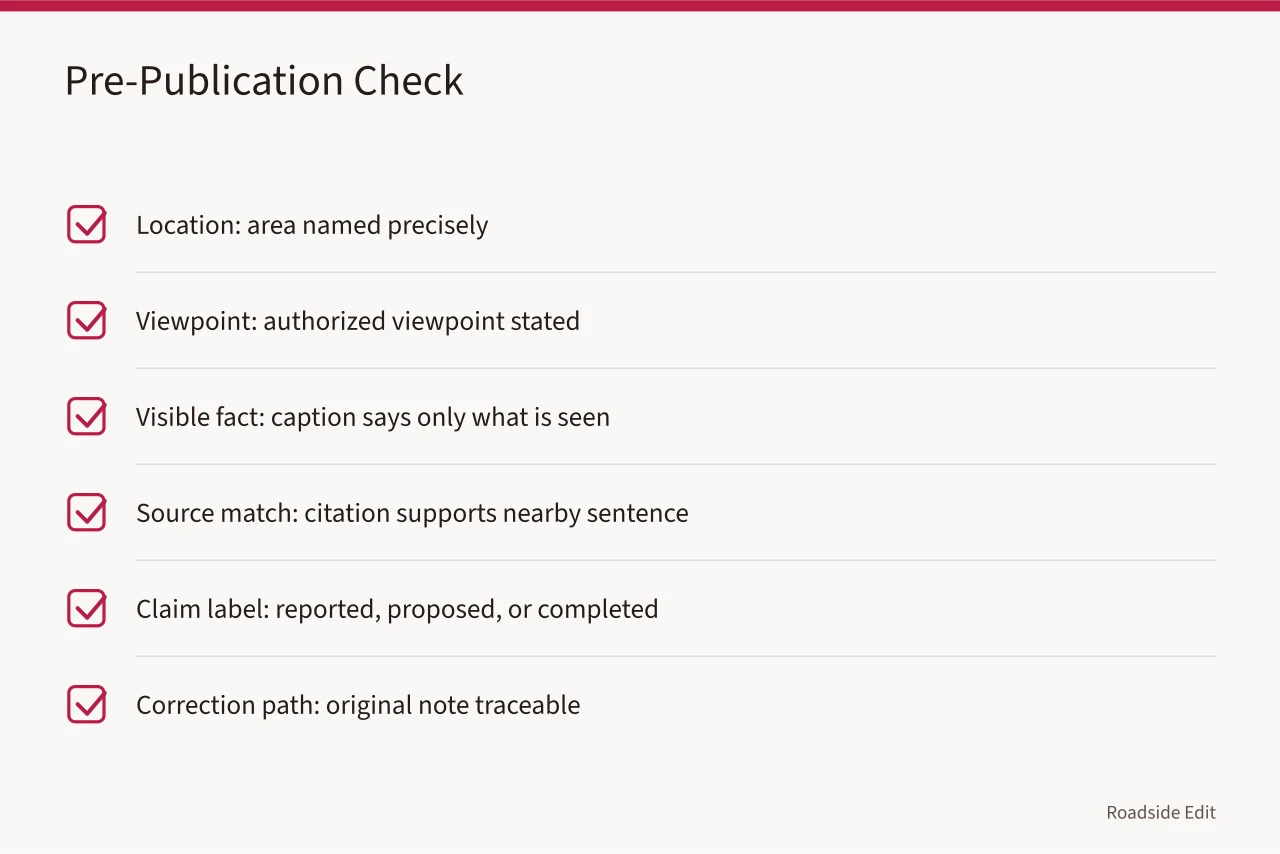
Run the pre-publication check
Use this checklist on every exterior article, image caption, business profile, and list entry. It is short enough for a working editor but detailed enough to uncover an unsupported leap.
The National Park Service's Preservation Brief 6 warns that abrasive cleaning can damage historic building materials. It is not a cleaning instruction for every motel. The lesson for an exterior article is narrower: do not recommend a cleaning method from an image or apply material-specific advice without knowing the material and the source's limits.
Mistake 1: Calling a visible condition a cause
Words such as "leak," "settlement," "mold," or "electrical failure" carry technical meaning. A ground-level image may show a stain, crack, gap, or unlit fixture. It usually cannot establish the hidden cause, urgency, or correct remedy.
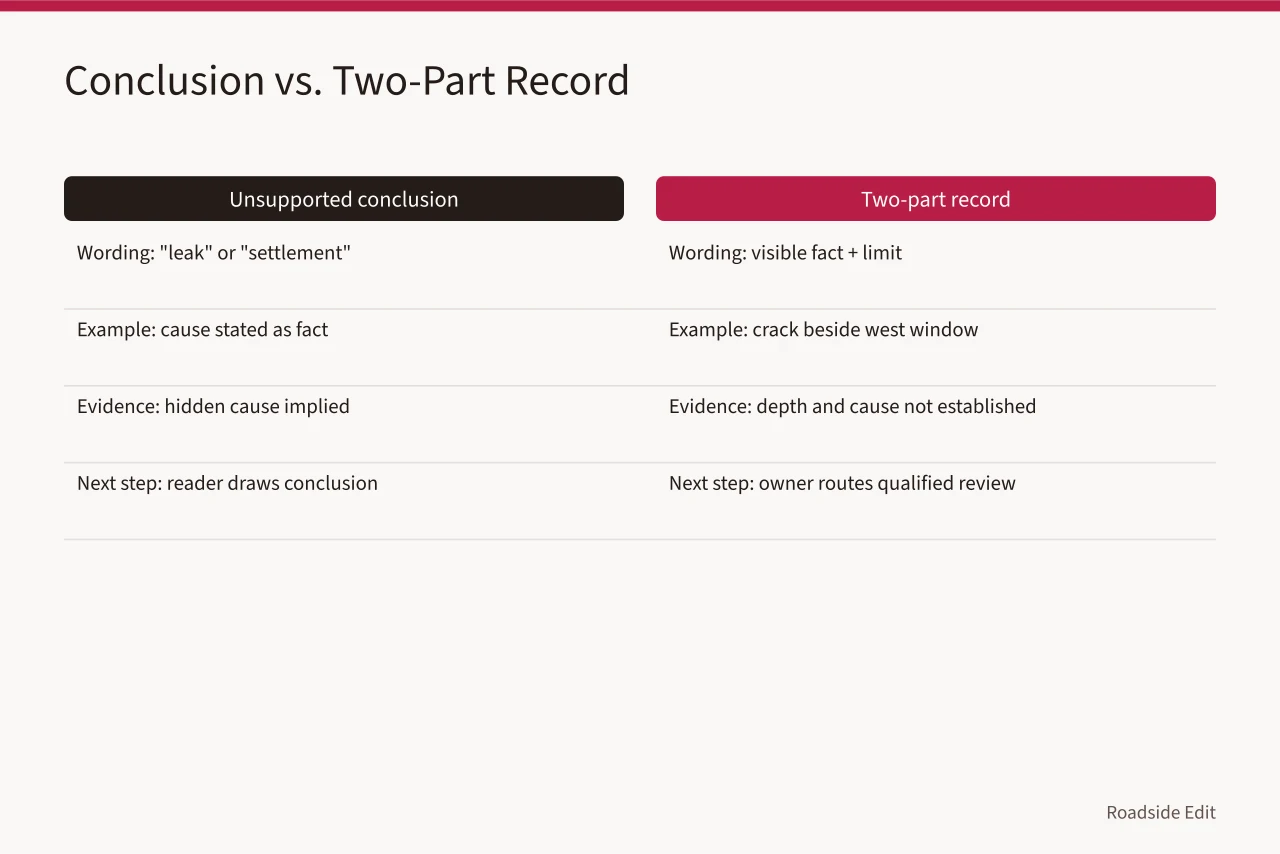
Replace a conclusion with a two-part record:
- Visible fact: "A vertical crack is visible beside the west entrance window."
- Limit and question: "The image does not establish depth, cause, or repair need. The owner should identify who can review the area."
This format gives a reader a useful description and prevents the page from making a claim that its evidence cannot support. It also helps a business answer the question responsibly rather than being asked to defend a conclusion it did not make.
Mistake 2: Stretching a source beyond its subject
A source may be strong and still be wrong for the sentence. A historic-preservation guide may cover one material or condition. A regional climate page may cover an area, not one motel. An OSHA rule may apply to covered workplaces, not establish a guest-area conclusion from a photo.
Before linking, ask four questions:
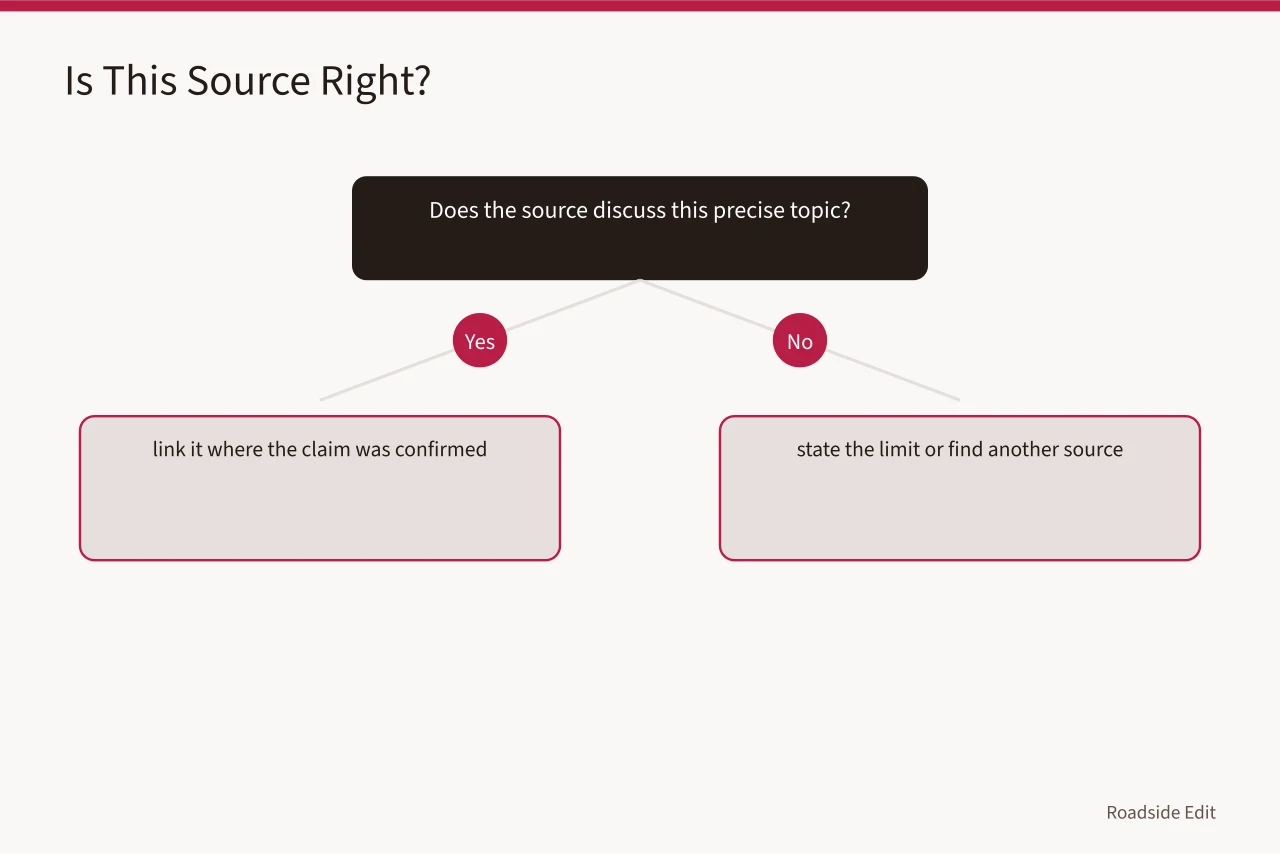
The National Park Service's documentation standards and guidelines call for reliable sources and clear limits that allow documentation to be independently checked. Those standards address historic-property records, not motel editorial copy. They reinforce a good editorial habit: link where a claim was confirmed, and state the limit when the source does not decide the individual property.
Mistake 3: Treating a photograph as a complete inspection
An image has a time, angle, light condition, and access boundary. A responsible caption names those facts. It does not imply that the photographer walked a roof, touched a railing, opened equipment, or saw behind a surface.
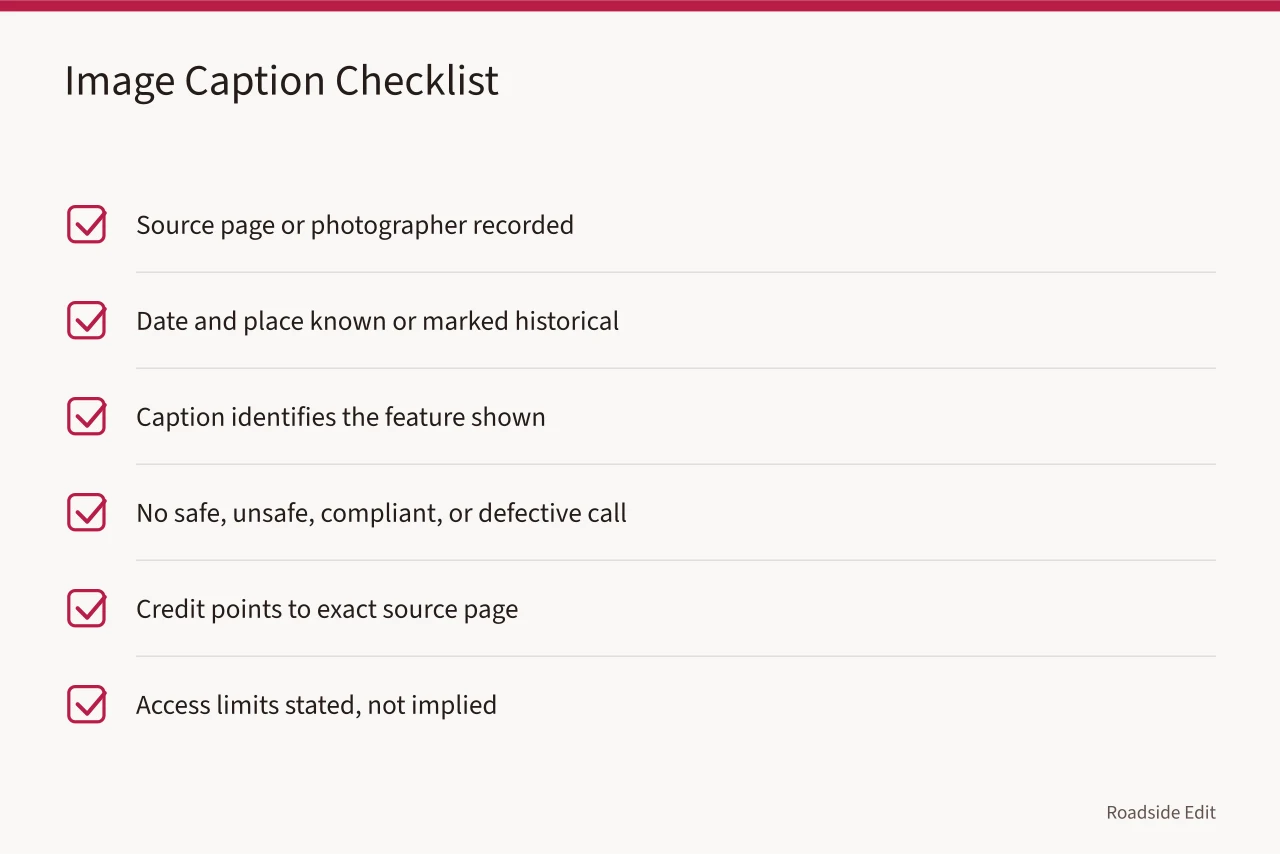
Do not seek a closer image by using a ladder, crossing a barrier, entering a restricted area, or touching an unknown feature. A record that says "not observed because access was not authorized" is accurate and useful.
Mistake 4: Hiding the difference between content and advertising
Later, a contractor, motel, or tourism business may pay for a placement or submit a description. That information can be valuable when it is clearly labeled. It cannot become independent support for an editorial claim about a property condition, local authorization, or likely outcome.
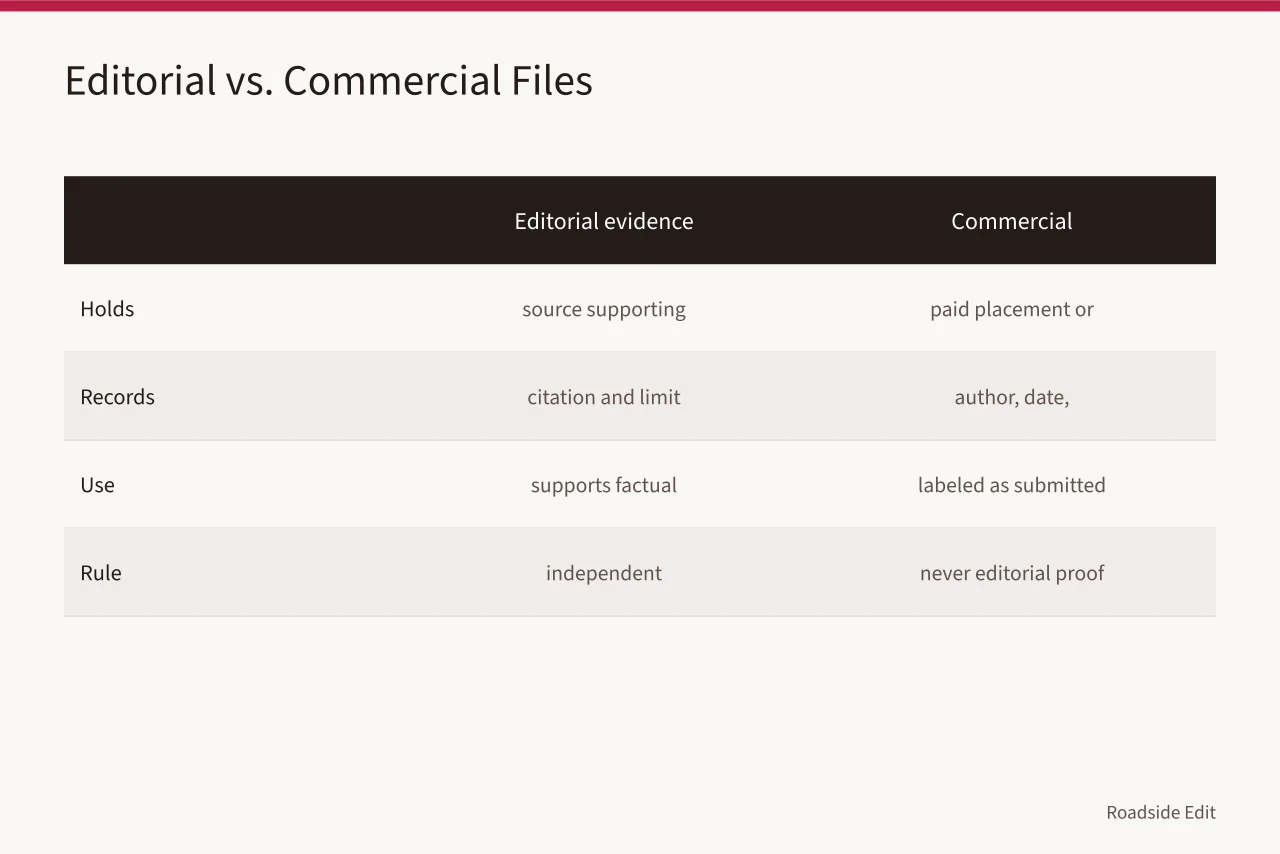
Keep two files: an editorial evidence file and a commercial submission file. The commercial file should retain the author, date, disclosure, and any edits. The evidence file should contain the source that supports a factual statement. Do not copy a provider's claim across the boundary without independent confirmation.
The Federal Trade Commission says advertising designed to look like independent content should be recognizable as advertising. Read the FTC native-advertising guide. That rule addresses advertising format, not exterior maintenance. It supports clear labeling and explains why paid material should not be made to look like editorial proof.
Mistake 5: Leaving an open question with no owner
An article that identifies a concern but never names the next responsible role does not help much. It can leave readers tempted to make their own technical conclusion. Every open question should have a routing note: owner, authorized manager, local authority, utility, or qualified professional.
| Open question | Better routing note |
|---|---|
| What is behind this visible stain? | Owner to determine appropriate qualified review |
| Is this access route required to remain open? | Responsible property contact or local authority to assess |
| Who may inspect the roofline? | Owner to confirm authorized access plan |
| Is a business claim current? | Business to supply date and source; editor to label it submitted |
The routing note should not pretend that contact was made or a decision was reached. Use "pending," "reported," or "awaiting response" when that is the current state.
Mistake 6: Correcting the article by erasing history
When a source changes or an image is mislabeled, correct the page. Keep a short internal correction record with the original claim, date, new evidence, changed wording, and reason. This lets the team avoid repeating the error and makes it clear that the revised statement is supported.
The National Archives' information-quality guidelines describe correction procedures that identify affected information and document the response. The policy applies to agency information, not a private content site. Its practical point is still helpful: correction is strongest when the record shows what changed and why.
Mistake 7: Publishing private or security-sensitive detail
Do not include access codes, staff schedules, guest information, camera blind spots, private phone numbers, or detailed service routes in public content. A record can state that the responsible party was notified without exposing the channel or a person's private details.
Before publication, make a final privacy check. Ask whether each property detail is necessary for the informational purpose, sourced appropriately, and safe to make public. If not, keep it in the restricted operational record or remove it.
Common questions
Can a page list a possible cause beside a photo?
Only if a qualified, source-supported review establishes that cause for the property. Otherwise, record the visible fact and route the question to the responsible party.
Is it okay to include a provider's statement?
Yes, when it is attributed and clearly disclosed as submitted or sponsored material where appropriate. Do not describe it as independent evidence without separate support.
What makes a correction complete?
It identifies the original statement, date, new source or evidence, revised wording, and reason for the change. Keep that note with the editorial record.