Guides
Part of Motel exterior mistake prevention: 8 errors to avoid in 2027
How to keep motel exterior mistakes records that survive scrutiny
Motel exterior mistakes records guide for 2027 helps U.S. owners retain source provenance, correction history, disclosed submissions, evidence limits, and handoffs.
The best protection against an exterior-content mistake is a record a later editor can retrace. A good file shows the image or document used, who supplied it, when it was checked, what it supports, and what it does not prove.
A bad file has unlabeled photos, copied claims, and a history that disappears when someone changes a caption.
This guide helps owners and editors build a clear evidence trail for motel exterior coverage. It does not provide a building assessment, repair plan, permit determination, or property-specific safety conclusion.
What to take away
- Retain the source file and the text claim as a matched pair.
- Store a limitation beside every photo and provider statement.
- Keep evidence, editorial judgment, and commercial submissions in separate folders.
- Record a correction as a new dated event.
- Prepare a compact handoff before people or systems change.
Build the claim packet, not just a photo folder
Each published statement should have a small claim packet. The packet may live in a spreadsheet, content system, or structured folder, but it must connect the published sentence to its support. A photo without its original page or date is a lead, not a finished evidence record.
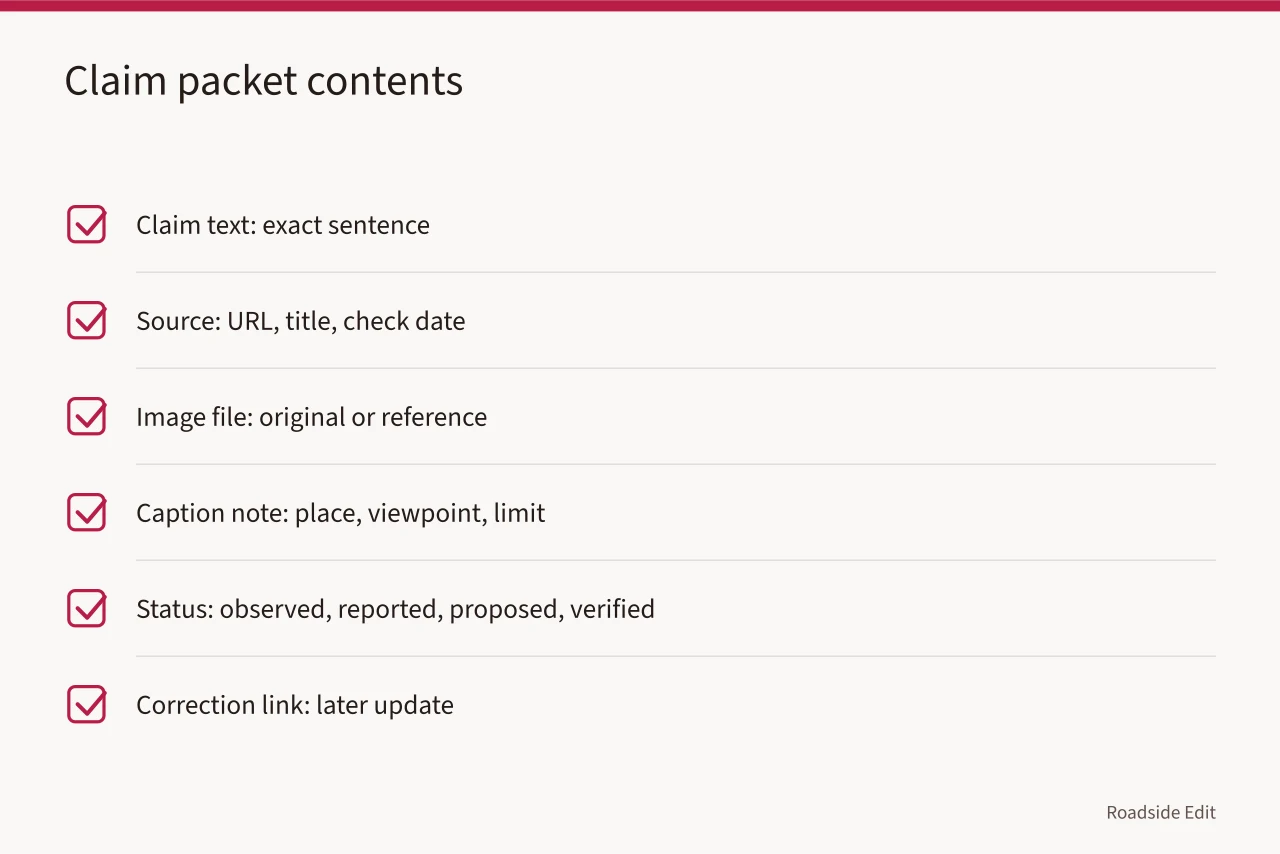
The National Park Service's HABS historical-report guidelines explain that photographs and written documentation work together and that exterior descriptions should be clear and concise. The guidelines concern formal historic documentation, not every motel article. Their useful lesson is that a picture and its written record should reinforce one another without claiming what lies outside the frame.
Record what a photograph cannot tell you
The strongest photo note has two parts: what is visible and what is outside the evidence. It might say, "A painted sign face is visible from the street approach on June 3, 2027. The image does not establish the sign's electrical condition, structure, or permit status." This is not evasive. It keeps a visual record accurate.
Add these fields when the image enters the system:
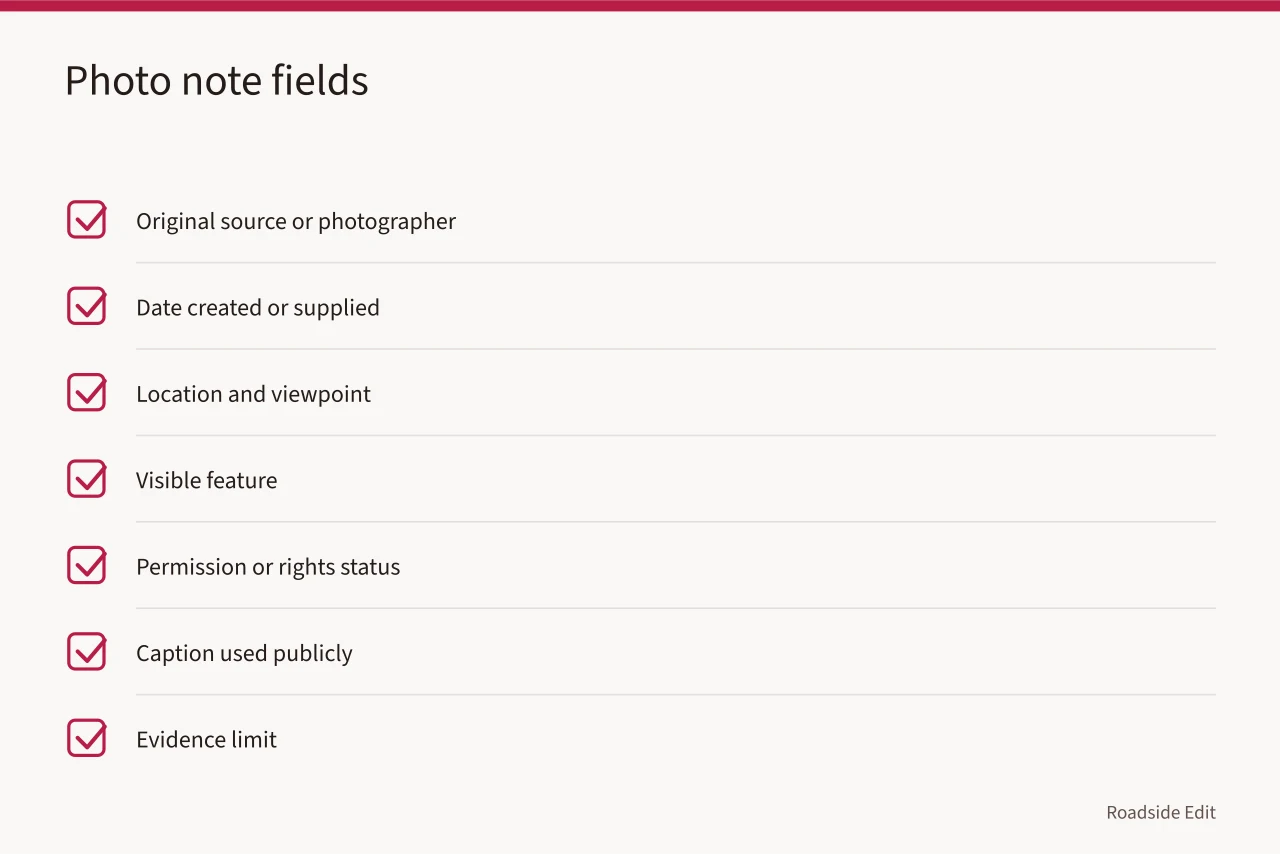
If a date or location is uncertain, mark it uncertain. Do not solve a missing fact by copying a nearby article or a business listing. A confident but wrong label is much harder to correct than an honest gap.
Separate the four evidence lanes
Most editorial errors begin when records with different status are mixed. Use four separate lanes, each with a clear label.
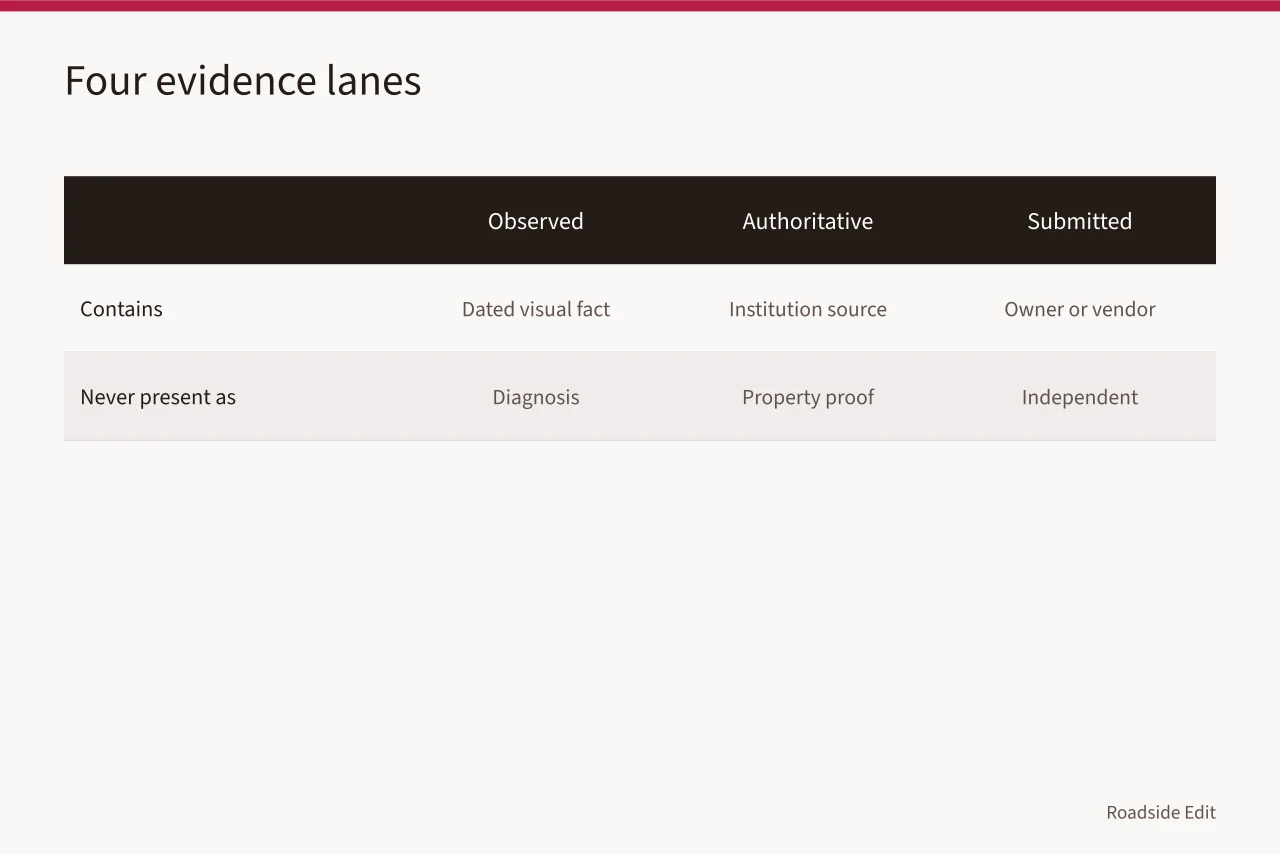
The National Archives says records associated with the same project, transaction, study, or subject should be maintained together when that relationship provides needed context. Read the National Archives recordkeeping requirements. The policy applies to federal agencies, not a private content system. It supports keeping each claim packet together while retaining clear labels for the different kinds of material inside it.
Make commercial submissions traceable and disclosed
A business may submit a profile, quote, service description, or request for paid placement. Keep the original submission, sender, date, edits, and disclosure in its own commercial file. It can support an attributed statement such as "the business says it offers exterior painting." It cannot independently prove workmanship, license status, property condition, or expected result.
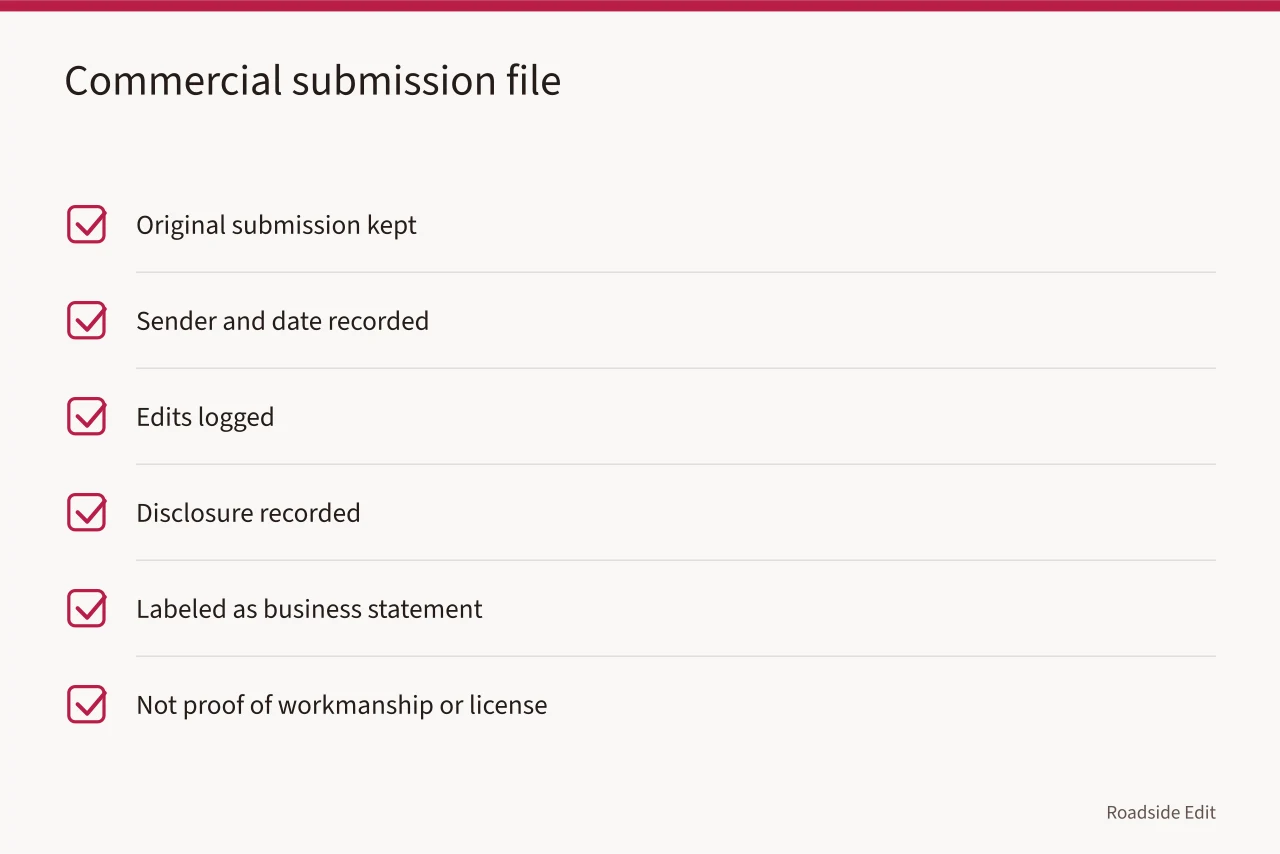
The Federal Trade Commission explains that material connections that could affect how people evaluate an endorsement should be clearly disclosed. Review the FTC endorsement guides FAQ. That guidance is about endorsements, not motel maintenance. It supports a direct publishing rule: when payment, a free service, or another connection exists, maintain the disclosure record and make the relationship clear to readers.
Do not merge a sponsored description into the evidence lane because it sounds plausible. A good record makes the origin of every claim visible.
Use correction cards instead of overwritten captions
Mistakes happen. A photo may be located incorrectly. An authoritative page may be superseded. An owner may supply a record that changes a reported date. When new information is credible, fix the publication. Retain the old record and create a correction card.
| Correction field | Example |
|---|---|
| Original claim ID | EXT-2027-034 |
| What changed | Motel location corrected |
| New support | Library catalog record checked June 6 |
| Why it is better | Catalog gives a specific location |
| Published action | Caption updated and correction logged |
| Date and role | June 7, 2027, editor |
The National Archives' information-quality guidelines describe correction processes that identify the information at issue and document the response. Those guidelines govern agency information. The usable parallel is straightforward: corrections should show which statement changed, the new support, and why the revision was made.
Do a final evidence check before publication
Before publishing, review each text claim, caption, and external link in the packet. Ask whether the cited page supports that exact sentence, whether the photo credit points to the actual image page, and whether a provider statement is visibly labeled as such.
Run these five checks:
- Does every factual statement have appropriate support or a clear observation label?
- Does every image have a source, narrow caption, and stated limit?
- Is the external link a specific page rather than an organization homepage?
- Has any sentence turned a regional or historic source into a claim about this property?
- Are commercial material and private details outside the editorial evidence packet?
If a claim fails a check, change the claim or remove it. Do not keep a citation that contradicts or does not actually support the nearby wording.
Make handoffs resilient
When a manager, writer, or agency changes, give the next person an index instead of a pile of files. The index should list active claim packets, last reviewed dates, open corrections, commercial disclosures, and items waiting on the owner or a qualified reviewer.
Restrict private property details and security information to the people who need them. A public article needs source-backed educational content, not access codes, guest details, or internal schedules. This boundary makes the editorial archive both safer and easier to audit.
Common questions
Is an old photo usable if its date is unknown?
It may be useful as historical context if its source and uncertainty are stated. Do not use it to make a current property claim or attach a confident date that cannot be verified.
What is the difference between reported and verified work?
Reported work is what an owner, provider, or staff member says occurred. Verified work is supported by appropriate evidence that the responsible party has reviewed. Keep those labels separate.
Should a correction remove the original caption completely?
Update the public caption when needed, but retain the original wording and reason for change in the internal correction record. That prevents the same error from returning later.