Guides
Roadside design studio safety questions to ask before publishing
Roadside design studio safety questions for 2027 separate observations from conclusions, respect access limits, and identify the next responsible decision maker.
Safety questions should make a team slower and clearer, not more confident than its evidence allows. Use these prompts before a roadside observation, event idea, or public article. A design studio can recognize a question and record a handoff. It cannot certify a site as safe, accessible, or ready for use.
What to take away
- Ask where the evidence ends and avoid filling a gap with a conclusion.
- Ask who has authority for the next decision and who controls the location.
- Ask whether a route, event, or work-site claim needs site-specific review.
- Ask what record can support the published wording and its limitation.
What is the studio trying to learn safely?
Start with the purpose of the observation. Is the group recording a visible feature, testing an event idea, comparing an arrival route, or gathering questions for a responsible party? The purpose defines the limit. A visual observation can document an exterior condition from a known viewpoint. It cannot determine structural integrity, code compliance, hazardous materials, or a future occupancy result.
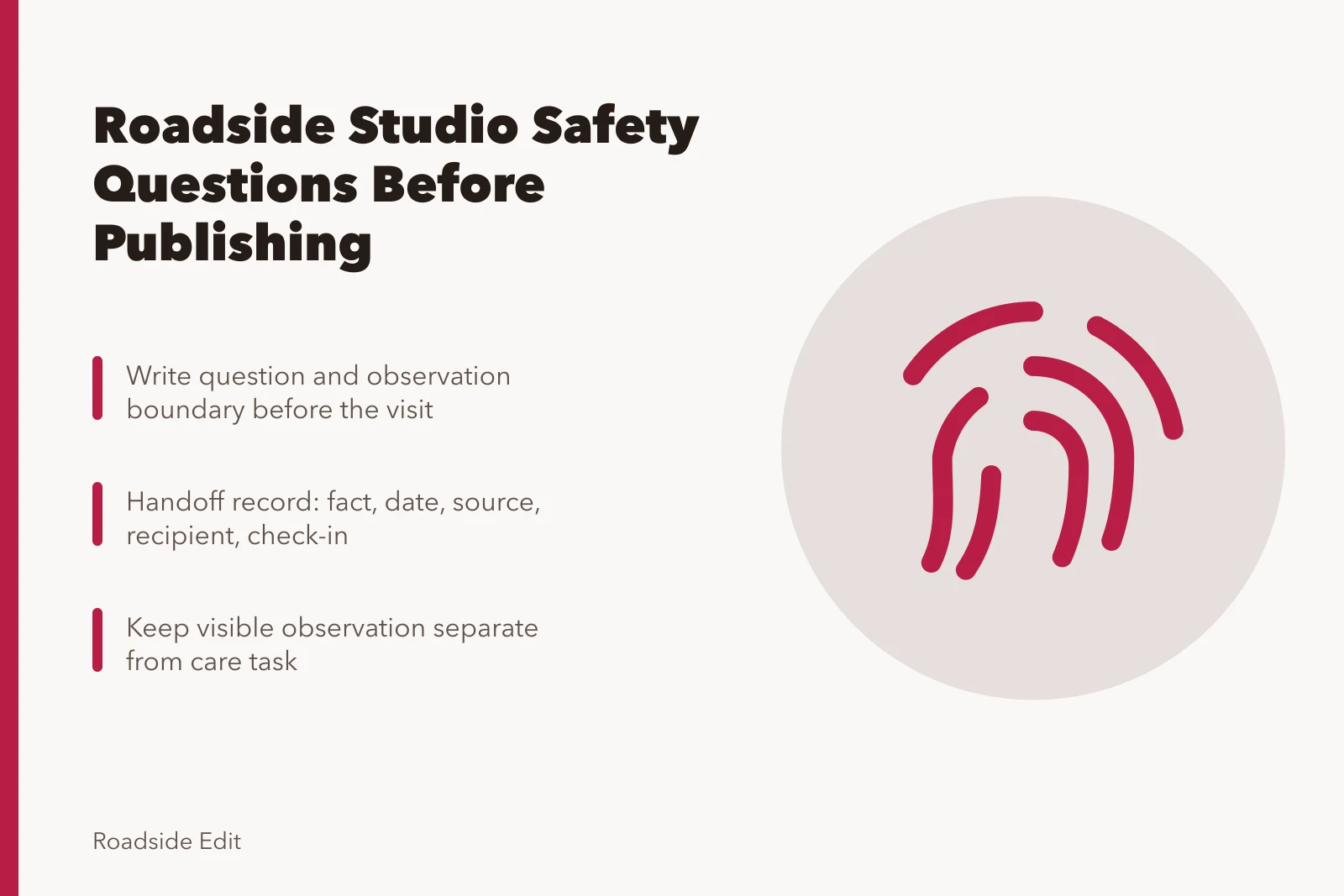
Write the question and the observation boundary before the visit. For example: "Document the visible north-facing sign from the public sidewalk, without entry or contact." This gives the team a way to collect useful information without turning curiosity into unauthorized access or an informal inspection.
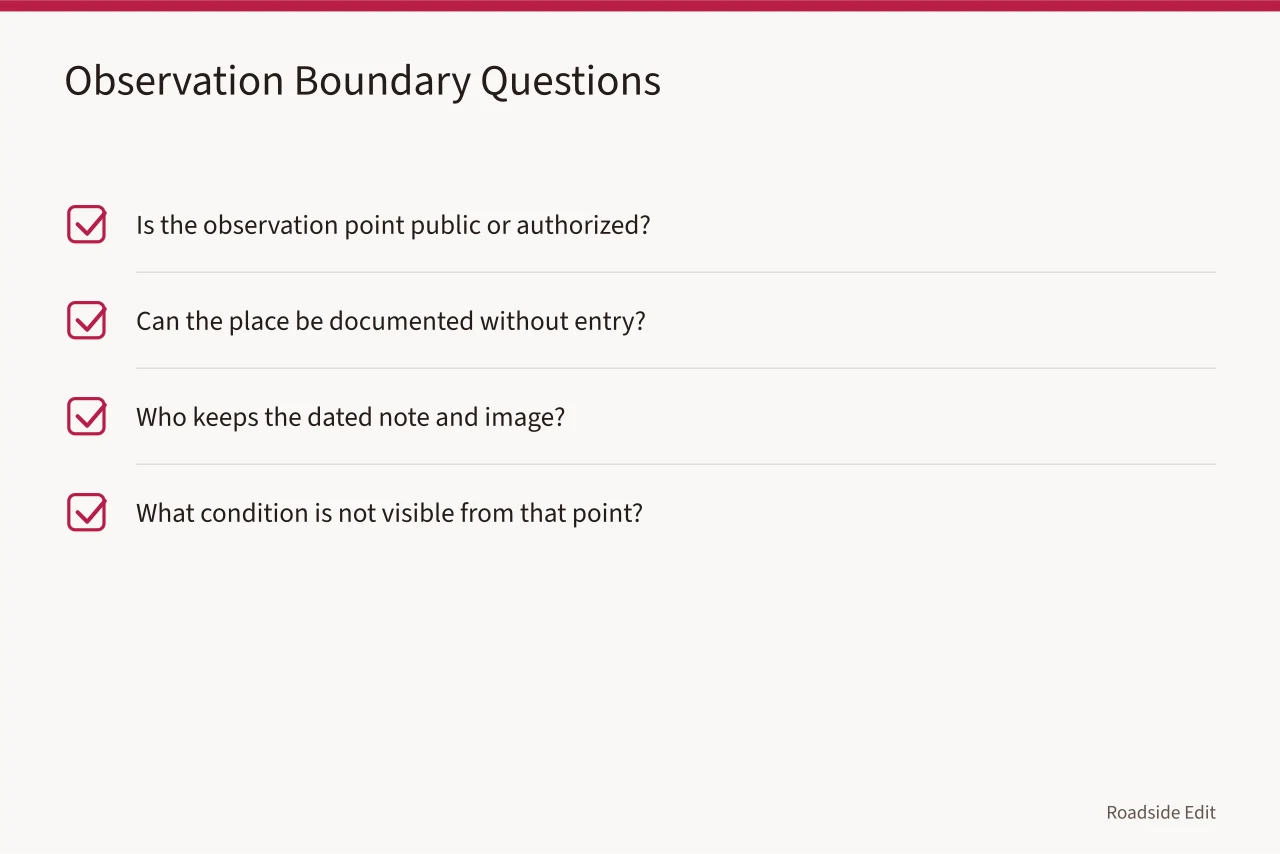
These questions help an article describe its limits. They do not answer whether a site is suitable for access, occupancy, use, or a proposed project. If the answer to any question is unknown, record the unknown and route it to the person responsible for the site or work.
What should be asked about a public route?
| Ask this | Why it matters |
|---|---|
| Does the proposal affect a path used by pedestrians? | A temporary activity may change circulation |
| Who controls that space? | Editorial interest is not authority |
| Is an alternative route needed? | The responsible party must assess the actual conditions |
| What rule or local process applies? | Applicability cannot be assumed from a general article |
The Access Board's public-right-of-way guidelines address pedestrian facilities and include requirements that apply when their scoping provisions are triggered. Review the Access Board scoping chapter. This source does not determine compliance for a specific roadside place.
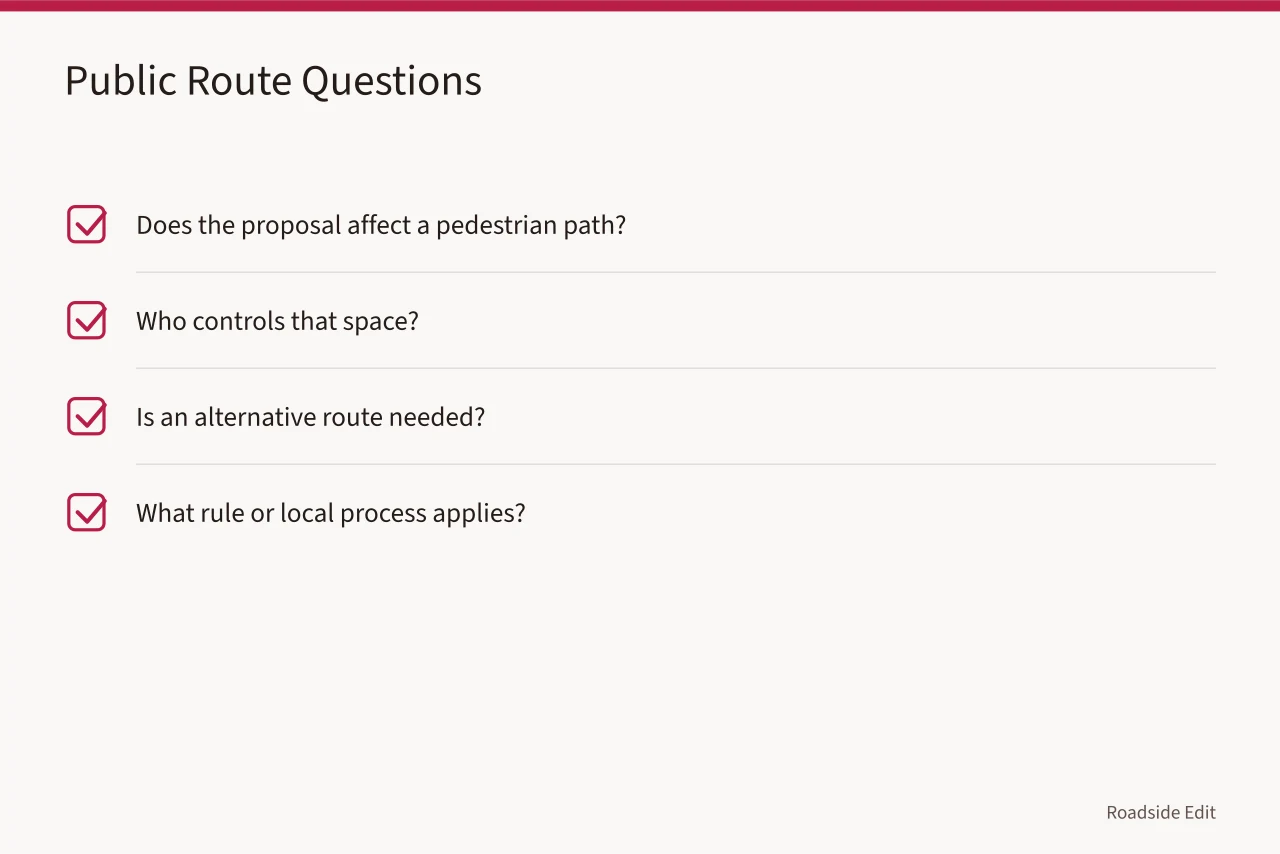
Ask what is changing, which part of the route people use, who maintains it, and which local or project process must answer the question. Do not use a studio drawing, a current image, or a historic photograph as proof that a route meets a requirement. The responsible source must make that finding.
When an event idea appears, separate idea from site status; a group may explore a potential gathering, open house, or public activity. That does not confirm public access, crowd capacity, route status, staffing. It does not confirm permits or emergency planning.
The studio can produce a question list for the organizer; it should not publish an assurance that no responsible record supplied.
What should happen after a reported concern?
First, identify the source of the report. What was directly observed? Who reported the concern? What date and location are attached? Was the responsible party notified? What response, if any, is documented? A gap in the answers is a reason to narrow the article, not to publish a stronger claim.
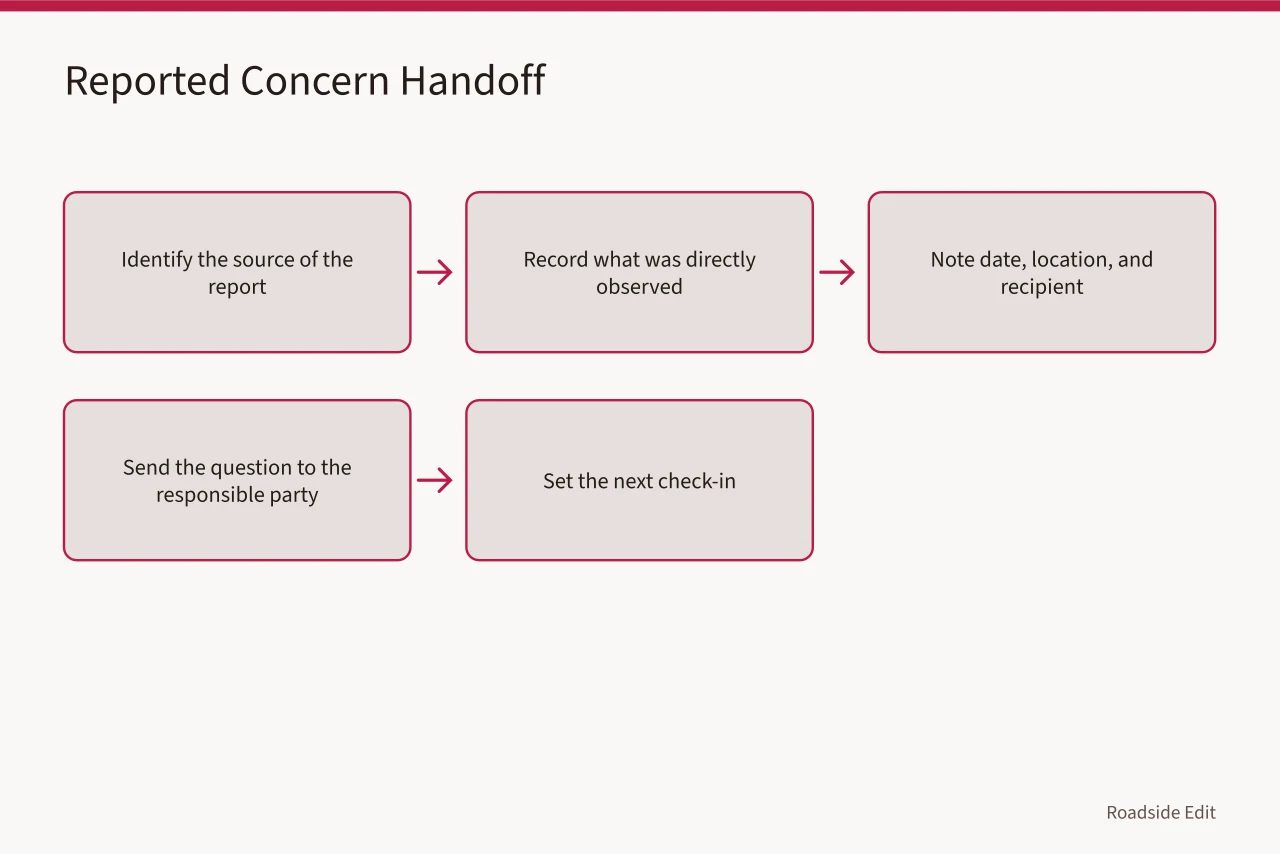
Create a handoff record with the reported fact, date, source, recipient, question sent, and next check-in. Do not add a diagnosis. A handoff can say that a dated photograph or report was sent for appropriate review. It should not say what the photograph means or which repair will be selected.
OSHA advises employers to identify and assess hazards through inspections and other information sources. See OSHA's hazard-identification guidance. That guidance concerns workplace safety. It does not make a studio report a hazard assessment, but it supports passing a potential concern to the responsible site process instead of asking editors or visitors to investigate it.
How should condition and maintenance questions stay separate?
A current visible observation is one thing. A recurring care task is another. A condition assessment or treatment decision is another again. Keep them separate in the discussion and in the published article. A routine task may be scheduled from a documented plan. It does not establish that an unresolved condition has been diagnosed or corrected.
Preservation Brief 47 from the National Park Service explains that regular inspection and maintenance can keep small exterior problems from becoming big repairs. Read Preservation Brief 47 on maintaining historic building exteriors.
The brief is preservation guidance, not a condition report for a particular site. It supports asking if a documented recurring care task exists, rather than assuming an observation shows the needed work.
What belongs in a public safety-related update?
Use a narrow structure: date, source, what is known, what is not known, and the next documented action. If a source only reports a concern, say that. If a route is under review, say that. Do not replace a limited report with claims that a property is safe, open, accessible, or approved.
Paid listings and sponsor-provided material require a separate check. A sponsor can make a dated statement about its own project. The article should attribute it and avoid expanding it into an independent assurance.
The Federal Trade Commission's endorsement guidance addresses disclosure of material connections in endorsements and advertising. Read the FTC's endorsement-guides questions and answers. It does not set the safety rules for a roadside project. It supports clear disclosure when a commercial relationship could affect how readers understand the statement.
What should be checked before publication?
Does the article distinguish a photograph from an assessment? Does it avoid legal, technical, and medical conclusions? Does it disclose a sponsor or paid listing? Does it remove personal details? Can a reader tell what should be reported and what should be left to qualified review?
The image is illustrative only. It does not establish a property's safety, access status, condition, or project approval.
A safety-questions checklist
- Is the purpose and observation boundary written down?
- Does each route question identify the responsible process?
- Are reported concerns kept separate from diagnoses?
- Does every outside question have a handoff recipient and next check-in?
- Are maintenance tasks kept separate from condition findings?
- Does public wording distinguish a sponsor statement from an independent conclusion?
Common questions
Does a safety question require a public warning?
Not automatically. A concern may need a private report, a better record, or qualified review before any public statement.
Can a team promise an accessible event?
No. The responsible organizer must assess the actual location and applicable requirements.
What is the safest editorial verb?
Use "observed," "reported," or "proposed" when those are the facts you can support.