Guides
Part of Gas station preservation: regional adaptation questions to ask before 2027 plans
How to build 2027 gas station preservation records that track owner claims
Record a 1950s porcelain-enamel sign and a 1960s plastic box sign by material, date, and hazard context, so 2027 gas station owner claims stay checkable.
A regional record for a roadside station is only as good as its material detail. "Original porcelain sign" and "original sign" are different claims, and only one of them can be checked against a photograph.
What to take away
- Record signs and fixtures by material first: porcelain enamel, plastic-faced box, painted steel, or neon.
- Note tube diameter and transformer count for any neon, because replacements change both.
- Date every hazard and planning statement, and cite the FEMA or NPS page it came from.
- Keep supplied copy separate from field evidence, and keep the correction owner named.
- Give each open question a next-review date, or narrow the public wording.
Record by material, not by description
Two stations built four years apart can carry the same silhouette and completely different fabric. A 1950s porcelain-enamel panel is a fired glass coating on steel. A 1960s box sign is a plastic face in an extruded aluminum can. They age differently, they photograph differently, and they are documented differently.
| Element | What to record | Why it matters |
|---|---|---|
| Porcelain-enamel panel | Panel count, mounting frame, chipping at bolt holes | Over-painting original enamel is a common loss |
| Plastic-faced box sign | Face material, can profile, lamp type | Faces are replaced, cans often survive |
| Neon | Tube diameter in millimeters, transformer count and location | Diameter and load are the dating evidence |
| Canopy soffit | Material, vent pattern, fastener type | Ties the canopy to a build decade |
| Pump island | Footprint dimensions, curb material | Survives resurfacing better than the pumps |
| Forecourt drainage | Grate pattern, inlet position | Usually the oldest intact surface feature |
Photograph each element with a scale. A tape measure in frame turns "large sign" into a dimension someone else can verify.
Separate the three kinds of statement
Every sentence in a station file is one of three things: something a surveyor observed, something a document shows, or something a person said. Keep them apart.
A dated photograph, a local record, or a contemporaneous report can establish historical context. The National Archives describes primary-source evidence as material that answers the question it came from. A 1961 station photo answers what the sign looked like in 1961. It does not answer what is on the roof today.
Owner-supplied copy is a third category. The Federal Trade Commission's endorsement guidance explains that material connections may need clear disclosure. Keep the submitted wording, the submitter, the date, and the disclosure together, so a later correction can show what the business said and what independent records support.
Put hazard context beside the claim, with a date
The National Park Service lists floods and storms among threats to historic places, and notes that the right protection tool depends on the situation. FEMA's natural and cultural resources capability guidance frames protection of historic properties through planning, mitigation, response, and recovery.
For a station file, that means one line of local hazard context with a source and an effective date. It does not mean the property flooded, needs a particular treatment, or will behave like the next county over. Write the context, date it, and stop there.
Anything structural, electrical, or underground goes to a licensed engineer, electrician, or environmental authority. It also goes to the authority having jurisdiction. A neon transformer count is a documentation fact. Whether that transformer is safe to energize is not an editorial question.
Test the sentence, not the topic
At review, ask whether the cited source still supports the exact wording, and whether it names the same place and period. Then ask whether a proposal has become a decision or the information has simply aged.
If the answer is unclear, qualify the sentence or cut it. A claim that has quietly grown more certain with each reuse is the most expensive kind of error in a regional file, because nobody can find where it started.
Keep the correction owner visible. The publisher owns the public wording; the property or project contact confirms facts inside their authority. Where a question has no owner, publish a narrow historical statement rather than a current conclusion.
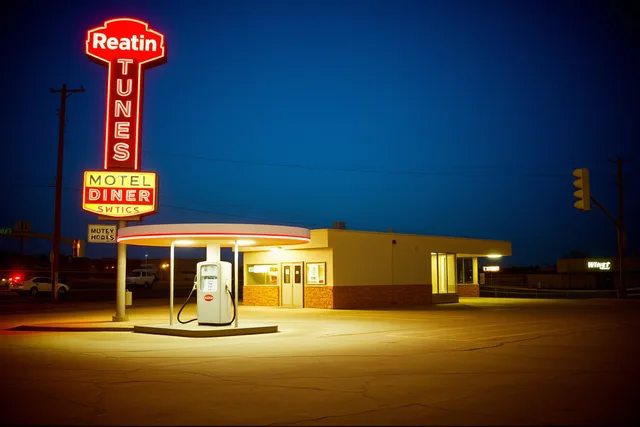
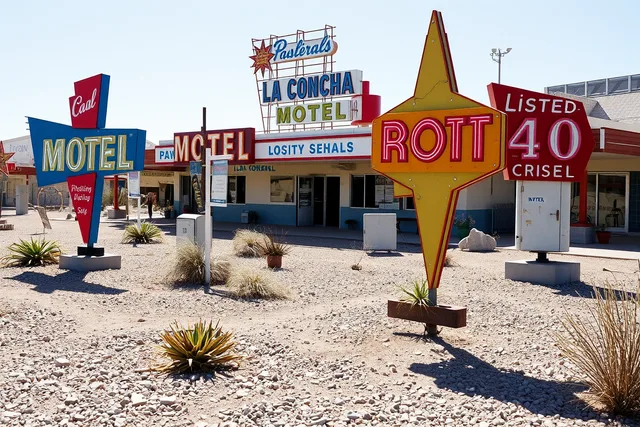
This image is historical context and does not document current conditions at another site.
Common questions
How often should a station record be reviewed?
Match the review date to how fast the statement can change. Operating status and local hazard context need frequent checks; a 1950s porcelain panel's material description rarely changes. For guidance on gas station preservation safety records, owners should separate documented facts from open questions before publishing any claim.
Can an old article be deleted after an update?
Retain the source history in the editorial file, then revise the public text. Readers should see current, qualified wording, not a gap where the old claim sat. Teams that plan a historic motel restoration across regions face the same review discipline when material details and local hazard context change at different speeds.
Who owns the final correction?
The publisher owns the public wording. The property or project contact confirms source facts within their authority, and a licensed trade confirms anything structural or electrical.