Guides
Part of Modern roadside design mistake prevention: 6 errors to avoid in 2027
Five warning signs your roadside design records need a pause before 2027
Modern roadside design warning signs for 2027 help U.S. teams spot weak records, unclear boundaries, unsupported claims, and changes that need a pause.
Warning signs help a team pause before a small assumption becomes a public claim, an unapproved action, or an unreliable project record. They do not diagnose a location or determine whether a change is permitted. They identify when the current information is too weak for the next step.
What to take away
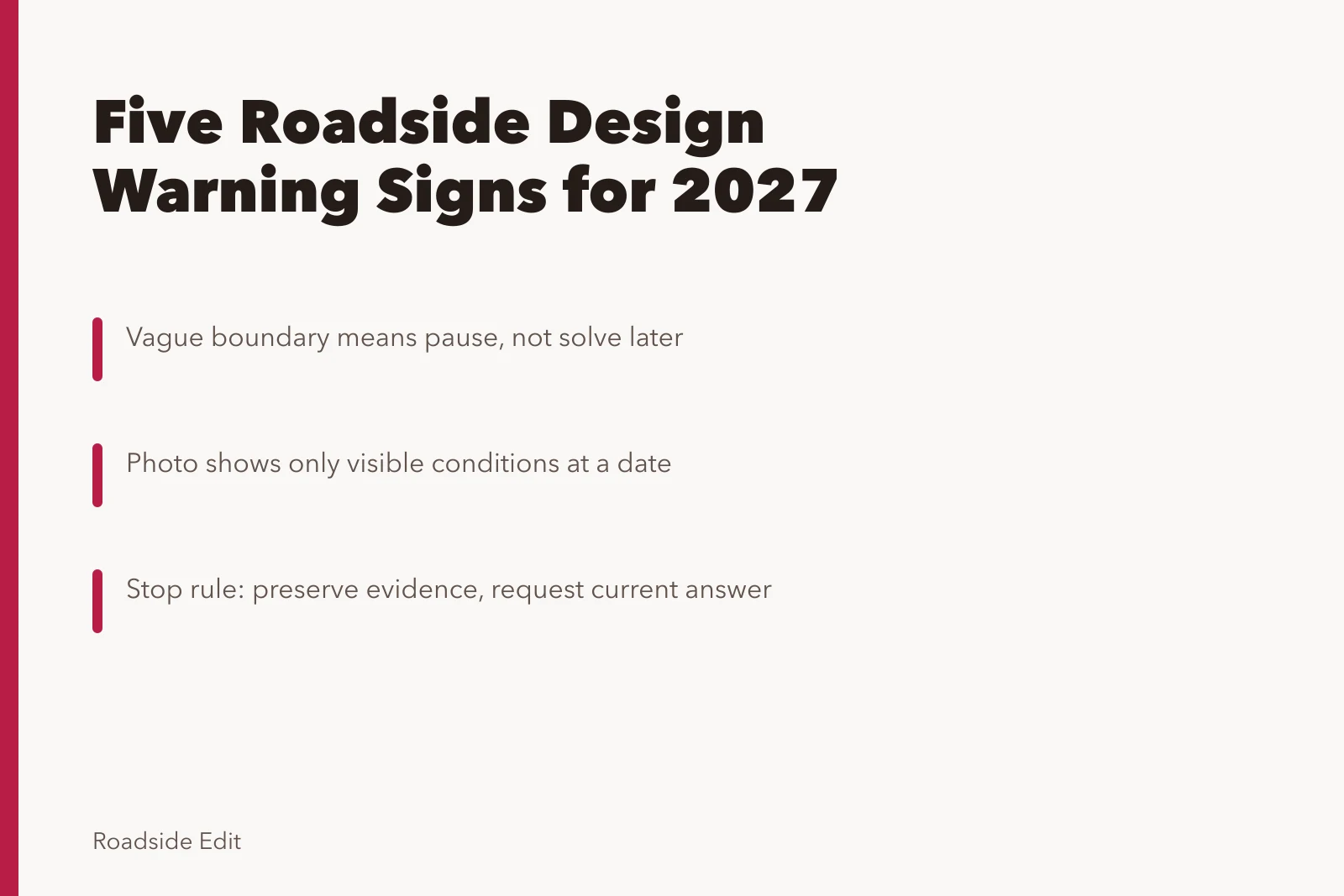
- A vague boundary is a reason to pause, not a detail to solve later.
- A strong visual example does not prove local suitability.
- Missing maintenance ownership can change the viability of an option.
- The right response to uncertainty is a documented question and responsible escalation.
Five signs that need a pause
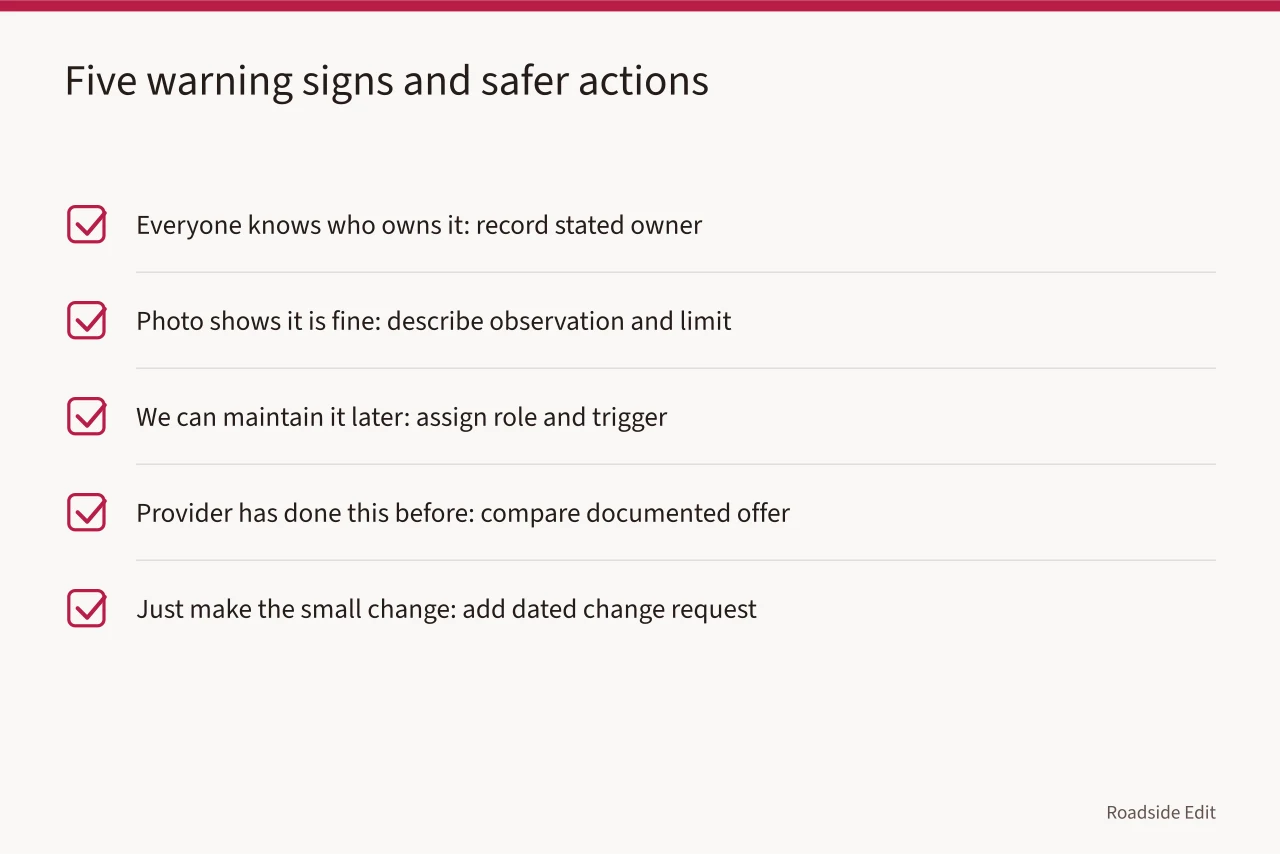
| Warning sign | Why it matters | Safer next action |
|---|---|---|
| "Everyone knows who owns it." | Shared routes and edges can have separate responsibilities. | Record the stated owner and identify what would confirm it. |
| "The photo shows it is fine." | Images show only visible conditions at a date. | Describe the observation and its limit. |
| "We can maintain it later." | Care may determine whether the idea remains workable. | Assign a role, trigger, and record method. |
| "The provider has done this before." | Prior work does not prove fit for this scope. | Compare the documented offer with the current question. |
| "Just make the small change." | Small changes can affect records, authority, or future claims. | Add a dated change request and stop rule. |
Watch for records that overclaim
The Secretary of the Interior's standards and guidelines say documentation should match the subject's significance and management needs. The documentation guidance does not replace a local requirement.
It supports one practical editorial rule: keep enough information to explain what is valuable, what was observed, and why the record was made.
Do not convert a short description into a technical finding. "Surface appears worn in this image" is an observation. "The surface is unsafe" is a conclusion that needs the appropriate evidence and review. The same distinction applies to claims such as accessible, durable, compliant, or historically intact.
Set a stop rule before work starts
A stop rule says when routine activity must be handed to someone with the right authority or current information. Use a stop rule when work could affect a public route, traffic operations, utilities, drainage, a historic resource, unknown property, or a promise made in published material.
Write the rule in plain language: "If the boundary, owner, or condition differs from the record, preserve the existing evidence and request a current answer before changing the scope." The rule is not an obstacle. It is a method for preventing later correction costs and unsupported reporting.
NPS Historic Property Project Documentation is a project-planning tool that brings documentation into development and decision-making. Read the NPS HPPD overview. It does not set local project authority. It supports the stop-rule habit of connecting a proposed action to the current record and decision path before acting.
| Stop-rule trigger | Keep in the escalation record |
|---|---|
| Boundary differs from the plan | Location, prior boundary, and current observation |
| New affected owner appears | Source of the ownership question and next contact |
| Work expands beyond routine care | Proposed scope, excluded work, and approval needed |
| Public claim no longer matches the record | Original claim, correction source, and update date |
Keep the escalation record short
The record should state the date, observable condition, source files, location description, person receiving the question, requested decision, and next review date. Exclude unnecessary personal or sensitive details. Attach a photo only with a note that it documents appearance, not ownership, safety, or performance.
NPS says historic structure reports can preserve findings of research, investigation, and physical work for future users. See the NPS Historic Structure Reports overview. This does not require a formal report for a roadside feature. It supports retaining the note that explains why a change was paused, referred, or later approved.
Separate a correction from a conclusion
When an earlier description is incomplete or wrong, correct it with the source and date. Do not replace the former claim without a note. A correction might say that ownership is unconfirmed, a photo was illustrative only, or a stated scope has changed. This approach keeps public content honest without accusing a provider, owner, or earlier editor of misconduct.
NPS planning guidance describes planning as a process that includes review and revision as information changes. Read the NPS planning standards and guidelines. It is not a local permit rule. It supports recording the next review when a decision rests on incomplete information.
Common questions
What should trigger a pause?
Any conflict between the current record and the site, unclear authority, an unverified claim, or a proposed change outside the agreed boundary.
Is a warning sign proof that a project should be cancelled?
No. It means the next step should be confirmation, documentation, or appropriate review rather than an unsupported decision.
Why keep observations separate from conclusions?
It helps readers understand what was actually seen and prevents a limited record from being presented as a broader finding.