Guides
Part of Neon sign restoration maintenance plan: how owners keep records that hold up
Neon sign restoration maintenance plan: budget notes before you commit to 2027
Neon restoration budgets stay accurate when glass, transformers, access and permits sit on separate lines with dated vendor quotes behind each one.
What to take away
- Budget neon restoration by line, never by a single total: tubing, electrodes, transformers, GTO cable, labor, access, permits, engineering, contingency.
- Get a written scope from each shop with hourly rate, minimum call, travel and parts markup before you compare anything.
- Date every catalog screen and distributor quote, and keep it with the line it supports.
- A certificate of appropriateness in a historic district can add weeks and fees before any material is ordered.
- Removal and reinstallation of a large sign is its own line, priced before the restoration contract is signed.
Build the budget one line at a time
A neon restoration budget is a stack of small, checkable numbers. Each one has a supplier, a unit, and a date. When a line has none of those, it is not a budget yet, it is a wish.
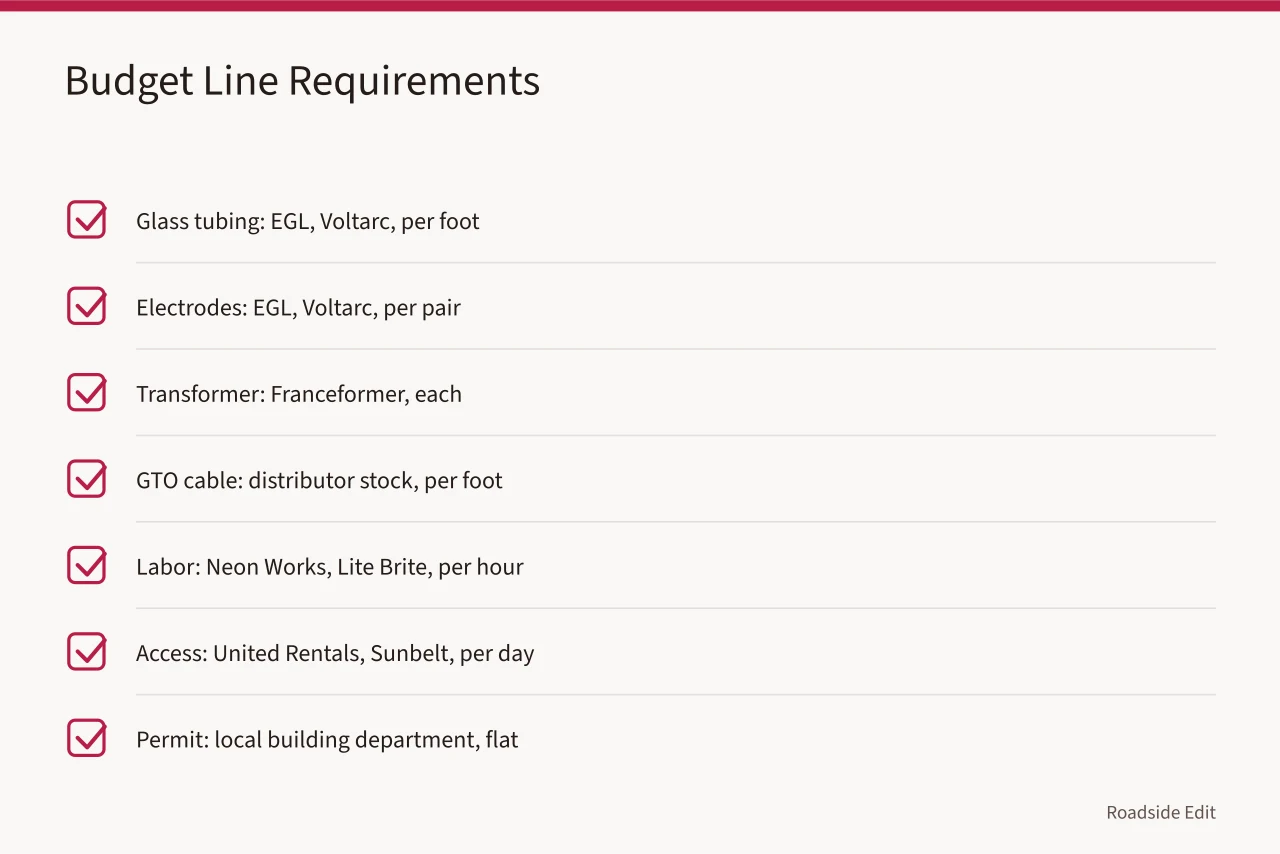
| Line | Named source | Unit | What the quote must state |
|---|---|---|---|
| Glass tubing | EGL Company, Voltarc Technologies | per foot | Tube diameter, gas mix, color match |
| Electrodes | EGL, Voltarc | per pair | Size and seal type |
| Transformer | Franceformer | each | Voltage, current, outdoor rating |
| GTO cable | Distributor stock | per foot | Voltage rating, UV jacket |
| Labor | Neon Works, Lite Brite Neon, Let There Be Neon, Western Neon | per hour | Minimum call, travel, parts markup |
| Access | United Rentals, Sunbelt Rentals | per day | Boom or crane, site access, permit |
| Permit | Local building department | flat | Historic district review, if any |
| Engineering | Licensed structural or electrical engineer | per stamp | What the stamp covers |
| Contingency | Percentage of the above | percent | Trigger list |
Neon Works in Oakland, Lite Brite Neon in Brooklyn, Let There Be Neon in New York and Western Neon in Seattle all list neon restoration and fabrication among their services. None publishes flat rates. Ask each for a written scope covering hourly rate, minimum call, travel and parts markup, then compare the scopes before the totals.
EGL Company and Voltarc Technologies supply neon tubing and electrodes. Franceformer is a common transformer brand, sold through distributors rather than direct. Screen prices move, so date the catalog page and file the distributor quote beside the line it supports.
Removal and reinstallation of a large sign is a separate line from restoration. Size, mounting height and whether a crane is needed drive it, and it belongs in the budget before the restoration contract is signed.
Permits, engineering and who signs off
Sign permit fees are set by the local building department, so the figure varies by jurisdiction. In a historic district, a certificate of appropriateness may add review weeks and its own fee on top. Confirm the process with the authority having jurisdiction before you buy materials, not after.
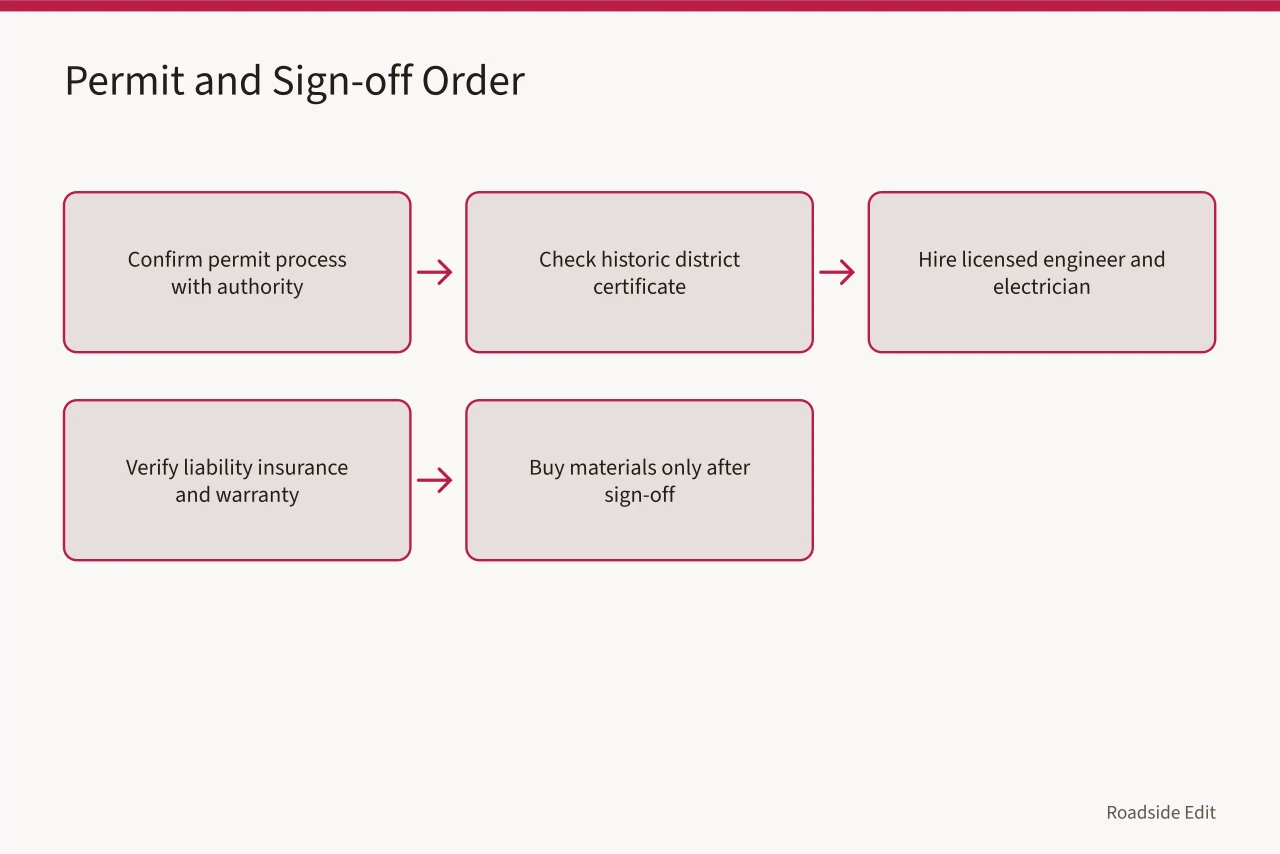
Structural and electrical questions belong to a licensed engineer and a licensed electrician. Canopy soffits, dry-stand pipes, transformer loads and underground tanks are not owner-inspection items. Your state board and the local fire marshal set the rules that apply to your site.
Ask every shop for liability insurance and a written warranty. A warranty of 90 days to a year on parts and labor is common. What matters is the wording: which failures it covers, which it excludes, and who pays for the second access lift when a transformer fails early.
Keep the record that makes the numbers usable
The National Archives describes examining a record's condition before choosing a preservation treatment. Its preservation overview supports a simple planning rule: keep the reason a line exists, the source behind it, and the date it was last considered.
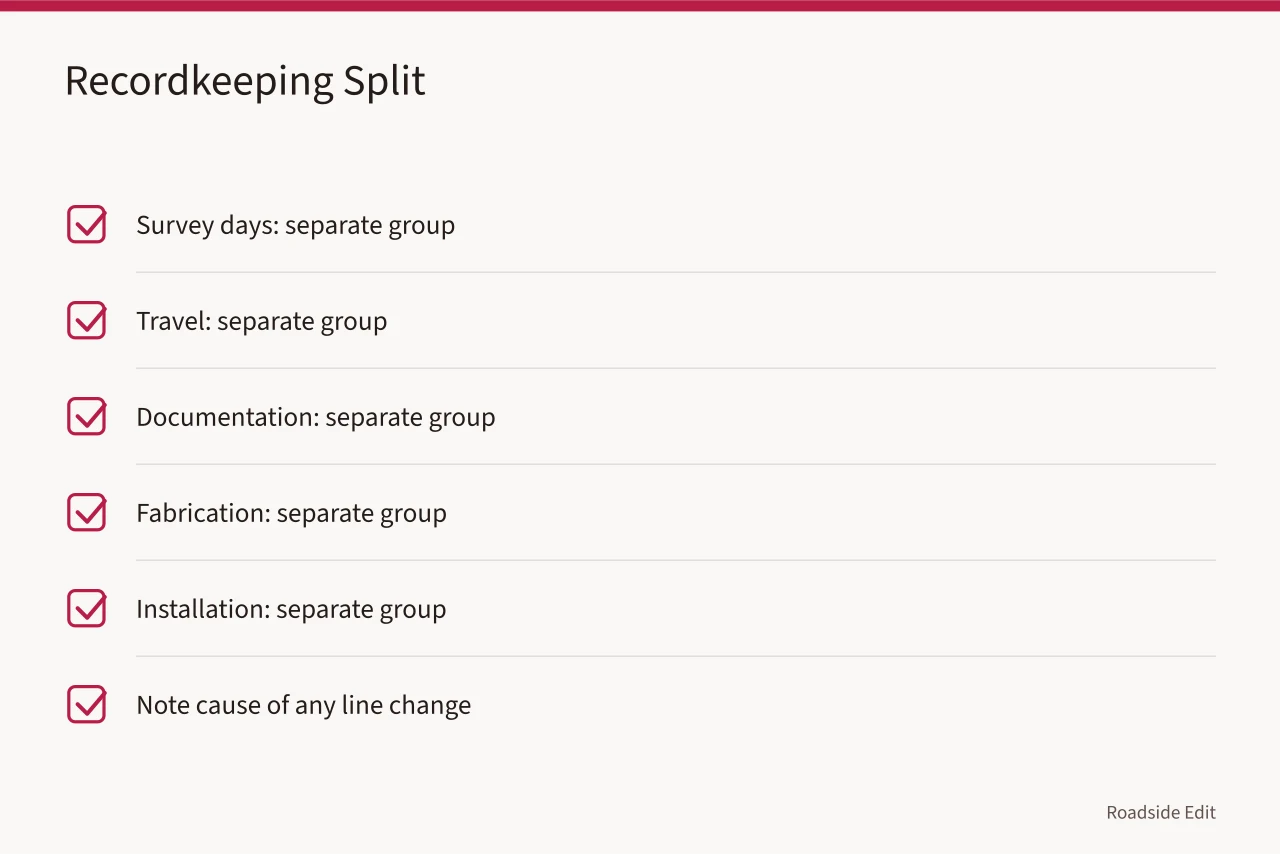
That rule is what the budget notes from the diner interior work put into practice, separating recordkeeping costs from technical work so neither hides inside the other. Apply the same split here: survey days, travel and documentation are one group, fabrication and installation another.
When a line changes, note what caused it: a new quote, an owner decision, a public correction, or an unresolved site question. A later reader can then see why a figure moved without re-reading the whole file.
The National Park Service treatment standards apply when a historic description is about to change. The preservation briefs show how much scope a preservation question needs. The National Archives preservation program sets the dated, traceable record. None of the three tells you what to do on your sign; they tell you what to write down.
Compare scopes, not totals
Two shops can quote the same sign and land far apart because they included different work. One may fold in research, access coordination and a follow-up record; the other may price only the bench work and leave the lift to you.
Write down each assumption, date and exclusion before using either number. Do not average a small set of quotes into a local market figure, and do not publish a provider's range as a market fact.
Label it provider-supplied, keep the original wording, and let a later reader see whether it described a limited task, another location, or an earlier year.
Common questions
Why not budget from an average cost?
An average hides location, scope and condition. A figure that blends a transformer swap with a full facade restoration describes neither job. Line items with named sources let you delete the lines your sign does not need.
Can documentation work be funded publicly?
Yes, when the source and purpose are stated. Any sponsor relationship should be disclosed, and the sponsor's own description kept separate from independently sourced statements. The planning records from the motel project show how that separation is kept.
Is a contingency a hidden fee?
No. A contingency names the unknowns: hidden damage behind the raceway, an access delay, a permit change. Give it a trigger list so it is drawn on for a stated reason. The case study questions cover how to record those draws.
Who decides what work is allowed?
Your State Historic Preservation Office or local landmarks commission, under the adopted ordinance, and the building department for permits. Section 106 review applies when federal money or a federal permit is involved. Ask them before the scope is fixed.