Guides
Part of Neon sign restoration maintenance plan: how owners keep records that hold up
How to keep neon sign restoration records that survive a handoff
Neon sign restoration care records for 2027 give U.S. owners a practical way to organize photos, sources, approvals, corrections, and public updates.
A neon sign care record is a publishing and stewardship file, not a substitute for electrical advice or a contractor report. Its job is modest: let a future owner, editor, or historian see what was observed, what was said publicly, and why a statement changed. The strongest files retain uncertainty instead of filling it with a neat story.
What to take away
- Give each photograph a date, viewpoint, credit, and factual caption.
- Separate confirmed sources, owner-supplied statements, and local recollections.
- Record corrections beside the earlier wording instead of quietly overwriting it.
- Make an index that another person can use without guessing what a file means.
Build a record packet, not a random folder
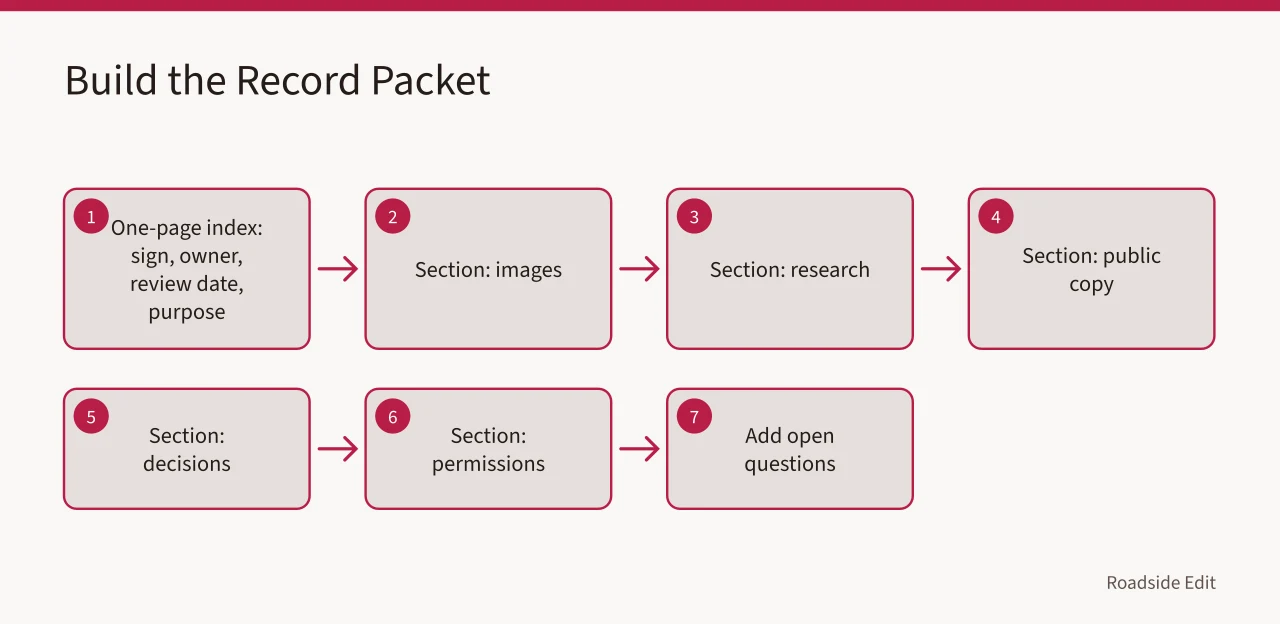
Start with a one-page index that names the sign or site, the file owner, the last review date, and the packet's purpose. Then create separate sections for images, research, public copy, decisions, and permissions, and add open questions.
The National Park Service explains that historic resource studies document and analyze a resource's history and significance. Its guidance on historic resource studies supports keeping researched context separate from marketing copy.
The index should answer three practical questions in under a minute: What is this file about? Which version is current? Where did each factual statement come from? If a record cannot answer those questions, add a note rather than inventing a conclusion. That restraint keeps a later article from turning a half-remembered claim into a permanent public fact.
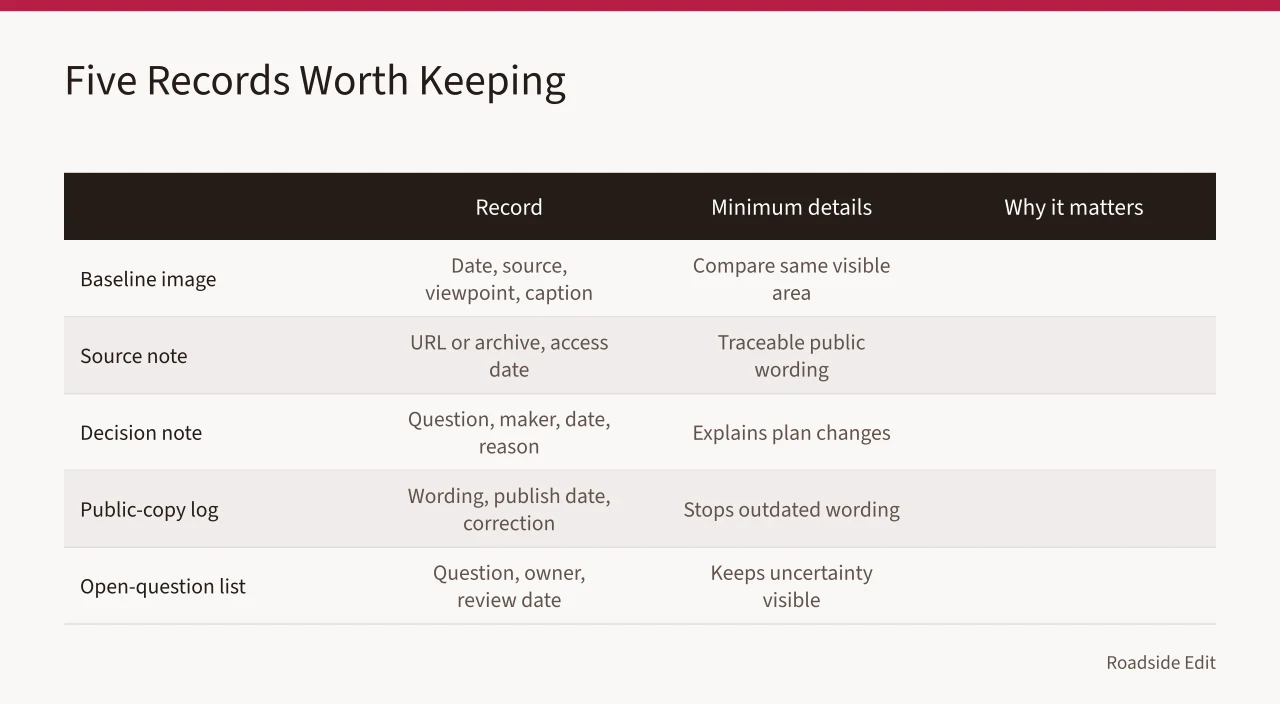
The five records worth keeping
| Record | Minimum details | Why it matters |
|---|---|---|
| Record | Minimum details | Why it matters |
| --- | --- | --- |
| Baseline image | Date, photographer or source, viewpoint, caption | Lets a later reader compare the same visible area |
| Source note | Specific URL or archive reference, access date, claim supported | Makes public wording traceable |
| Decision note | Question, decision maker, date, and reason | Explains why a plan changed |
| Public-copy log | Exact wording, publication date, correction date | Stops outdated wording from returning |
| Open-question list | Question, owner, next review date | Keeps uncertainty visible |
For each item, assign a stable ID such as IMG-2027-014 or SRC-2027-006. The label is not a claim about age, condition, or ownership. It is simply a handle that can appear in a caption, a research note, and a correction log. A consistent ID prevents a later editor from mistaking two crops of one image for two separate records.
For image records, keep the original file where permission allows, not only a cropped social-media version. Store the credit with the image, plus the date received and any stated use limits.
Mark whether an image came from an owner, a public collection, a photographer, or the publisher. A reader should never have to infer that an illustration is a historic photograph.
Create a short image log with columns for filename, record ID, date made or received, creator when known, rights note, and caption status.
Do not write "original" unless the file really is the original supplied by its creator or collection. A scan, screen capture, or resized derivative can still be useful evidence, but each needs an honest label.
Make corrections traceable
If a caption, date, ownership statement, or historical claim changes, add a correction note. State what changed, why it changed, and which record prompted the update. A reader does not need an internal debate, but they should not be left with two incompatible versions of the same story.
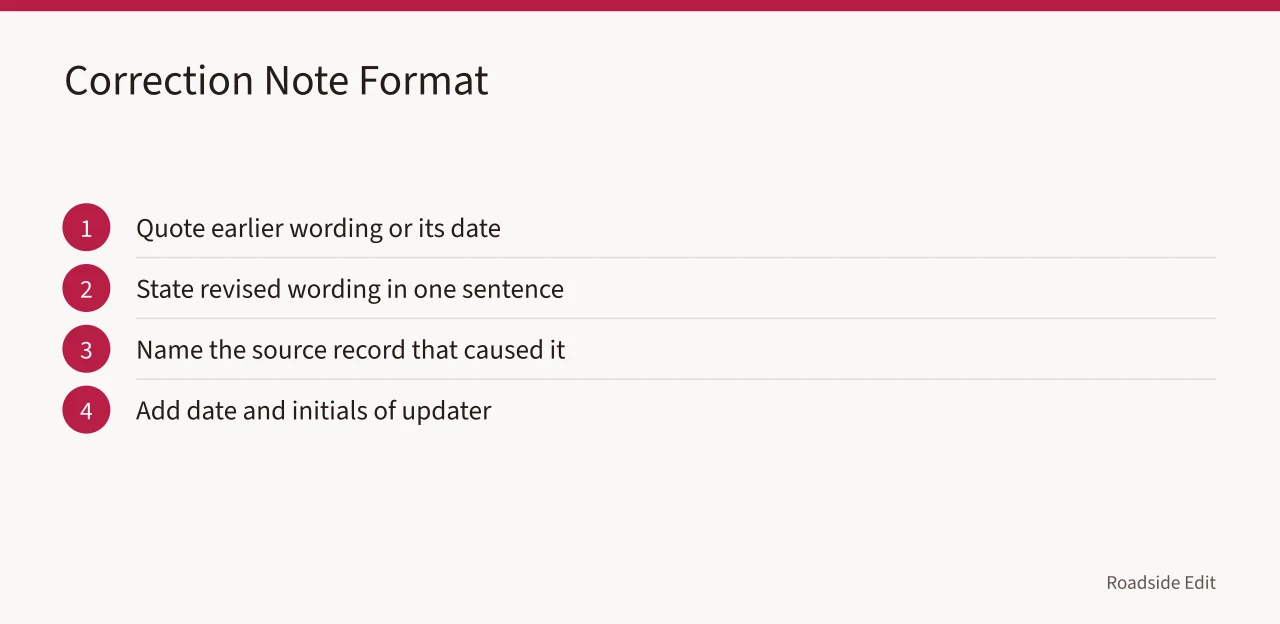
Use a simple correction format:
- Quote the earlier wording or identify its publication date.
- State the revised wording in one sentence.
- Name the source record that caused the change.
- Add the date and initials of the person making the update.
This method is useful even for small edits. A corrected street address, a revised installation decade, or a withdrawn ownership claim can change how a reader understands the sign. Keeping the trail also helps an editor answer a reasonable question without reopening every file in the packet.
Keep sponsored information labeled
Paid profiles, directory listings, and sponsored features may be useful commercial material. Put them in a labeled section. Do not use them as the only support for a historical claim.
A clear separation protects the publisher, the reader, and the business being described. Record the exact copy approved for a paid placement, the date it ran, and the person who supplied any business details.
An owner can call a sign "beloved" or "iconic" in a sponsored profile. That is an attributed promotional statement, not a historical finding.
If the site later publishes a factual article, it should add a source note or label the owner statement as an owner statement. That distinction is especially useful when a business changes hands or a campaign is updated.
Use names that survive a handoff
File names should describe the record, not announce a conclusion. A practical pattern includes date, location label, view, and version number. Pair that name with a caption that says what is visible and a credit line that says where the image came from. Keep the original filename in the source note when it helps later verification.
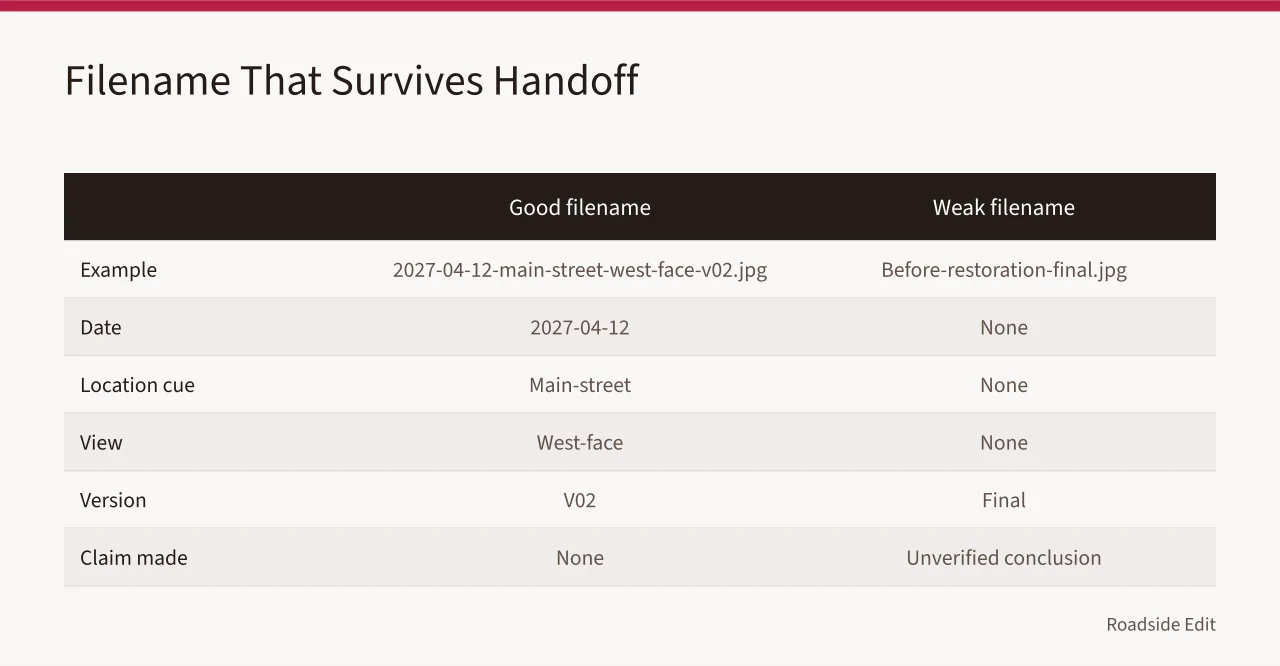
For example, 2027-04-12-main-street-west-face-v02.jpg tells a reviewer more than before-restoration-final.jpg. The first name identifies a date, a location cue, a view, and a revision. The second makes an unverified conclusion and becomes confusing if a newer file appears. A good filename is plain enough to survive a handoff, an export, or a change in software.
When a contributor leaves, transfer the index, source log, and correction log together. A folder of images without captions or source notes is difficult to use responsibly. A small, labeled packet is more useful than a large, unexplained archive.
The National Park Service's standards for treatment of historic properties distinguish preservation, rehabilitation, restoration, and reconstruction. That distinction gives an editor a reason to record the language used in a public description before changing it. The agency's Preservation Briefs collection also shows why a record should state the material or question at issue instead of making broad care claims.
The National Archives offers guidance on preserving archival materials that emphasizes proper handling and storage. For a publisher, the direct lesson is limited but useful: retain dated source files and make it possible to identify what was kept. These sources inform documentation practices. They do not tell a reader how to service neon tubing, transformers, wiring, or mounting hardware.
Prepare a clear handoff note
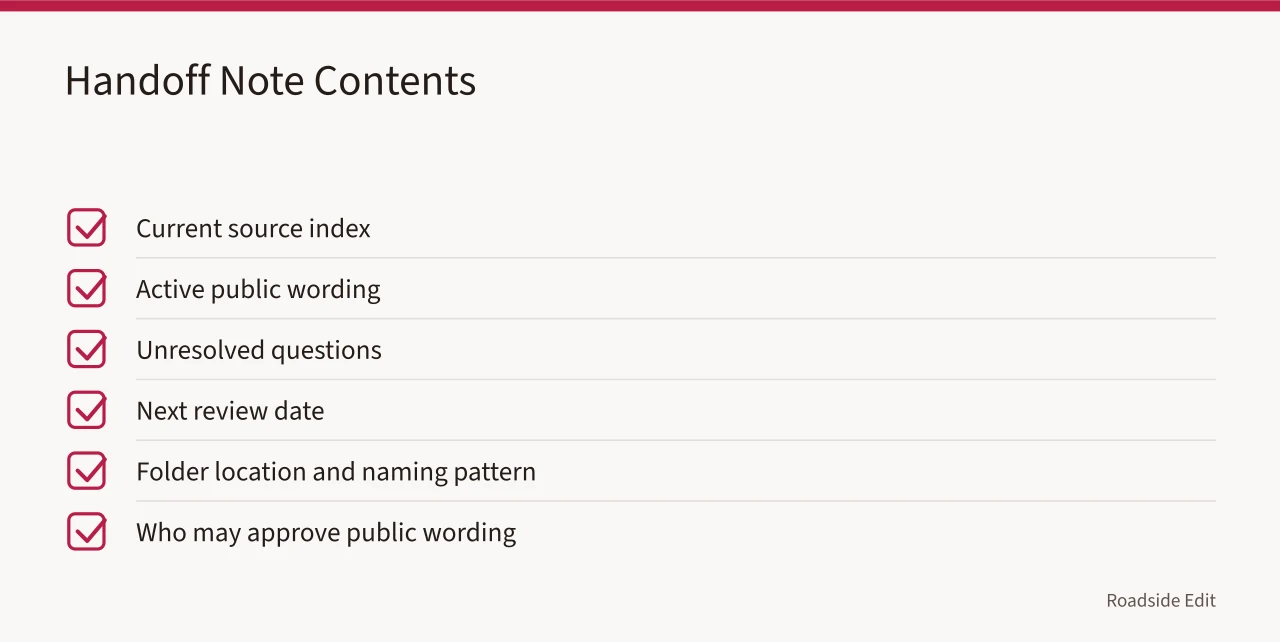
When an editor changes, provide the current source index, active public wording, unresolved questions, and next review date. A short handoff keeps evidence, attribution, and corrections from being lost during an update. Include the folder location, the naming pattern, and a note on who may approve new public wording.
Mark each record as public source, provider-supplied material, internal correction note, or unresolved question. It helps the next editor find evidence without mistaking an attributed statement for an independently confirmed fact.
If a source vanishes from the web, keep the access date, title, publisher, and a saved permitted copy or citation. Never swap a missing source for a vague reference such as "online research."
Review the packet on a calendar
A record packet needs a review schedule, not constant attention. Set a review after a major public update, ownership change, new archival material, or correction from a credible source.
A quiet site often needs only an annual review, so during the review check only parts likely to change: business name, contact details, public captions, and cited page access. Check image rights notes and open questions.
Use this short review checklist:
- Confirm that every published factual sentence has a matching source note or is clearly attributed.
- Check that image credits still identify the source page and any use limits.
- Read correction notes before removing outdated wording from public pages.
- Move resolved questions to a dated decision note instead of deleting them.
- Flag any statement that now needs a provider, historian, archivist, or legal review.
The goal is not a perfect archive. It is a trustworthy working record that tells the next person what the publisher knew at a particular time. That is enough to support careful articles, profiles, and sponsored placements without overstating the evidence.
Common questions
How long should the record packet be?
Long enough to locate the original evidence and understand each correction. A clear index matters more than a large number of files.
Can community recollections be included?
Yes, but label them as recollections, identify the speaker when appropriate, and do not present them as confirmed fact without supporting evidence.
Who should be able to edit the records?
Choose a named record owner and keep a change log. Others can contribute materials, but the published record needs accountable stewardship.