Guides
Roadside design studio fundamentals: how to run a workshop that holds up
Roadside design studio fundamentals for 2027: define a project question, gather site evidence, invite usable input, record choices, and respect local review.
A roadside design studio turns a messy place-based question into an accountable set of options. It is not a style board, an approvals promise, or a substitute for qualified design, engineering, accessibility, preservation, or local review.
The discipline is the useful part: define the question, bring relevant evidence into the room, record competing needs, and leave a trail explaining how the group reached its next step.
This guide is for editorial planning around U.S. roadside places such as small commercial corridors, historic highway buildings, entries, parking areas, sidewalks, and public-facing signs. It does not assess a specific property or tell an owner what to build.
What to take away
- Begin with a decision question, not a desired visual outcome.
- Collect site records, observed conditions, and stakeholder statements as different forms of evidence.
- Keep a studio's concepts separate from approvals, construction documents, and technical conclusions.
- Give participants a clear prompt and a record of what was heard.
- End with assigned next steps, unresolved questions, and dated source notes.
Define what the studio is for
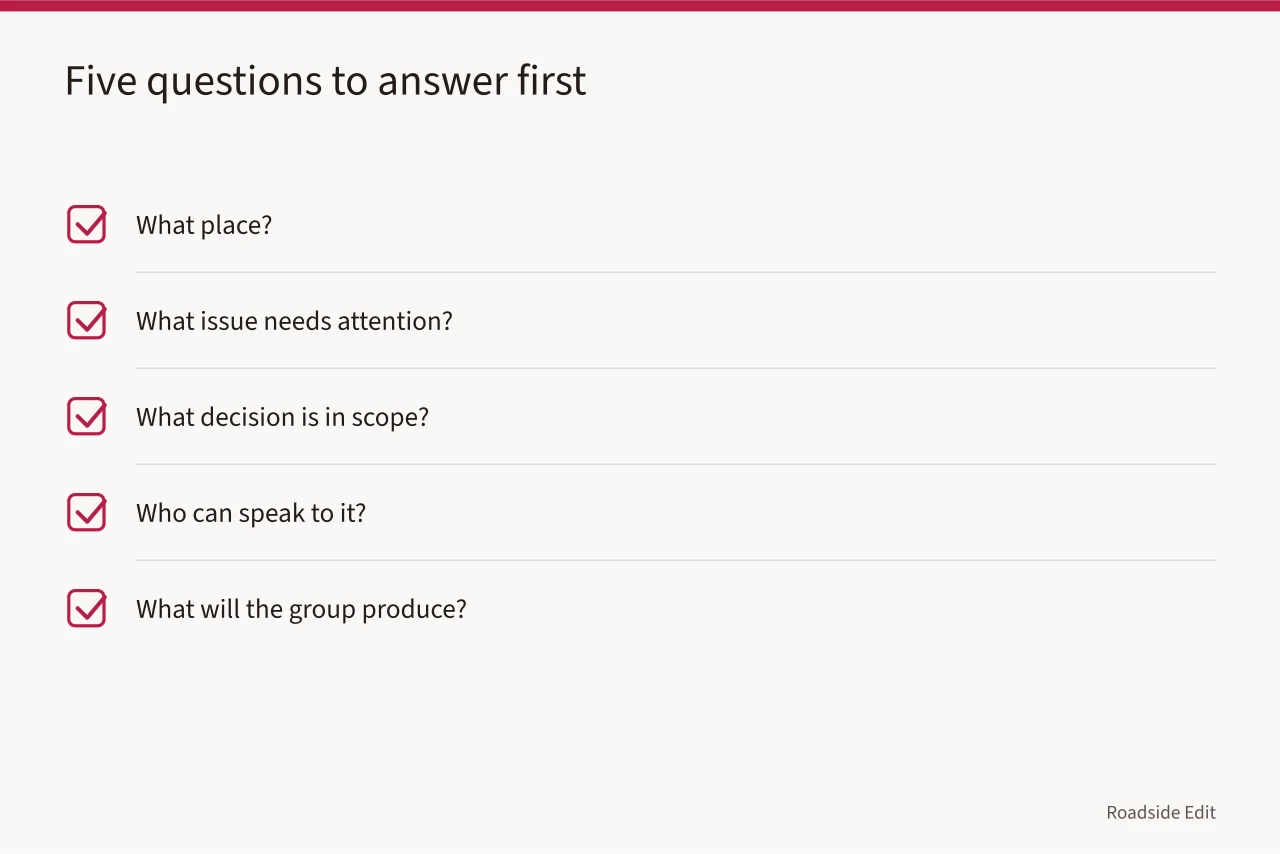
A group that says only "improve the corridor" has no usable task. A group that asks "which documented entrance conditions need further study before a concept is selected" has one.
The scope should name exclusions as well. A preliminary layout does not establish a property line. A participant's preference does not establish code compliance. A photograph does not reveal buried utilities, material condition behind a surface, or all routes used by visitors. These boundaries help the room be creative without turning a concept into an unsupported claim.
Treat the studio as a structured workshop
The National Park Service's handbook for managers of the Historic American Buildings Survey and Historic American Engineering Record describes a charrette as a form of organized brainstorming, a workshop with a physical-design component. Read the NPS handbook. That description supports using a studio as a structured workshop. It does not prescribe the agenda, outcome, or treatment for a different place.
Set an agenda that moves from evidence to questions to options, and do not open with a preferred rendering. Starting with the desired answer can make later evidence look like an obstacle instead of information.
A better sequence starts with a short site summary. Then ask participants to identify what is known, observed, reported by someone else, and what still requires verification.
Bring the right kinds of evidence
A compact evidence board is usually more valuable than a large slide deck. Separate information by type so participants do not confuse an archival record with a current observation or a participant comment.
| Evidence category | Useful studio purpose | Important limit |
|---|---|---|
| Dated site images | Shows a visible feature at a stated time | Does not prove hidden condition |
| Maps and parcel records | Frames the research area | Does not settle every legal boundary |
| Historic documentation | Identifies earlier features or use | Does not establish current feasibility |
| Agency guidance | Frames a question for review | Does not grant an approval |
| Participant input | Identifies lived experience or concerns | Does not independently verify a claim |
For every item, note its publisher or creator, date, location, and the narrow reason it is in the studio. If a source has an uncertain date, say so. If a drawing is not a construction drawing, label it clearly. These small labels prevent the group from building a detailed conversation on a vague record.
Invite people for the decisions they inform
Participants need not agree on a solution for input to be useful. Nearby operators may explain delivery patterns, and pedestrians may identify where a route feels confusing.
A property owner may identify a maintenance constraint, a historian may identify an earlier image's source, and a local reviewer may explain the process for an application; each role brings distinct knowledge.
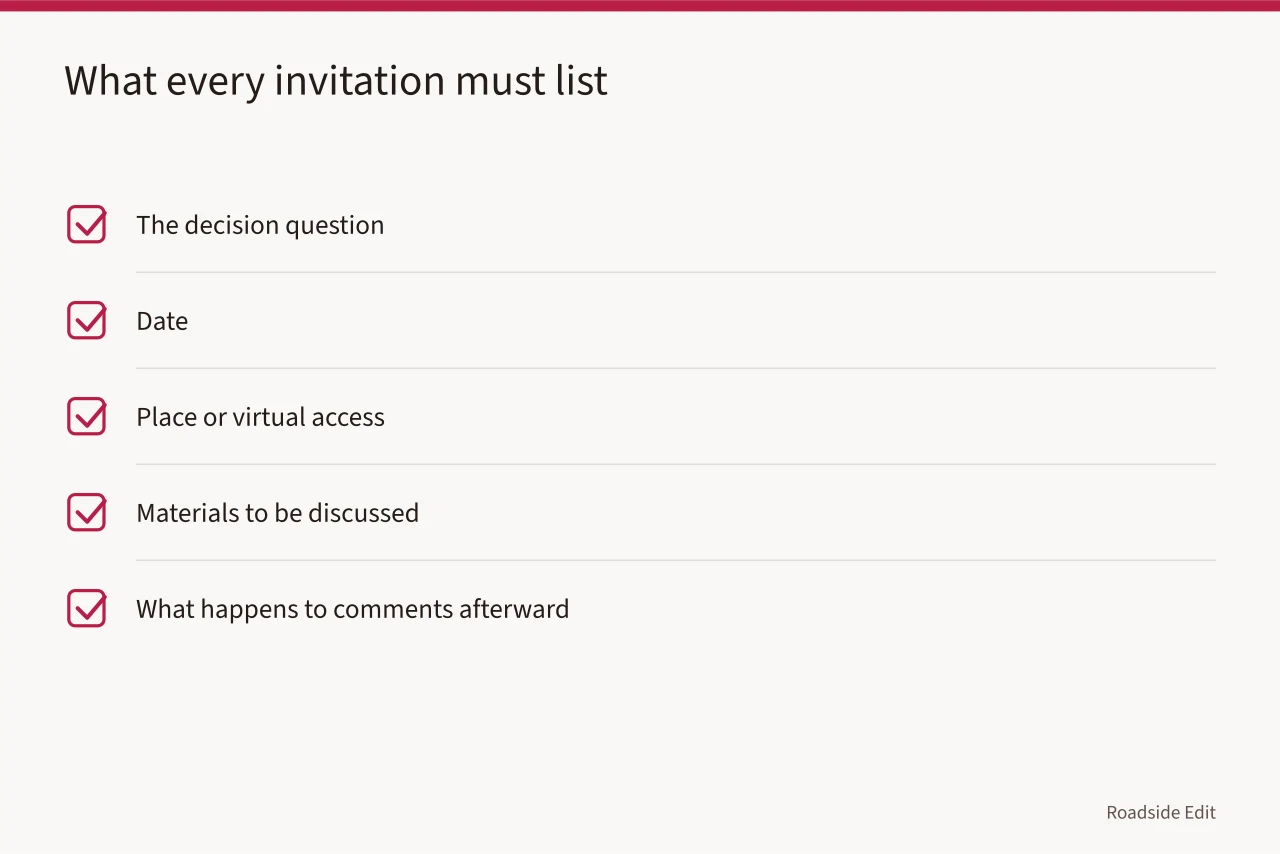
The invitation must list the decision question, date, place or virtual access, materials to be discussed, and what happens to comments afterward.
Avoid language implying a studio vote is an entitlement or final public decision. If the session is part of an official process, use the agency's actual notice requirements, not an informal invitation as a substitute.
Make access part of the question
Roadside places bring walking, wheeling, transit, delivery, parking, and vehicle movements together in a limited space. A studio should ask who uses the route, at what time, and where conflicts appear. That question is not the same as performing an accessibility assessment. It helps the group identify where specialist review, current rules, or better field information may be needed.
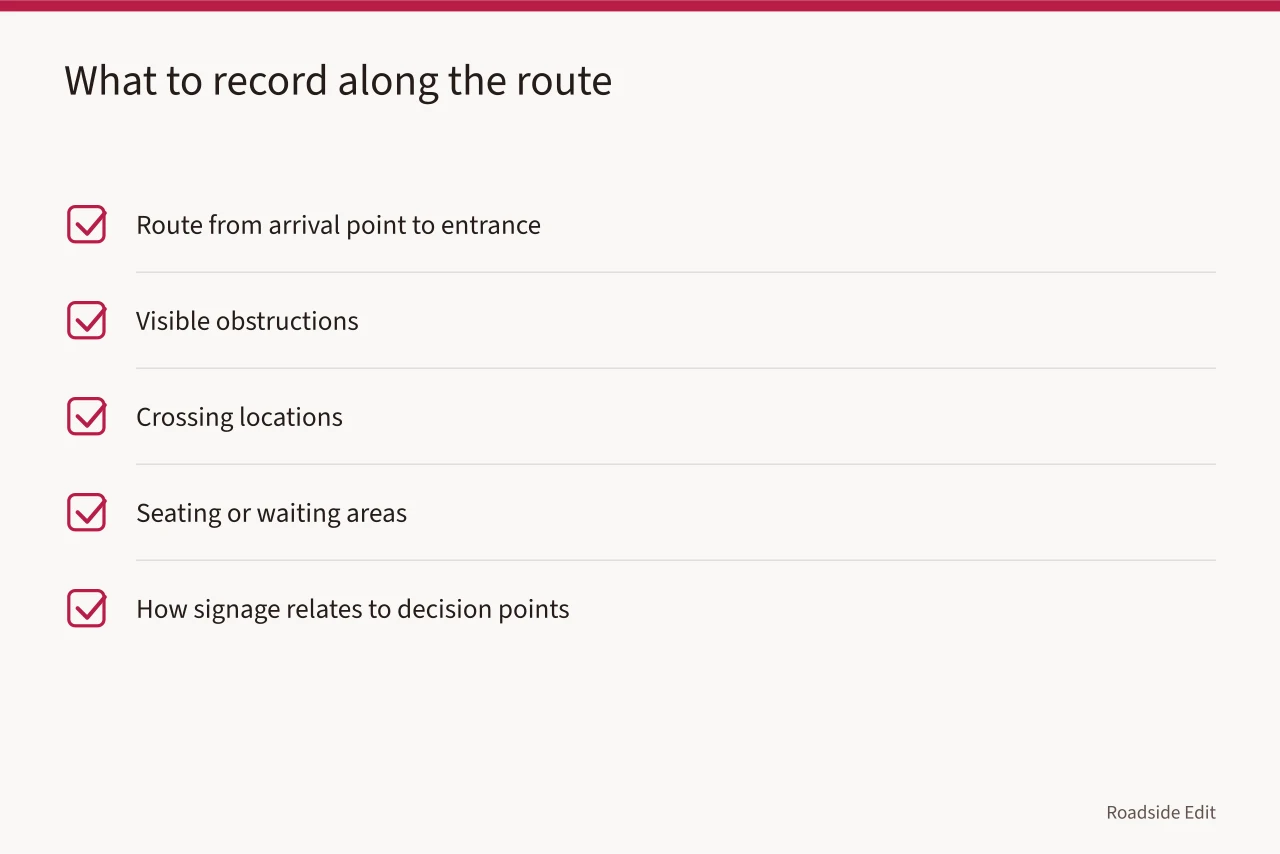
Do not guess measurements from a photograph or call a path compliant because one image shows it open. A good studio records the issue and the evidence needed to investigate it.
Generate options without pretending they are final
Use three or four alternatives that answer the same question in different ways. Label them concepts, not recommendations. Each option should state the problem it addresses, the evidence it responds to, the possible tradeoff, and what information would be needed before a decision. This format gives participants something concrete to react to without hiding uncertainty.
An option might reorganize a sign location, clarify a pedestrian arrival sequence, or test a different relationship between parking and a storefront. It should not claim a cost, approval outcome, traffic effect, safety result, or durability benefit unless the record for that specific conclusion has been established. A studio can prioritize further research. It cannot replace it.
Record both agreement and disagreement
The most useful studio record is not a polished recap that makes everyone sound aligned. It identifies the question, materials reviewed, participants, observations, concepts discussed, points of agreement, points of disagreement, decisions made, and items deferred. Attribute comments when attribution is appropriate and authorized. If a comment is summarized, make clear that it is a summary rather than a quotation.
Keep a small decision log with date, decision owner, source or input considered, reason, and next action. A decision log is especially valuable when the article later describes the planning process. It lets an editor distinguish "the group discussed" from "the responsible party decided." It also prevents a later design change from looking like an unexplained reversal.
Separate design work from public claims
Drawings and visualizations are powerful communication tools, which is why they need context. Mark a conceptual image with the project date, viewpoint, known assumptions, and the phrase "conceptual study" or equivalent. Do not use a polished image to imply that a permit exists, a contractor has been selected, a public agency endorses the work, or an outcome is guaranteed.
When a studio includes a business, sponsor, or product representative, give that participant a defined role and disclose in the project record. An article can report attributed contributions.
It should not turn a participant's interest into neutral technical conclusion, and the same rule applies to editorial coverage: an attractive design idea gets the same source discipline as a difficult one.
Leave with a research-ready next step
Close the studio by assigning a next action to a person or organization, not by declaring success. Useful next actions include locating an original drawing, checking current local requirements, requesting a site measurement, documenting a visible condition, seeking an owner decision, or scheduling a more formal review. Put a date beside the action and describe the evidence expected back.
Before publishing a studio recap, ask whether a reader could tell the difference between a source fact, participant view, visual observation, and editorial lesson. If not, revise. A well-run studio makes a future decision easier to understand. It should never manufacture certainty for a place that still needs review.
Use an editorial handoff note
If you write an article after the studio, make a handoff note before drafting. List the materials the writer may rely on, the background-only material, comments needing attribution, and unresolved subjects.
This short note is a practical guardrail for the entire writing process. It keeps a recap from adding a technical conclusion that no single participant, source, or responsible reviewer supplied. It also gives a future editor a clear reason for every limit in the article.
The National Archives primary-source guide helps distinguish a participant record from later commentary. The EPA smart-growth code examples provide contextual planning examples, not local rules. The Federal Trade Commission endorsement guidance supports disclosing material relationships in public-facing coverage.
Common questions
Is a design studio the same as a public hearing?
No. A studio is a working session. Any required public notice, hearing, or approval process follows the rules of the responsible jurisdiction.
Can a concept drawing be published as a final design?
No. Label it as a concept unless the responsible source documents a final decision.
What should a studio recap include?
Include the question, date, participants, materials reviewed, main points, decisions, unresolved items, and next actions.