Guides
How to compare modern roadside design providers before you hire
Choosing roadside design help in 2027 gives U.S. owners a clear way to compare scope, relevant experience, records, fees, and responsibilities before hiring.
Choosing help for a roadside-design project means matching a defined question to a responsible scope, not finding the most confident answer. A provider may excel at visual design, documentation, project coordination, site care, and fabrication. It may also excel at preservation research and public communication.
None of those labels proves the provider controls the site, can make a legal determination, or fits every task.
This guide is for a U.S. owner, editor, or project team comparing outside help for a modest roadside feature, publication assignment, research task, or planning conversation. It is not a bidding rule, a professional-licensing standard, a site assessment, or advice about permits, safety, accessibility, utilities, traffic, or property rights.
What to take away
- Define the work before comparing providers.
- Ask candidates to explain their role, evidence, limits, and handoff record.
- Compare the same inputs, deliverables, and change conditions for every candidate.
- Treat references and past examples as context, not proof of a future result.
- Keep a dated decision record so a published account can separate facts from promotion.
Start with a task, not a provider category
"designer" can cover several very different roles. One person may develop a visual concept, another may document existing conditions, a third may coordinate a limited communication project, and a specialist may help interpret a narrow research question.
If a team begins with the category rather than the task, it risks asking for a result the provider never agreed to deliver.
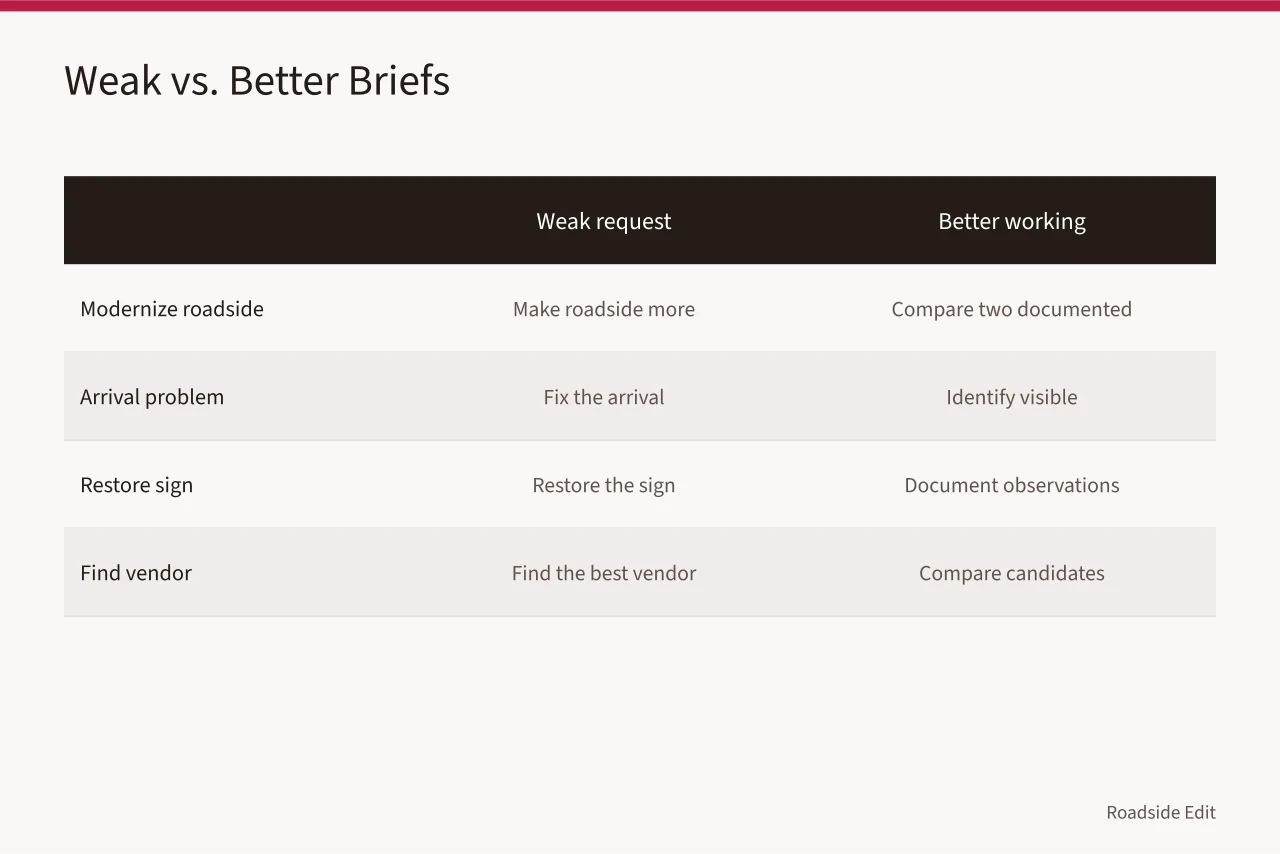
Write a one-paragraph working brief naming audience or user, feature or record, decision. Name known boundaries, current evidence, desired deliverable, and what remains unconfirmed.
A useful brief might request a wayfinding concept based on an existing documented route, a source-based profile of a roadside business, or an inventory of visible features. It should not promise access, approval, performance, safety, or compatibility, and it should not promise a physical outcome the record does not support.
| Weak request | Better working brief |
|---|---|
| Make the roadside more modern | Compare two documented communication approaches for first-time visitors |
| Fix the arrival problem | Identify visible orientation questions and the responsible follow-up process |
| Restore the sign | Document current observations, records to locate, and questions for the appropriate owner |
| Find the best vendor | Compare candidates against a defined deliverable and evidence standard |
Separate qualifications from promises
Experience, education, portfolio work, and references can help a team understand a provider's background. They do not prove the outcome of a new assignment. Ask the candidate to state what they personally will do, what other role is needed, what evidence they need from the client, and what question is outside the engagement.
The National Park Service's Professional Qualifications Standards describe minimum qualifications for particular historic-preservation disciplines. Those standards do not license a person for every project or replace current local requirements. They are useful context for a narrow selection principle: credentials should be read in relation to the actual task, not used as a blanket claim of authority.
Find a provider who states limits clearly. A credible one might say, "I can prepare a documented concept based on the supplied records; ownership, field condition, and approvals must be confirmed separately." That beats an unlimited promise, because it tells the team what it can rely on.
Federal selection procedures offer a second, narrow lesson about clarity. The Federal Acquisition Regulation source-selection procedures describe evaluating proposals against stated factors in a federal procurement. That process does not govern a private roadside assignment. It does support identifying the factors that matter before reading proposals, rather than creating reasons after a preferred candidate has emerged.
Compare like with like
Ask every candidate to respond to the same brief and list the same categories. Do not compare a detailed proposal that includes research, revision, file delivery, and handoff notes with a short price that covers only an initial sketch. Differences may be reasonable, but they should be visible.
| Comparison field | What to request |
|---|
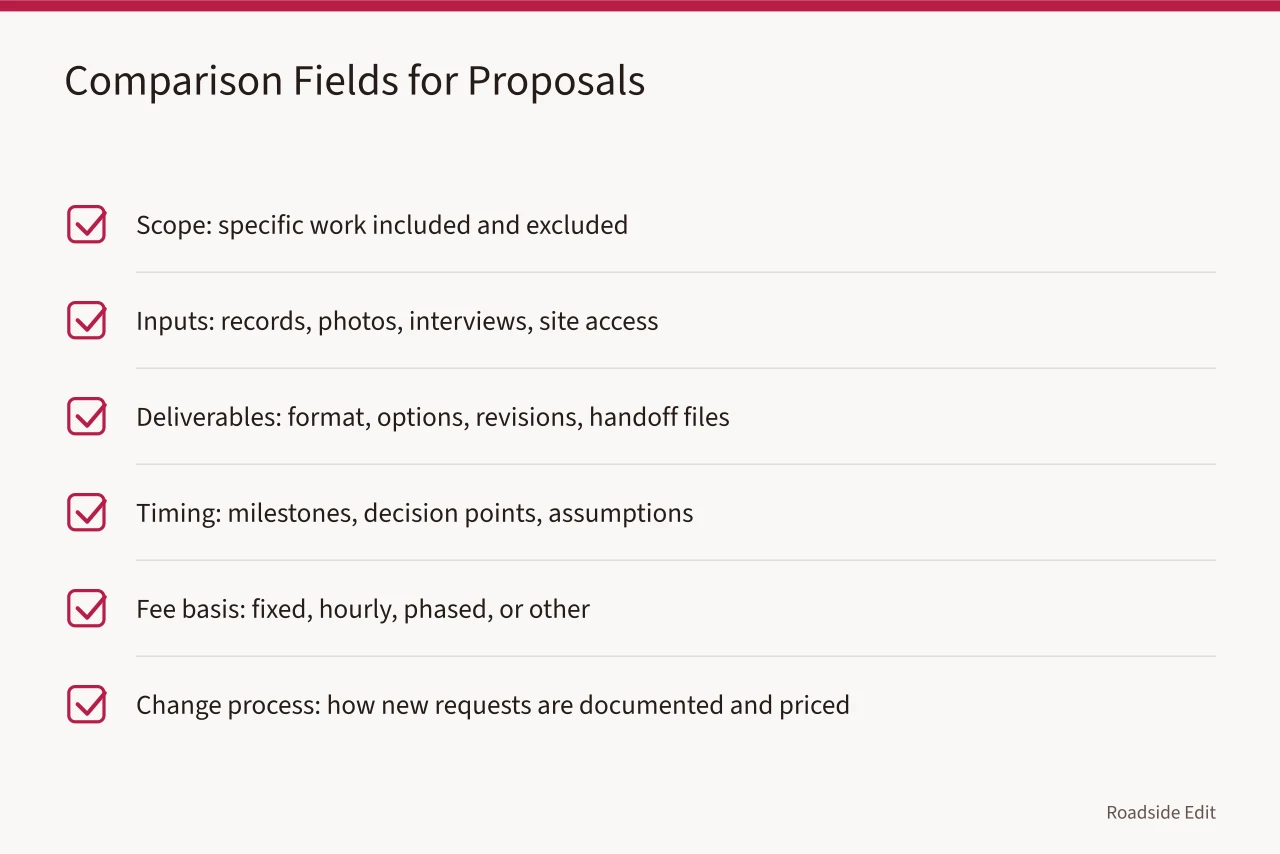
The goal is not to force every provider into one method. It is to avoid hiding scope differences behind a single total. A low fee may reflect a deliberately narrow assignment. A higher fee may include records, coordination, or future-use files that another proposal excludes.
The decision should describe those differences, not treat price alone as a quality score.
Cost and timing deserve the same care. The General Services Administration's cost and schedule management guidance treats them as part of project management for federal real-estate work.
A private owner does not need that system. Ask instead: which project input, review, or decision could change the price or delivery date, and how will the team record it?
Ask for evidence that fits the assignment
Relevant past work gives more useful information than a large portfolio. Ask for examples that resemble the current task in complexity, deliverable type, context, and role. A candidate should say what they did personally, what the client supplied, and what changed between the original plan and the delivered work.
If the example is confidential, a plain-language description of its scope and lessons can be more useful than an image without context.
Do not ask a provider to disclose another client's sensitive information, quotes, address details, or private files. A professional response can explain the kind of work completed and the role performed without turning a prior client into a marketing asset.
Make responsibilities explicit
Every project has work that belongs to the client or another authority. Common examples include confirming ownership, providing accurate existing records, deciding between options, managing public communication, obtaining approvals, or arranging specialized review. A hiring decision should name those responsibilities rather than transferring them silently to the provider.
Use a responsibility table before work begins:
| Question | Responsible role | Evidence or record | Next date |
|---|
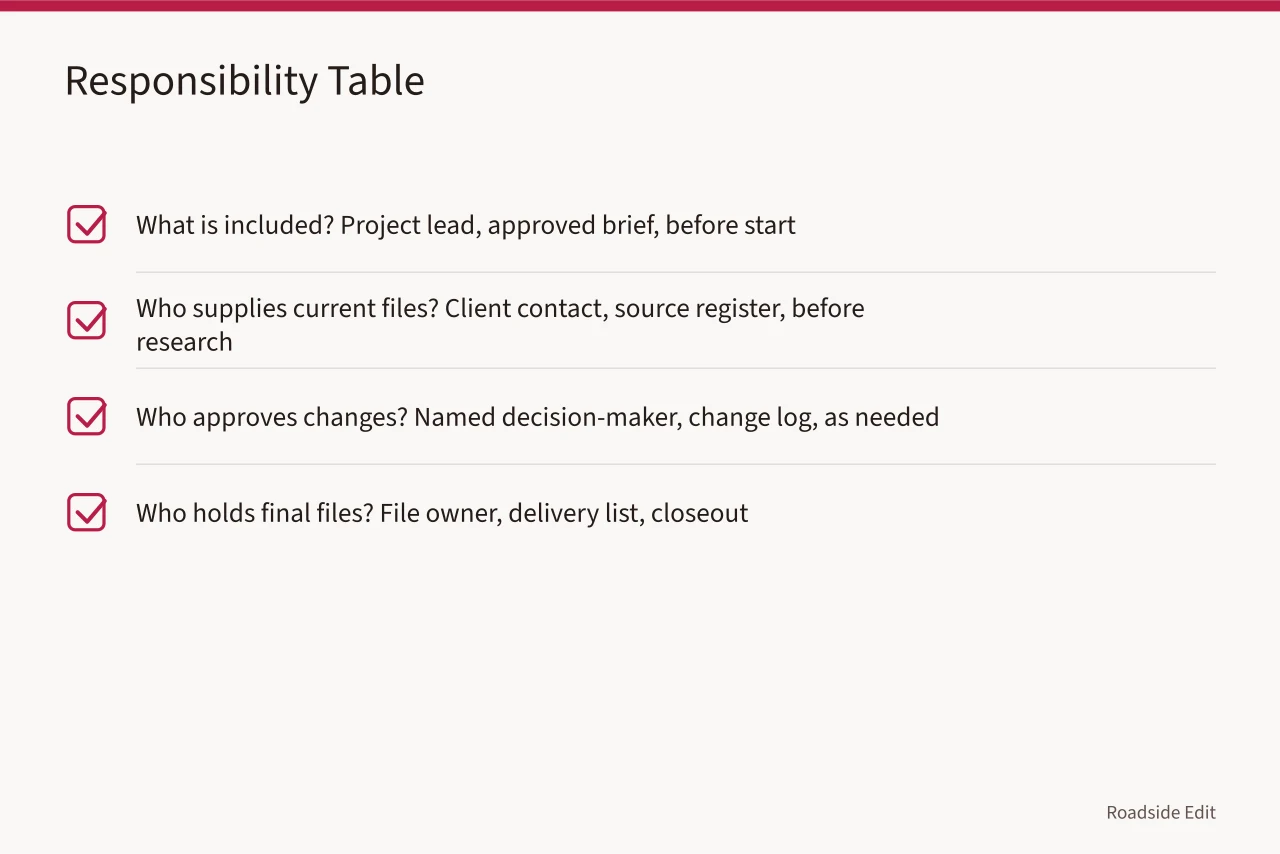
This is a planning aid, not a contract. Its value is that it reveals when an important decision has no owner.
Check the proposal for usable limits
Before accepting a proposal, read the exclusions and assumptions as carefully as the headline deliverables. Check three things: whether the provider identified client input, whether revision rounds have a stated purpose, and whether a scope change has a defined path.
If a proposal says it will "handle everything," ask which activities are included and which need different authority or specialty.
Good limits protect both sides. They let a provider decline work that is outside their role, and they let an owner see what must be arranged separately. They also make later editorial coverage more accurate because the project file can distinguish the provider's stated service from an outcome the record cannot prove.
Keep an honest decision record
The selection note should state candidates considered, the common brief, and information received. It should give reasons for the decision, conditions attached, and open questions.
Avoid unsupported rankings such as "best," "safest," or "guaranteed." Instead describe fit: the selected provider supplied requested deliverables, explained relevant experience, and identified a workable process for changes under the recorded scope.
If a provider appears later in an article, directory, review, or sponsored list, label the relationship accurately. A business profile can report its stated services and a documented engagement. It should not imply independent testing or universal results unless the publication has evidence and explains its method.
Plan the handoff before the first meeting
The final handoff is easy to miss when talk centers on a visual result. Decide early which files you will deliver, how sources are identified, what is editable, what is final, and who keeps the working record.
A useful handoff note can include the approved brief, final deliverables, and source references used by the provider. Add the delivery date, open questions, and the next person responsible for updates.
Ask whether any supplied materials have restrictions on reuse or publication. A project photo, client statement, map, trademark, or paid listing may need a different permission path from the design work itself. Record the answer in the project file instead of assuming that possession of a file permits every future use.
This closeout step also helps an editor. It gives the publication enough context to describe what the engagement covered without filling gaps with promotional language. The reader sees a documented service relationship and a bounded scope, not an unsupported promise about a place or product.
Check authority before treating a question as settled
Some questions belong to the owner, a public agency, a utility, a property manager, or another specialist. A provider can identify a question and explain the material they need. They should not be presented as the final authority on ownership, access, permits, safety, traffic operations, or a site's legal status unless the record establishes that role.
The National Park Service Historic Preservation Program overview describes federal preservation assistance and technical information. It is not a substitute for local review or a private project decision. Its useful reminder is that technical guidance, public authority, and a provider's service are separate things. A clear proposal says which one it offers.
Before a team makes a public statement, use this short test.
- Is the statement about a documented deliverable or about an outcome that depends on another decision?
- Does the project file identify the source, date, and limit of the statement?
- Is the responsible authority named if the claim concerns approval, access, or an official designation?
- Would a reader understand whether the provider's role was research, design, coordination, or construction work?
If an answer is no, reduce the claim to what the record supports or obtain the missing confirmation. This protects the reader as well as the provider.
Use a short, repeatable review sequence
Provider selection is easier when candidates follow a sequence. First, issue a common brief, collect questions and corrections before the final response date, and third, compare scope and evidence on a single sheet.
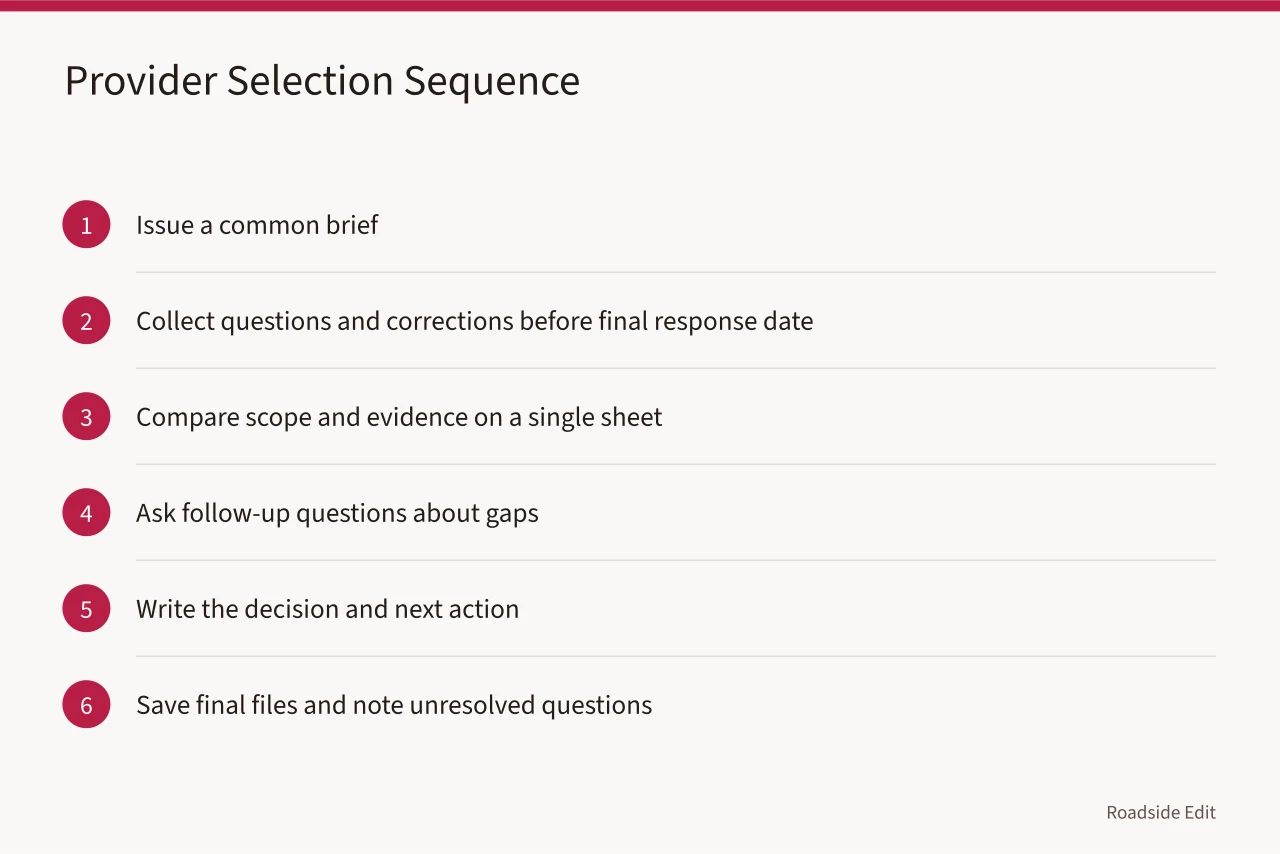
The sequence should be proportionate. A small editorial assignment may need only a brief, two proposals, and a one-page decision note. A larger physical project may need more formal procurement and professional review. What matters is that the amount of process matches the uncertainty and the consequences of a wrong assumption.
Keep marketing separate from selection
Agencies and businesses may later seek inclusion in an article, a review, or a directory. That possibility should not shape the selection record. A paid placement needs a clear disclosure. An editorial mention needs verifiable support. A provider chosen for a limited task should not receive a broad claim of endorsement because of that task.
Maintain two records where necessary. The project folder can contain the private brief, proposal, change notes, and delivery list. A publication folder can contain the approved factual description, source evidence, disclosure language, and image permission or credit. This division helps a future editor correct a public page without altering the history of the work itself.
Common questions
What should I ask before hiring a roadside design provider?
Ask what task the provider will perform, what information they need, which deliverables they will provide, what they exclude, and how changes will be documented.
Can a portfolio prove a provider is right for my site?
No. It can provide context about past work. Fit still depends on the current scope, records, responsibilities, and applicable review process.
Why should scope changes be written down?
A dated change record keeps a new request from being confused with the original agreement and gives both sides a shared record of the decision.