Guides
A Field Guide to Mid-Century Motel Boomerang Signs
Mid-century motel boomerang signs are easy to spot and hard to date. This field guide separates them from starbursts, arrows and amoebas, and shows where to look.
What to take away
- A boomerang sign is a bent, asymmetric shape, thicker on one arm and tapering along the other, built to read as motion from a car at highway speed.
- Most surviving examples went up between roughly 1946 and 1965, and reproductions exist in fresh paint.
- The outline alone dates nothing. Read it with the lettering, the face material and the mounting.
- The densest clusters sit on Sun Belt motel rows and in Route 66 towns.
- Every sign here can be studied from a public sidewalk. Anything past the curb line needs the owner's permission.
The bent outline and its neighbours
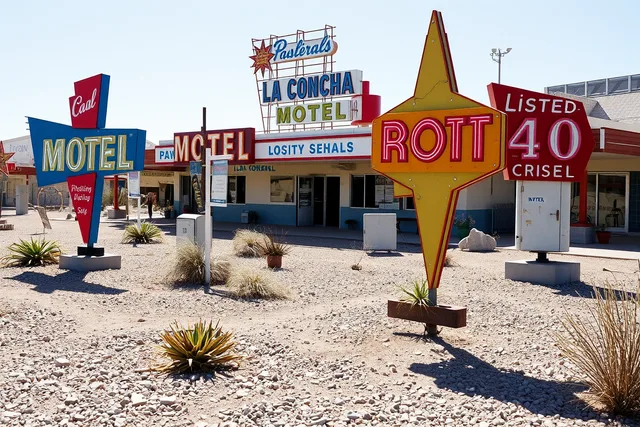
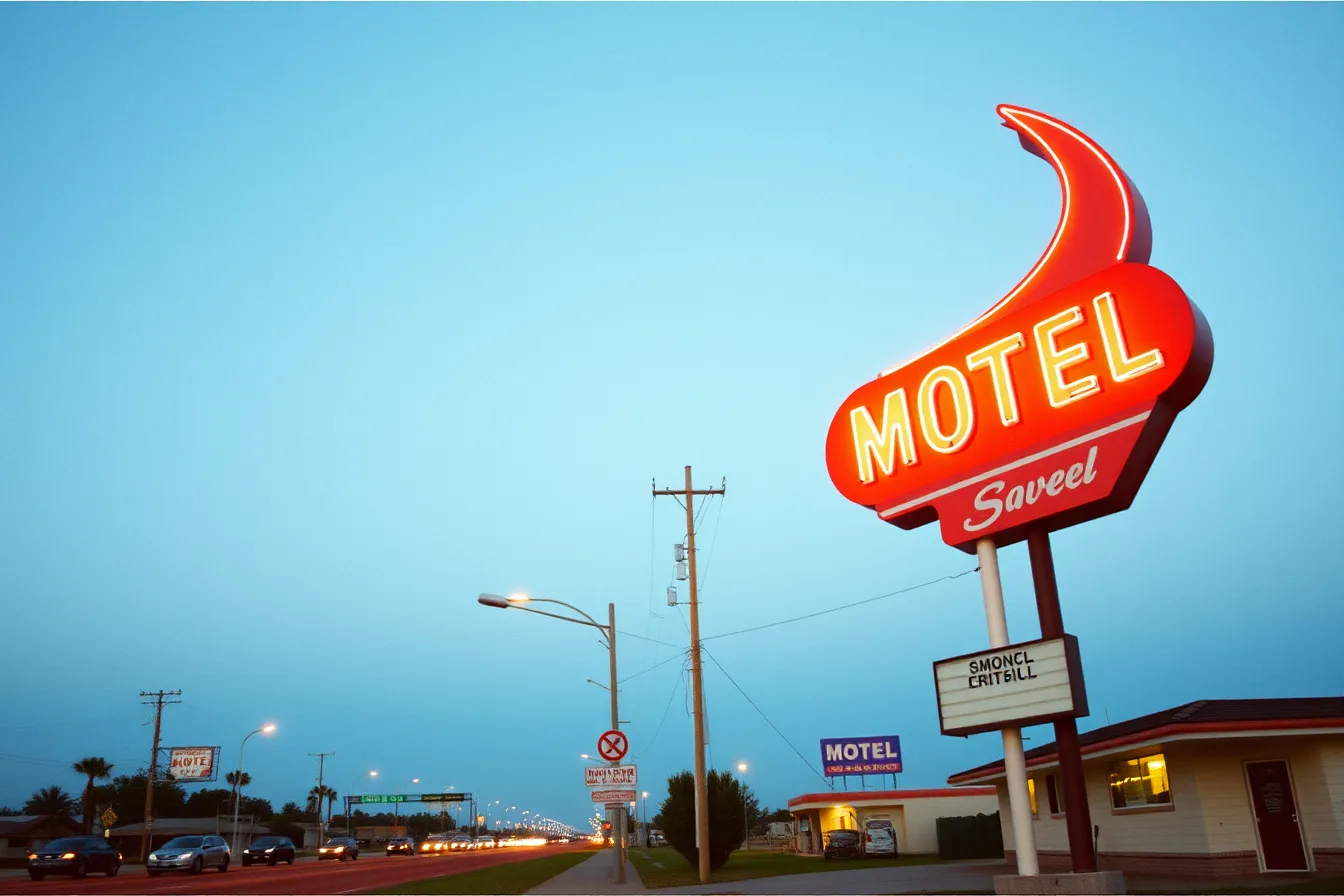
The word boomerang gets attached to any motel sign that refuses to sit still, which is why arguments about identification begin before anyone looks at the pole. A true boomerang form has two arms of unequal length meeting at a soft bend. The angle usually falls between 90 and 120 degrees.
The silhouette is the giveaway, but the face carries information too. Mid-century examples usually hold porcelain enamel or acrylic panels. The motel name sits in script or in a slanted sans serif that leans with the shape. That pairing is now filed under Googie architecture, a style named for a Los Angeles coffee shop that opened in 1949.
Boomerangs share a motel row with other bent forms, and the neighbours cause most mislabelling. A starburst throws spikes from a single center. An arrow keeps a straight shaft and ends in a head that points at the driveway. An amoeba closes on itself with no point anywhere.
All of them belong to one building type, and that type has a history worth reading before you date signs. The American motel was remade after 1945, and its signs grew taller as highways pushed outward from the center of town.
The criteria matrix
The date windows below are illustrative. They come from dated postcards and trade catalogues rather than a formal survey, so treat them as a range to test.
| Feature | Boomerang | Starburst | Arrow | Amoeba |
|---|---|---|---|---|
| Outline | Two unequal arms, soft bend | Spikes from one center | Straight shaft with a head | Closed curve, no points |
| Angle | 90 to 120 degrees | Six or more spikes | None along the shaft | None |
| Face material | Porcelain enamel or acrylic | Enamel or bare neon | Enamel or sheet metal | Enamel or molded plastic |
| Lettering | Script or slanted sans | Name inside the core | Name along the shaft | Name on the curve |
| Mounting | Pole or roof | Pole, often two-faced | Pole, angled to traffic | Pole or wall |
| Illustrative window | 1946 to 1965 | 1955 to 1970 | 1946 to 1962 | 1958 to 1972 |
Work down the rows and stop when a feature matches. The outline row settles most cases before you reach the mounting.
Where each label is the right answer
Reach for boomerang when the two arms differ in length and the bend is soft. A starburst label fits when one point throws spikes in six directions or more. Use arrow only when the form points at a driveway and the shaft runs straight. Amoeba is the right term when the outline closes on itself.
Most confusion lands between boomerang and arrow. A sign with one thick arm and one thin arm looks directional when the thin arm points toward the office. Check whether the end is a point or a taper.
Naming a type is half the job. Help for roadside architecture covers the other half, including which trade handles which task.
What all four types share
No outline dates a sign on its own. Faces get repainted, tubes get replaced, and whole signs get moved between poles. Reproductions of mid-century shapes appeared through the 1980s and 1990s, so a crisp boomerang in fresh paint can be thirty years old.
Hardware outlasts paint and is the better evidence. Look at the pole base, the anchor bolts and the transformer, and photograph each one.
When a face needs work rather than a label, neon sign restoration help is the starting point, because tube fabrication is a trade of its own.
Choosing between close calls in the field
- Shoot the whole sign straight on, then step back for the roofline behind it.
- Photograph the pole base, the anchor bolts and any maker's plate.
- Record the lettering style and whether the face is enamel, acrylic or repainted sheet.
- Compare the result against dated postcards of the same motel.
A sign photographed from the sidewalk is a record. A sign measured from a ladder is a project.
- Full sign, straight on
- Pole base and anchor bolts
- Face material in close up
- Lettering and maker's plate
- The block around it, for context
Keep a roadside renovation photography list on your phone, because the details that date a sign are the ones easiest to forget under a clear sky.
Where the good examples still stand
Route 66 towns hold the best field conditions. Tucumcari in New Mexico, Shamrock in Texas and Kingman in Arizona all keep motel rows with original poles. Sun Belt cities from Phoenix to San Bernardino kept theirs because growth pushed new construction outward instead of over the old strip.
Dry air helps, and so does an economy that never generated enough pressure to tear the row down. Where a historic motel restoration project is already running, the owner usually knows the sign's date and will say so.
National Park Service guidance on historic signs documents how original neon was made and what a compatible replacement looks like, which is the standard a local review board will apply.
Common questions
Is there a single inventor of the boomerang sign? No. The shape spread through trade catalogues in the late 1940s, and dozens of fabricators sold versions of it.
Can I tell an original from a reproduction on sight? Sometimes. Check the pole base, the glass tubes and the paint layers. A newer face on an older pole is the most common mix.
Does Googie mean the same thing as boomerang? No. Googie is the broader style, and boomerang is one shape inside it. A starburst canopy can be Googie with no bent sign anywhere.
Do I need permission to photograph these signs? From a public sidewalk, no. On private property, ask first, and expect a different answer at a working motel than at an abandoned one.