Guides
Neon Sign Restoration: Tube Bending vs. LED Retrofit
Neon tube bending vs LED retrofit comes down to repairability, historic review and how each one ages. A practical comparison for US roadside signs.
What to take away
- Tube bending repairs a gas-discharge system. LED retrofit replaces the light source and usually the face behind it.
- Historic district guidelines and the Secretary of the Interior's Standards generally treat tube work as repair and LED faces as an alteration.
- Diodes win on running cost and cold starts. Glass wins on repairability and how the sign reads up close.
- The hardware you already own decides more than the technology argument does.
What actually differs
Tube bending and LED retrofit are sold as two routes to the same photograph. They are different trades with different failure modes.
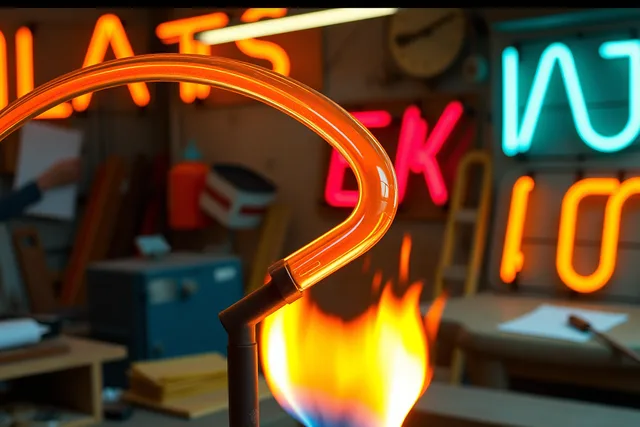
A neon sign ionizes neon, argon or a blend inside sealed glass, driven by a transformer that steps voltage into the thousands. The National Park Service brief on neon covers glass selection, electrode placement and pumping, which is the work a bender actually sells.
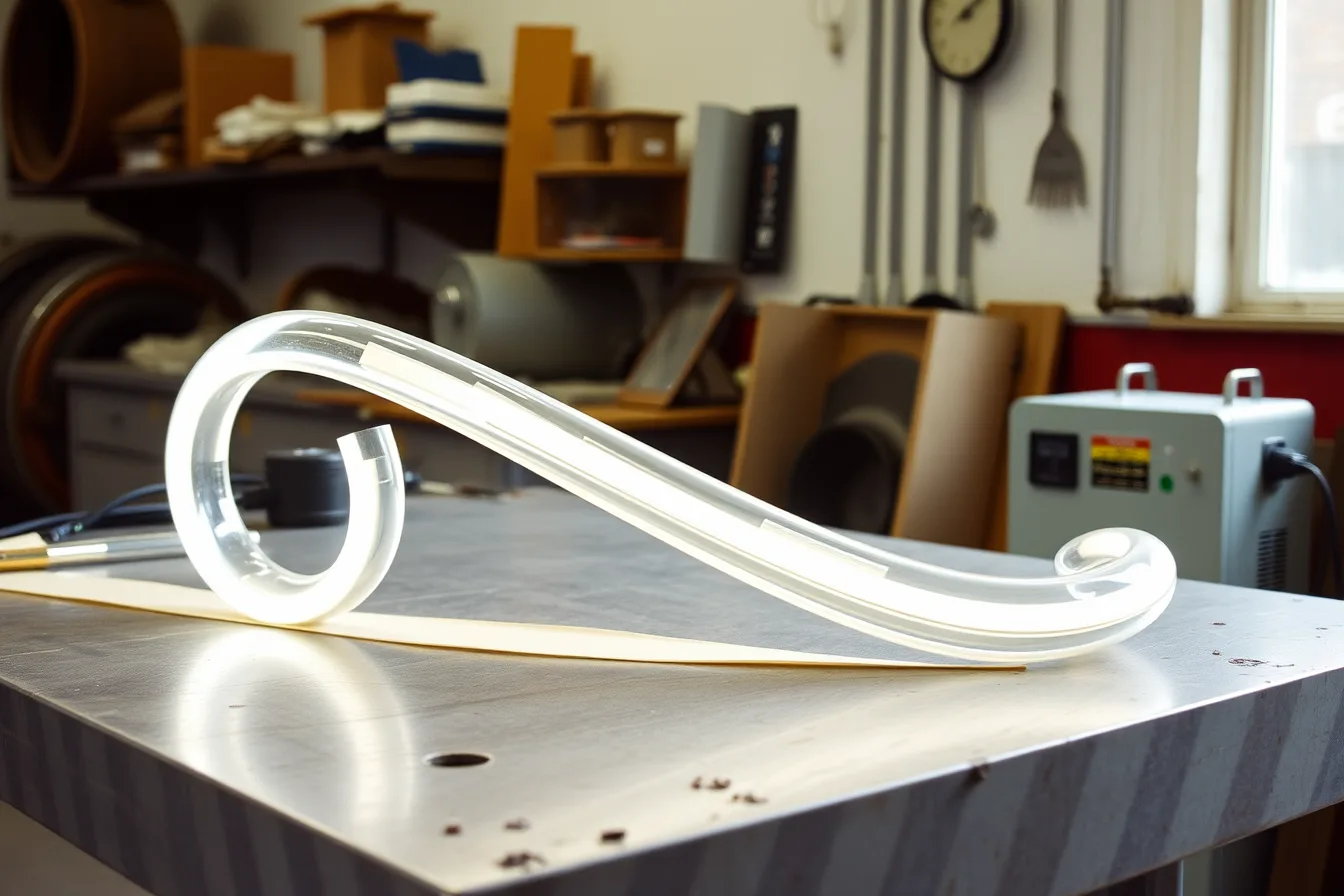
An LED retrofit keeps the outline and swaps glass for diode strip or a flexible rope product sold as neon. From roughly 30 feet (illustrative) the two look alike. At arm's length, seams, coating and a flatter color show.
The criteria matrix
A sign shop and a review board ask different questions. This is where the routes separate.
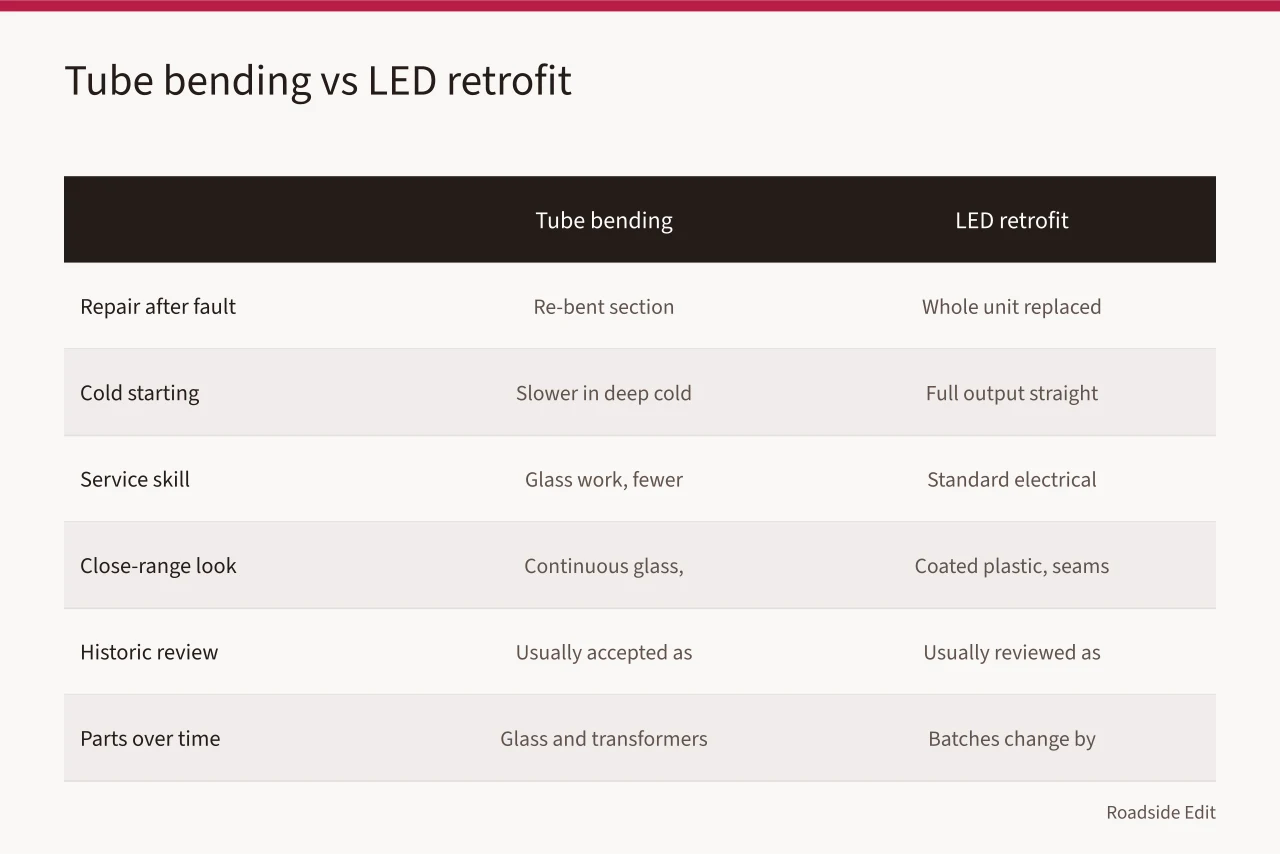
| Criterion | Tube bending | LED retrofit |
|---|---|---|
| Repair after a fault | Failed section re-bent and re-installed | Sealed unit often replaced whole |
| Cold starting | Slower in deep cold without the right transformer | Full output straight away |
| Service skill | Glass work, fewer shops | Standard electrical work |
| Close-range look | Continuous glass, visible electrodes | Coated plastic, visible seams |
| Historic review | Usually accepted as repair | Usually reviewed as alteration |
| Parts over time | Glass and transformers still produced | Batches change between generations |
Review boards lean on one principle: keep original material, and use a compatible substitute only when nothing original survives. The National Park Service guidance on historic signs sets that out for signs specifically.
Where tube bending is the right answer
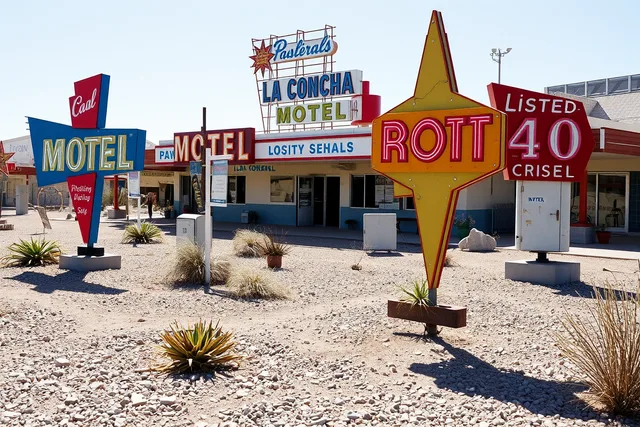
A contributing building in a local historic district is the clearest case. If channel letters, transformers or some glass survive, bending counts as repair. Review bodies expect repair. A blade sign read at walking pace, like one over a motel office, favors glass.
Neon Sign Restoration Help explains how to check a shop for glass and pumping capability before you commit.
Where LED retrofit is the right answer
Original hardware is gone, or the sign is a later addition. A pole sign read only from a highway lane is another candidate.
Where there is no safe access for tube service, a light source with a long rated interval matters more than glass. A saturated color matters if tube gases cannot hit it without custom mixing. Reversibility counts: historic review favors a change that can be undone.
Example: a blade sign on a 1958 motel
An owner has a projecting blade with the channel intact, two dead transformers and most of the tube broken. Dating the sign against postcards and tax photographs puts it in the original build, so it counts as contributing. Historic Motel Postcards sets out that work.
Bending new tube and replacing the transformers restores the sign as built. A retrofit needs a new face, loses channel detail and invites a review argument.
What both options share
Neither route fixes a dead circuit, a failing bracket or a wall that will not hold weight. Both need a licensed electrician in most states, and both meet the same listing requirements for electric signs. Those requirements sit outside the glass-or-diode choice.
Neither restores legibility if the letterforms were wrong to begin with. Neither rescues a sign at the wrong scale for its building. Gas Station Canopy Restoration shows how surviving original material settles the same argument on a different roadside structure.
The sign is only as good as the bracket, the circuit and the wall behind it.
How to choose between the close calls
- Photograph the sign in daylight and after dark, keeping tube, channel and bracket in frame.
- Date the sign from postcards, tax photographs or old newspaper adverts before you ask for a quote.
- Ask the local historic district office whether the sign counts as contributing.
- Get one quote for tube and transformer repair and one for a complete face replacement.
- Check the transformer enclosure, wiring and service access against current code.
Close calls usually come down to age and access. If the sign predates the building's last remodel and a lift or roof can reach it, repair is the better bet. If it is a 1990s addition on a pole, the case for diodes is strong.
Record the sign before anyone touches it. Roadside Renovation Photography covers what to capture and why the order matters.
Common questions
Can an LED retrofit pass historic review? Sometimes. Guidelines usually treat a new face as an alteration, so approval depends on how visible the change is and how easily it can be reversed.
Do US shops still bend neon tube? Yes, though the trade is concentrated in fewer shops than it was in the 1950s. Ask specifically about glass, pumping and transformer work.
Which option lasts longer? Diode products are rated in the tens of thousands of hours by their makers. Neon tube life depends on the transformer, the duty cycle and how well the tube was pumped.
Is LED cheaper to run? Diode strip draws less power per foot for the same outline in most retrofits. The size of the saving depends on the sign, its hours and your electric rate.