Guides
How roadside building regional adaptation shapes a source map
Roadside building regional guide for 2027 helps U.S. readers organize place-specific sources, project context, climate records, and updates without design advice.
Roadside building regional guide for 2027 helps a publisher describe local context. It rejects one response for every building in a state, county, or climate zone.
A roadside diner in one town, a motel in another, and a former service station on a nearby alignment may share a broad regional story. They may face different site conditions, ownership, uses, public rules, and project records.
The useful editorial job is to organize evidence. A page can identify the location, the source of a historic claim, a public planning document, an official hazard or climate resource, and the date each source was checked. It should not prescribe an adaptation measure, predict future damage, or claim that a building is prepared for a regional condition.
What to take away
- Region is context, not a substitute for property-specific evidence.
- State the location and source date beside a regional claim.
- Keep weather, hazard, preservation, use, and public-access records separate.
- Avoid turning general planning guidance into a design recommendation.
- Update local pages when their responsible sources change.
What regional context can do
Regional context helps readers understand why a published source may discuss water, heat, wind, snow, sunlight, fire, storms, changing use patterns, or visitor access. It can also help a site group related places without claiming they are physically identical.
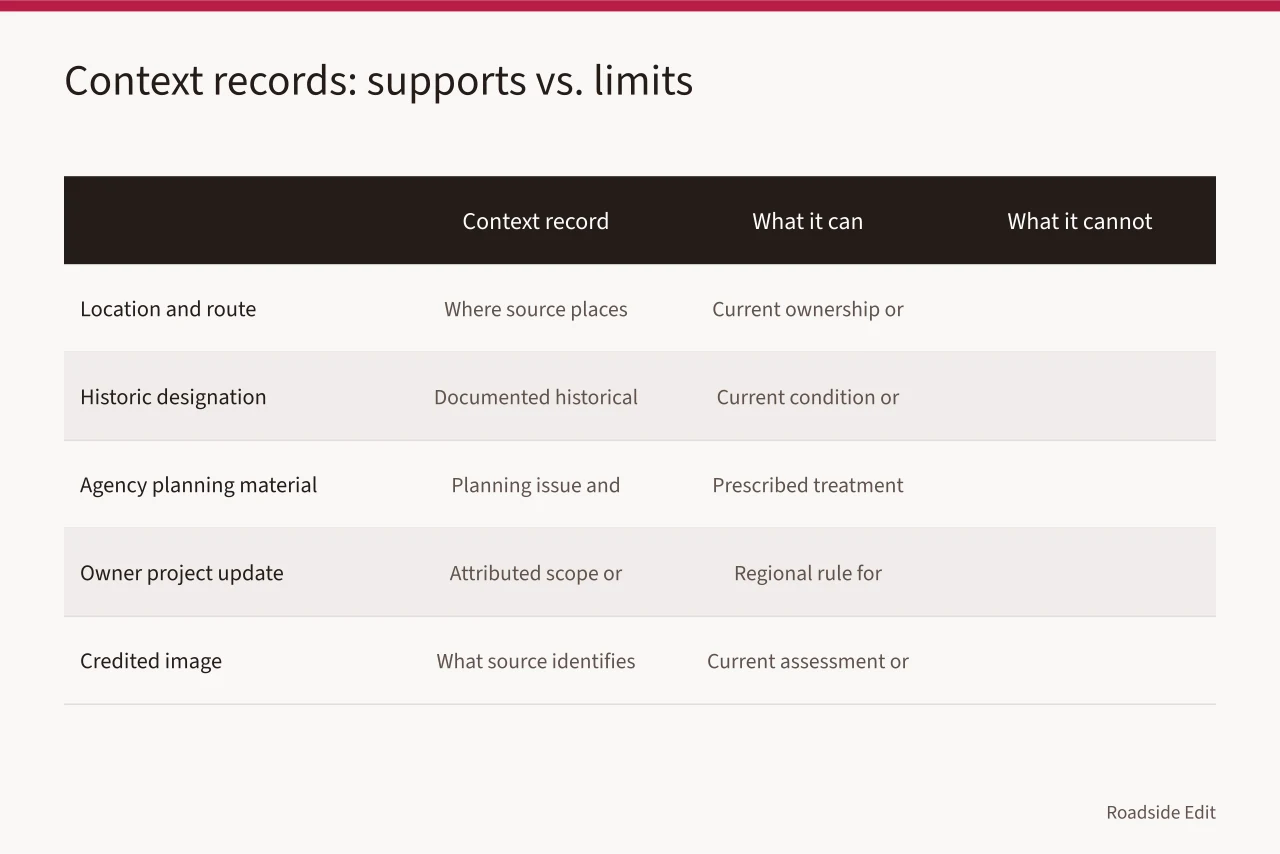
| Context record | What it can support | What it cannot prove |
|---|---|---|
| Location and route | Where the source places the property | Current ownership or public access |
| Historic designation or report | The documented historical context | Current condition or project status |
| Agency planning material | The planning issue and source date | A prescribed treatment for a property |
| Owner project update | An attributed scope or status | A regional rule for other buildings |
| Credited image | What the source identifies at the documented time | A current assessment or permission to enter |
The table is a useful guardrail. A regional page can be rich in detail without using the word "should" to tell an owner how to change a property. The moment a page moves from documented context to specific work, it needs the appropriate project authority and qualified expertise.
Start with place, not a label
Labels such as desert, coastal, mountain, prairie, urban, or rural can be useful shortcuts. They can also hide important differences. A building's block, drainage pattern, occupancy, materials, setting, local rules, history, and condition are not determined by the label alone.
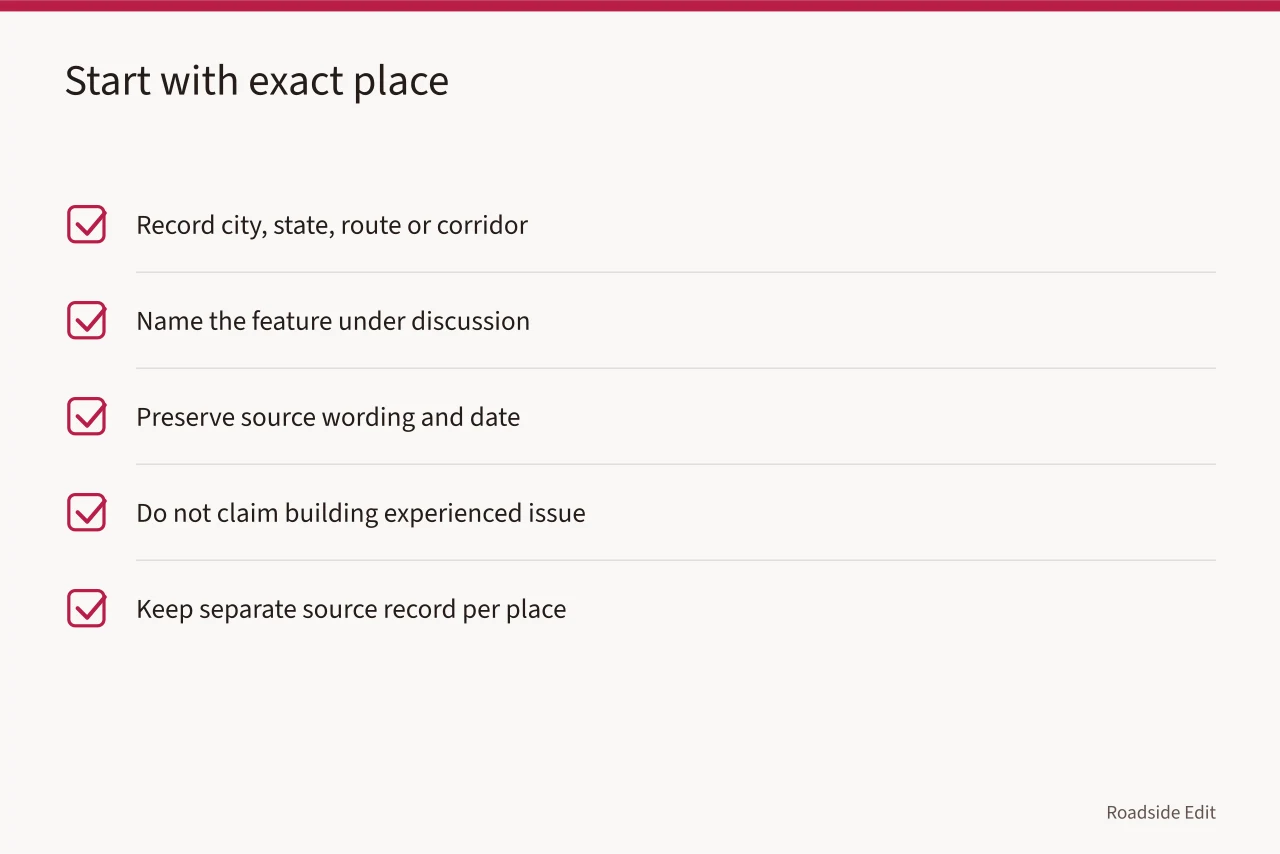
Start the editorial file with the exact place the source names. Record the city, state, historic route or corridor where relevant, and the feature under discussion. Note what the source says about regional context, and if a public source mentions a floodplain, heat, a storm, or changing precipitation, preserve that wording and date.
Do not expand it into a claim that a specific building has experienced the issue unless the source says so.
This approach also prevents accidental duplication across the network. A regional page for one property should not be copied to another place simply because both share a state or highway. Each article needs its own source record and its own reason for inclusion.
Separate general guidance from a project decision
The National Park Service's Cultural Resources Adaptation page explains that historic buildings and other cultural resources are tied to their specific locations and experience conditions differently. Read NPS Cultural Resources Adaptation guidance. The page supports a source-based editorial approach: place matters, and cultural resources are individually unique. It does not tell RoadsideEdit which action any property owner should take.
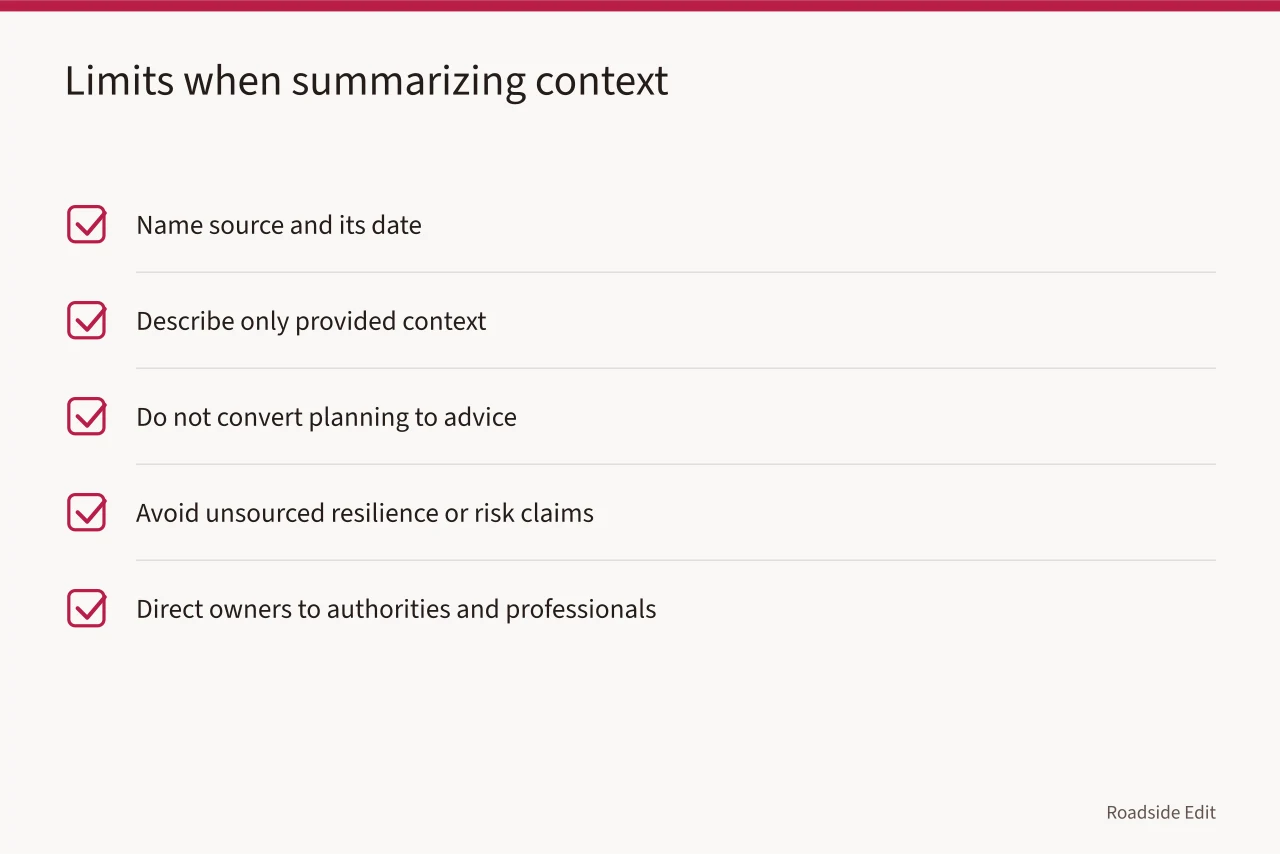
When an article summarizes regional context, use these limits:
- Name the source and its date.
- Describe only the context the source provides.
- Do not convert a planning framework into property advice.
- Do not describe a place as resilient, safe, prepared, or at risk without a source that makes that specific finding.
- Direct owners seeking a project decision to responsible authorities and qualified professionals.
The limits make the guide more durable. A general page can link a reader to a responsible agency resource while leaving the building-level decision where it belongs.
The Department of Energy climate-specific guidance map groups U.S. locations for building-energy guidance. It is not a property assessment. In a regional article, it can support a broad location context but not a conclusion that a specific roadside building needs a particular response.
Build a regional source map
A source map is a small table or database view that shows what each record can answer. It is not a map of recommendations. For each location, retain the source, source type, date, scope, and update trigger.
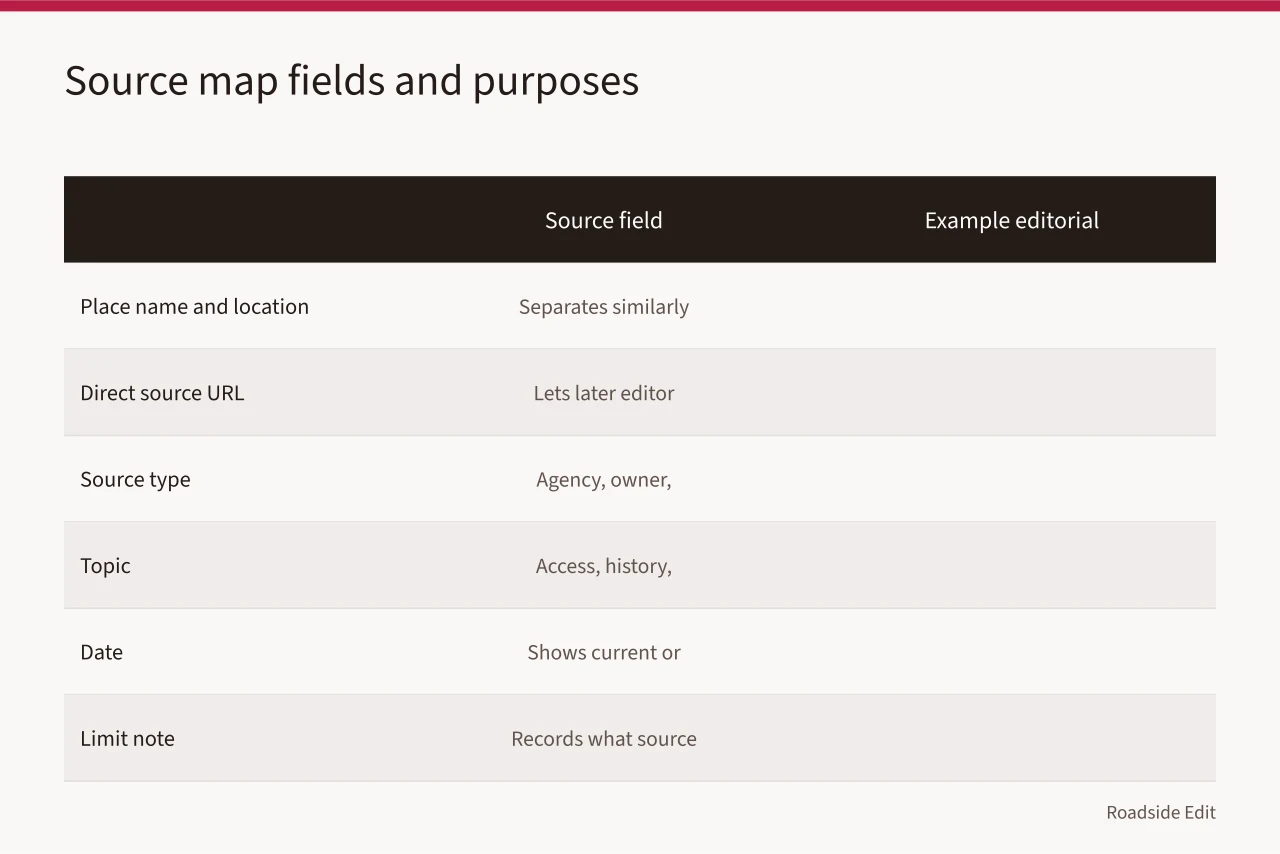
| Source field | Example editorial purpose |
|---|---|
| Place name and location | Keeps a property separate from similarly named sites |
| Direct source URL | Lets a later editor verify the original context |
| Source type | Agency report, owner update, historic record, or provider submission |
| Topic | Access, historic context, planning, current use, or image credit |
| Date | Shows whether the information is current or historical |
| Limit note | Records what the source does not establish |
| Review trigger | Identifies when an alert, project, or provider update needs checking |
For example, an agency planning page may give broad regional context. The related property page may only use it to explain why location should be considered. If an owner announces a particular project, keep that announcement separate. The agency page does not confirm completion, and the owner update does not establish a rule for other locations.
Compare places carefully
Comparison is tempting in regional coverage. Two roadside buildings may have similar age, style, or use. They may still have different materials, settings, project histories, legal jurisdictions, and documentary records. A comparison is only useful when it tells readers what the records actually share and where they diverge.
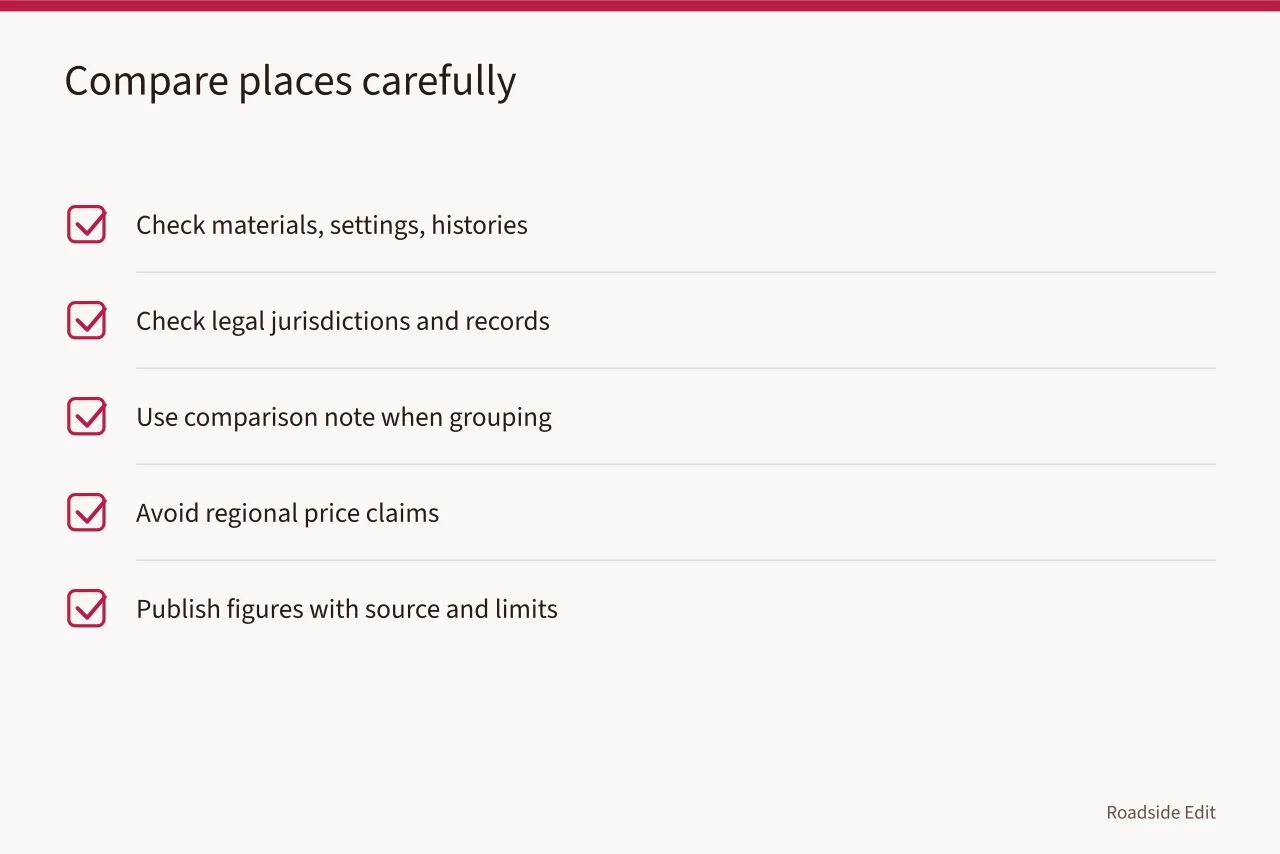
Use a comparison note when necessary: "These places are grouped for regional context. Their documented condition, access, and project history should be read separately." The note stops a reader from treating a nearby example as a prediction or recommendation for another property.
Avoid regional price claims. A public grant, provider quote, or project budget has a scope, date, and status. It cannot establish what every roadside building in the region costs to maintain, adapt, or restore. Publish the documented figure only with its source and limits.
Handle hazards and weather with restraint
General resources may discuss changes in weather patterns or natural hazards. They can be useful links for readers who want to understand a region. They are not evidence that a particular building has been damaged, needs work, or meets a safety standard.
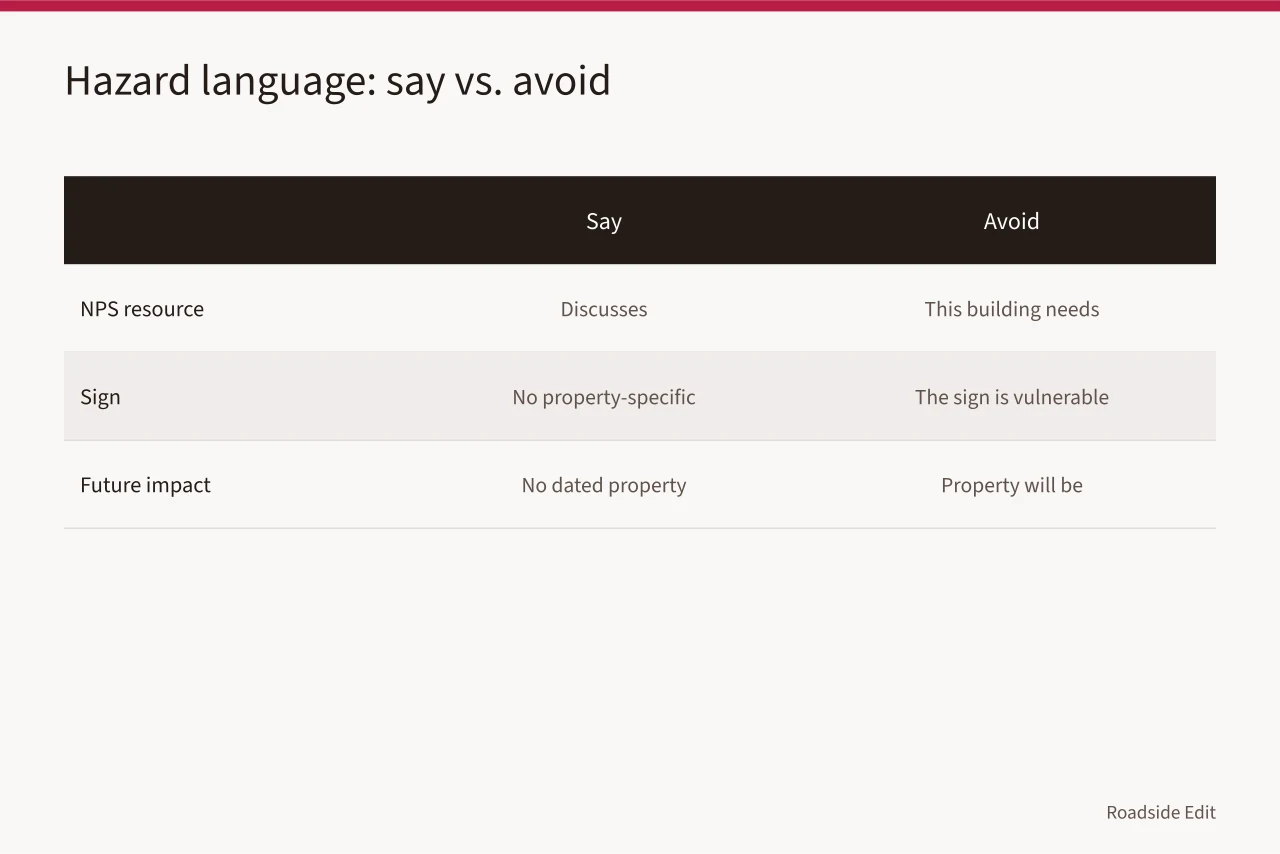
Articles may say: "The NPS resource discusses cultural-resource adaptation in the context of location-specific conditions."
They should not say "This building needs flood adaptation," "The sign is vulnerable," or "The property will be affected next year" without a suitable property-specific source.
This restraint is important for readers, businesses, and owners. A confident but unsupported warning can discourage visits, harm a business, or misrepresent a property. A dated, sourced context statement gives readers a better place to begin their own research.
Prepare regional business listings responsibly
Businesses may want to appear in a regional guide. The site can list a provider when the record clearly states the submitted service, geographic coverage, contact information, and any paid-placement disclosure. The listing should not claim that the provider has worked on a specific building, knows its condition, or endorses a treatment unless the evidence supports that statement.
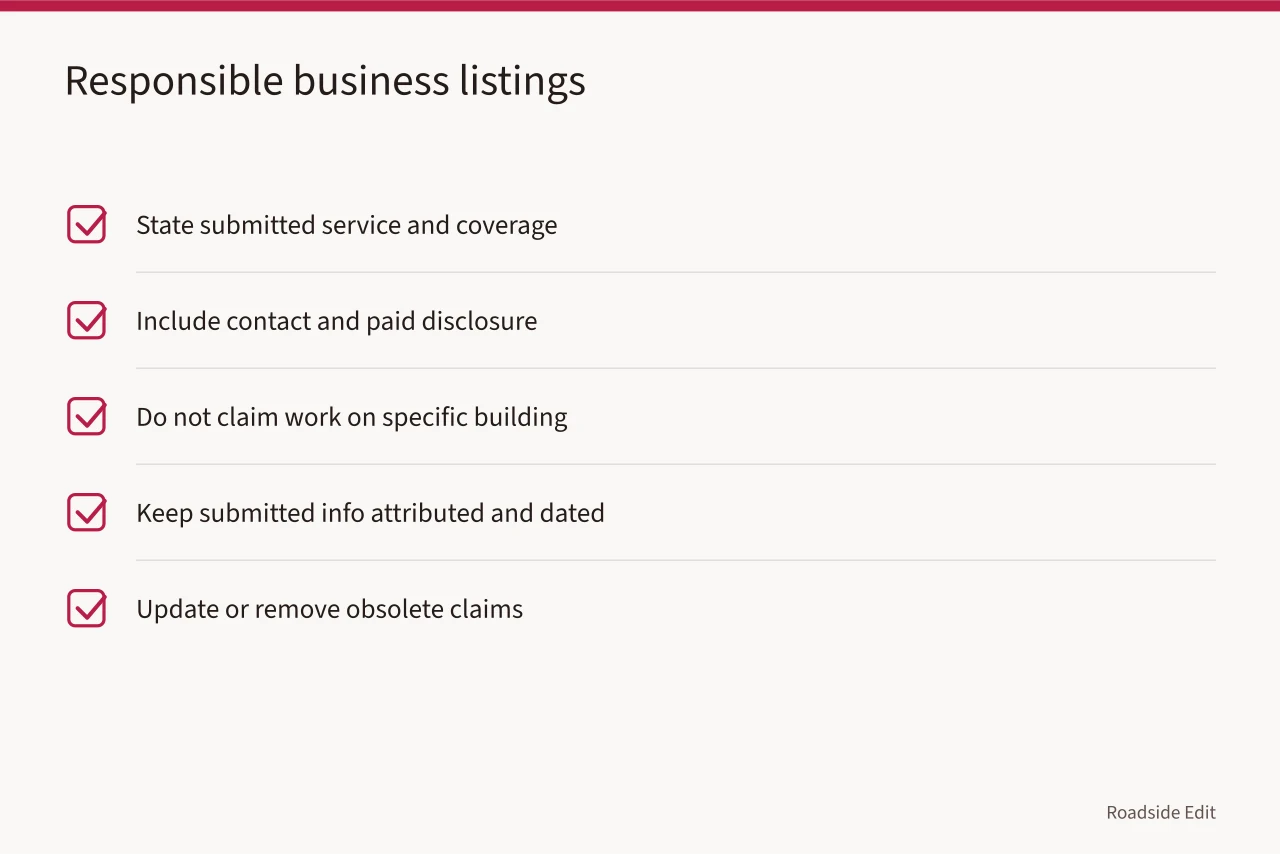
Keep submitted information in an attributed field. Preserve the submission date and scope. If a provider changes its coverage area or asks for removal, update the article and its associated record. Do not leave obsolete regional claims in a page because they once fit the category.
Review the guide when sources change
Regional pages need scheduled review because the sources that make them useful can change. Review after a public agency update, a local official notice, a project announcement, a provider revision, or an image-removal request.
| Review event | Editorial action |
|---|---|
| Agency page changes | Verify whether the regional context sentence needs revision |
| Property source changes | Update only the affected place record |
| Provider changes coverage | Revise or remove its attributed listing |
| Image credit changes | Replace or remove the image and related caption |
| Source becomes unavailable | Remove the unsupported claim or find a current specific record |
Every change should be dated in the editorial file. That history helps another editor distinguish a removed source from a missing source and a historical context statement from current information.
The National Archives agency recordkeeping requirements say related records should be kept together when their relationship provides context. The policy applies to federal agencies. It is also a useful discipline for regional pages because it keeps an agency source, a local update, and a later correction from being blended into one claim.
Commercial additions require a separate label. The Federal Trade Commission's endorsement guidance addresses disclosures where a material connection could affect how readers evaluate an endorsement. Keep a paid provider statement near its disclosure and away from independent regional reporting.
Source image
The Library of Congress catalog identifies this photograph as the Lux Theatre, a 1937 movie house in Grants, New Mexico, along historic U.S. Route 66.
Common questions
Can a regional guide recommend a treatment for a roadside building?
No. It can describe sourced context and direct readers to responsible authorities and qualified professionals for property-specific decisions.
Does a regional hazard resource prove that a building has a problem?
No. It provides broader context. A property claim needs a suitable source about that property.
Can nearby buildings share one article record?
Not when the page makes property-specific claims. Keep source, status, and scope records separate.
What should happen when a regional source is outdated?
Keep it as dated history only, revise the page with a current source, or remove the claim.
In this guide
- How a roadside building regional checklist keeps location and claims honestRoadside building regional checklist for 2027 helps U.S. editors verify location, regional sources, seasonal context, image credit, and property-claim limits.
- Roadside building regional comparison questions before you weigh local recordsRoadside building regional questions for 2027 help U.S. editors compare location, source scope, project stage, and local planning context without property advice.
- How to keep roadside building records with regional source scopeRegional records for roadside buildings pair a dated source with the exact claim it supports, so a 2027 article never turns a map into a fact.