Guides
Roadside renovation maintenance plan: how to scope a care checklist
Roadside renovation care checklist for 2027: log observations, set inspection boundaries, preserve records, and know when routine care needs a professional handoff.
Routine care is not renovation. A care plan notices changes, keeps a clear record, finishes limited recurring tasks, and passes problems to someone qualified to decide what comes next.
A roadside renovation maintenance plan usually fails on small things nobody wrote down. The U-Drop Inn and Tower Station in Shamrock, Texas, is a 1936 Route 66 gas station and cafe. Soulsby Service Station in Mount Olive, Illinois, dates to 1926 and sold Shell gasoline.
Both are listed on the National Register of Historic Places. On either property, later work has to answer to dated documents rather than memory.
A useful care checklist avoids two extremes. It never ignores a new problem. It never asks a volunteer, tenant, or editor to diagnose one.
What to take away
- Start with a dated baseline so later observations have something to compare against.
- Give every inspection a boundary, a responsible person, and an action after the check.
- Keep observations separate from conclusions about cause, safety, or required treatment.
- Maintain records of work, materials, and decisions so a later team can understand what changed.
- Name each property the way a reviewer will search for it: historic name, street address, and route number such as Route 66 or US 40.
Build a baseline before scheduling routine care
Take authorized photographs from repeatable locations. Stand in the same spot each time. Identify the view, the date, and the person who made the record.
The fixed views depend on the property. At Wigwam Village Motel No. 6 in Holbrook, Arizona, one view can frame the concrete teepee cabins built in 1950. At the Big Duck in Flanders, New York, a duck-shaped market from 1931, the baseline might begin at the north sidewalk.
Make a plain inventory of visible components: roof edges, drainage paths, walls, openings, and signs. Foundations and attached equipment belong on it too. Mid-century roadside properties usually add a pole sign, a canopy, and a separate restroom wing. Describe what is present without declaring a feature original, safe, or structurally sound unless a reliable record says so.
The National Park Service says its exterior-maintenance guidance supports regular inspections, monitoring, seasonal work, and written records of completed work. Read NPS Preservation Brief 47.
It focuses on historic buildings and does not give a site-specific work order for every roadside property. Its central point still applies: recurring care is easier to manage when the observation and the completed task are both recorded.
| Baseline item | What the file should show |
|---|---|
| Overall photographs | Location, direction, date, and any access limit |
| Close observations | The visible condition without guessing at its cause |
| Existing records | Source, date, and whether the record applies to the feature |
| Care contacts | Who observes, who receives a report, and who can authorize work |
| Current boundaries | Areas that should not be entered, touched, or photographed without permission |
| Sign and canopy | Viewing distance, visible lamp or neon status, and mounting condition seen without touching the fixture |
| Property identity | Historic name, street address, route number, and any National Register listing |
Match the check to a real condition
Do not make every inspection identical. A roof edge after heavy weather may need a different observation than a sign face, drainage area, or exterior wall. A hailstorm over a canopy calls for a storm-date entry that a quarterly walk does not.
Set a routine review date, then add event-driven checks for a documented report, storm, impact, access change, or visible new condition. The checklist should say what to look at, not what conclusion to reach.
The Society for Commercial Archeology, founded in 1977, has documented diners, motor courts, and signs for decades. Its journal helps a team decide which features carry a property's character.
Moisture shows why the observation must be specific. The National Park Service guidance on unwanted moisture covers roofs, gutters, walls, openings, and ground drainage. It also calls for regular overall building inspection. Review NPS Preservation Brief 39.
That does not mean every stain has the same cause. Record its location, size, date, and recent conditions, then use the designated handoff if the condition needs evaluation.
A pin-type meter from Delmhorst or a Tramex Moisture Encounter turns a damp patch into a number an observer can log. Neither instrument names the cause.
| Check type | Record this | Do not write this |
|---|---|---|
| Routine exterior view | "No visible change from the March reference image" | "Building is in perfect condition" |
| New mark or crack | Location, image, date, and whether access was limited | "Structural failure" without an assessment |
| Drainage observation | Water path, weather context, and repeat observation date | "The drainage system failed" without evidence |
| Storm check | Storm date, wind or hail direction, visible debris, and one repeat visit date | "The sign held up fine" |
| Completed task | Scope, date, responsible party, and source document | "Maintenance handled" |
Set clear handoff triggers
The checklist should tell an observer what to do next when routine care no longer fits the question. A restricted area, a sudden change, a safety concern, water entering an occupied space, or a damaged utility connection calls for the responsible contact, not an improvised repair.
A condition that cannot be observed safely does too. Follow property rules and local emergency procedures first.
The right contact often sits outside the property. On a listed building, that may be the state historic preservation office, a preservation architect, or a structural engineer. The Secretary of the Interior's Standards for Rehabilitation apply when a project uses federal money or a rehabilitation tax credit, so an exterior repair that looks routine can still need review.
For a historic resource, baseline assessment particularly helps. The National Park Service's stone-building management guidance calls a condition assessment a document of current condition. It identifies issues in building assemblies and materials. It informs maintenance, conservation, improvements, or new uses See the NPS condition-assessment guidance.
A checklist does not substitute for that assessment, but it can preserve observations and records that make a later assessment easier to understand. If a property will sit empty for years, NPS Preservation Brief 31 covers mothballing it.
Use a direct handoff note: "On [date], [observer] recorded [visible condition] at [location]. The item was referred to [responsible contact]. No cause or repair method is stated in this record." That sentence leaves room for qualified review and prevents an article from converting an observation into a diagnosis.
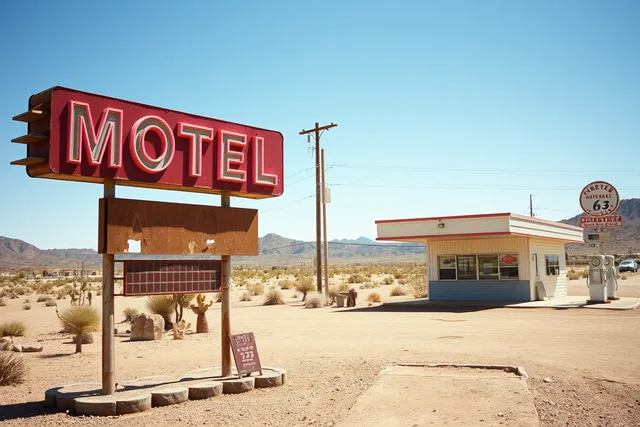
The photograph is historical context only. It does not establish the condition, care history, ownership, or repair needs of a property in a current maintenance record. A 2015 image of the neon at the Blue Swallow Motel in Tucumcari, New Mexico, says nothing about the transformer today.
Keep a project file that survives staff changes
The most useful maintenance record is not a folder full of unlabeled images. It groups each observation, source document, decision, and work authorization by the feature or event it concerns. Invoices and completion notes go into the same file. A file name or identifier should let the next reader trace a published statement to the underlying record.
Phone photos carry a capture date in their EXIF data. The free Tropy app from the Roy Rosenzweig Center for History and New Media at George Mason University reads it, and ExifTool by Phil Harvey does the same from a command line.
National Archives guidance says complete, accurate records preserve context when documents about one project, study, transaction, or subject stay together. Read NARA's recordkeeping requirements
These rules bind federal agencies, not every private site. They still give any editorial project a useful discipline: keep supporting material with the claim it supports, and preserve dates and source details instead of memory.
Use a short closing record after each inspection:
- State what area was observed and under what access conditions.
- Attach or identify the dated images and records reviewed.
- Name the visible change, if any, without assigning a cause, such as rust on a canopy edge or a missing letter on a pole sign.
- Mark the action as no follow-up, routine task, referred review, or emergency procedure.
- Set the next review date and identify who owns it.
Publish care information without overstating it
Public project updates should use the same limits as the private file. "A dated observation was referred for review" is often more accurate than "the issue is being fixed." Do not publish a treatment, cost, completion date, or safety conclusion unless a current source supports it.
Care records should also make corrections easy. If a later inspection changes the understanding of a visible condition, update the statement and retain the record date. That is normal maintenance of an article, not evidence that the earlier observation was careless.
Planning ranges, not quotes: as of 2026, a small sign repair typically costs a few hundred to a few thousand dollars in most markets. A full pole sign restoration often starts near $15,000.
A condition assessment for one roadside building typically falls between $5,000 and $25,000. Feature count and documentation depth drive the number.
Common questions
Does a care checklist replace a professional condition assessment?
No. It helps a team organize routine observations and handoffs. A condition assessment or other qualified review addresses questions that routine observation cannot settle.
Should every visible change receive the same response?
No. The response depends on the location, access conditions, available record, and property procedures. The checklist should preserve facts and direct the observer to the correct contact.
How long should maintenance records be kept?
Keep them according to the owner's, program's, insurer's, or legal requirements. At a minimum, retain the dates and sources needed to support any public claim about care or completed work.
Can a preservation grant pay for routine care?
Rarely. The National Park Service's Route 66 Corridor Preservation Program, authorized by Congress in 1999, awarded cost-share grants for preservation work on eligible Route 66 properties, and matching funds were required. Inspections and cleaning usually did not qualify. A state historic preservation office can say what does.
What tools keep a care file usable?
A dated folder per feature, a spreadsheet with one row per observation, phone photos with EXIF dates, Tropy or ExifTool to read those dates, and a moisture meter for readings logged as numbers.