Costs
Part of How to plan a roadside renovation that adapts to each region
How to compare regional roadside renovation budget notes before you publish
Roadside renovation regional budget notes for 2027 help compare local evidence, source dates, climate questions, and labor data without claiming a local price.
Regional context can make a roadside-renovation budget more honest, but it cannot manufacture a local price. An article may have useful information about weather, access, labor, season, or public risk data. That information creates questions for a project record. It does not replace a defined local scope, current source, or responsible review.
This guide shows how to track regional inputs without overstating them. It is not a price guide, hazard assessment, or permit determination. The aim is to help readers distinguish a national or regional data point from a property-specific estimate.
What to take away
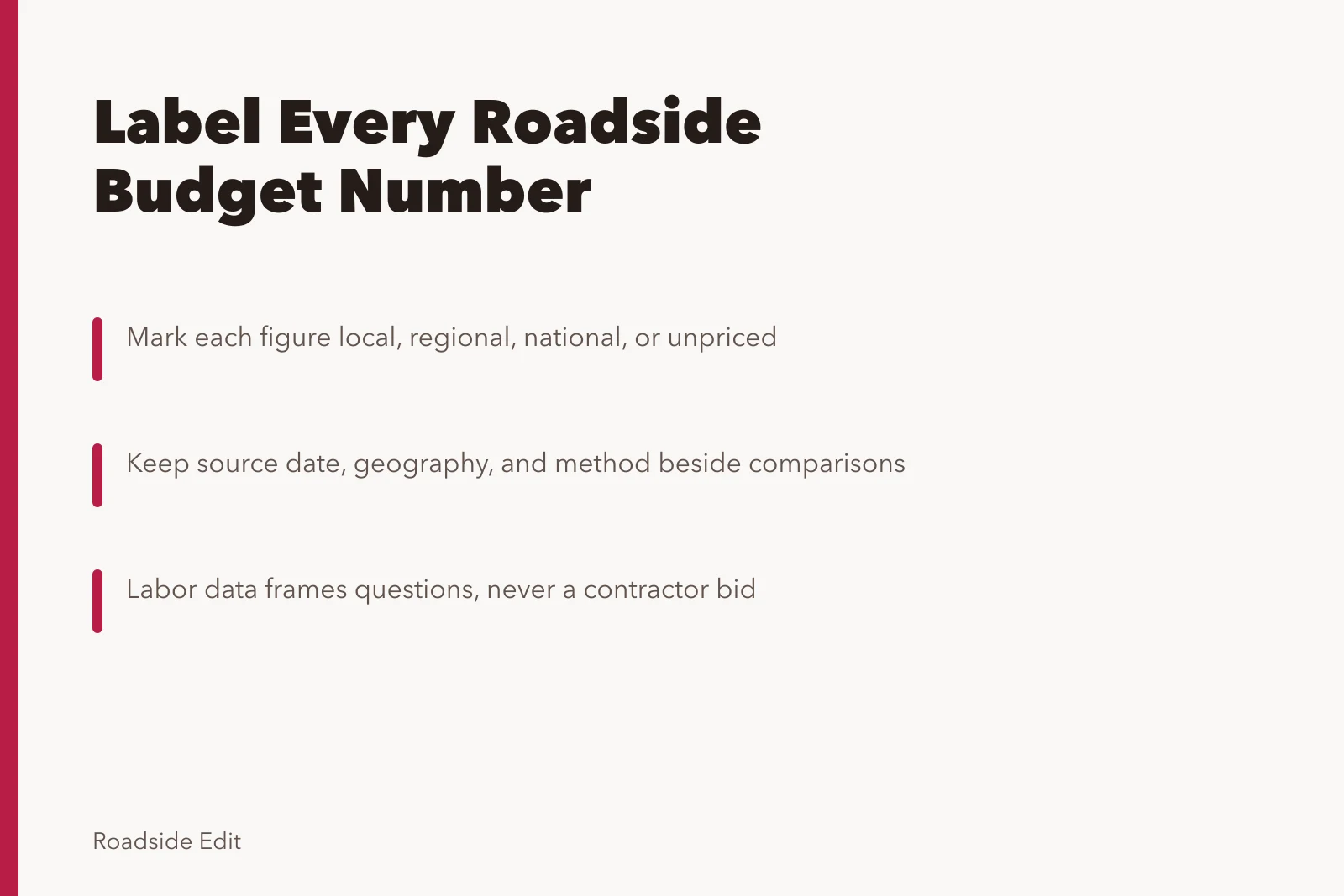
- Mark whether each figure is local, regional, national, or still unpriced.
- Use regional data to frame a question, not to declare a site condition.
- Preserve the data date, geography, and method beside every comparison.
- Do not convert broad labor or risk information into a contractor quote.
Give every number a geography label
Two estimates can appear comparable while describing different places. One could be a local proposal issued last week. Another could be a regional benchmark published last year. A third could be a national data series. The budget note needs to make those differences visible before anyone draws a conclusion.
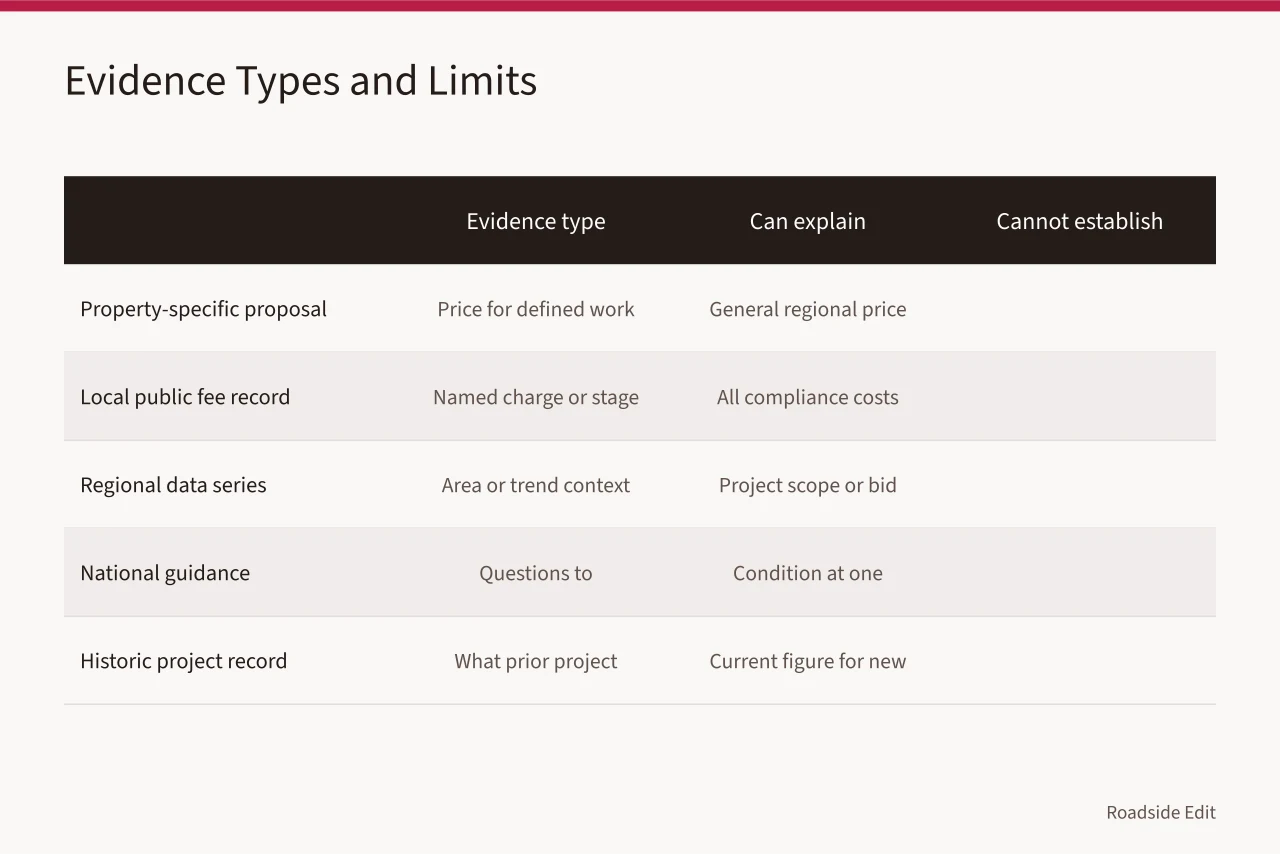
| Evidence type | What it can help explain | What it cannot establish |
|---|---|---|
| Property-specific proposal | Price for the defined work and date | A general price for a region |
| Local public fee record | Named charge or application stage | All project compliance costs |
| Regional data series | Context about an area or trend | A project scope or bid |
| National guidance | Questions to investigate | A condition at one property |
| Historic project record | What a prior project recorded | A current figure for new work |
Start notes with a location card: city or county, source geography, data date, project stage, and a sentence on whether the figure is directly usable or only context.
The card can say, "Regional data are included as context; this article has no current proposal for the property." That sentence prevents readers from treating a broad comparison as a local forecast.
The U.S. Climate Resilience Toolkit's planning and land-use page explains that planning and land-use decisions can incorporate hazard mitigation and climate vulnerability considerations. It does not price renovation work or determine conditions at a particular roadside site. The source supports a narrow use of regional context: budgeting for the study, planning, or design question that needs to be defined.
Separate exposure questions from spending decisions
A regional event history or data map can prompt useful questions about drainage, heat, wind, access, insurance, or work scheduling. It cannot tell a reader what work is needed or how much it will cost. Put the question in one column and the spending decision in another.
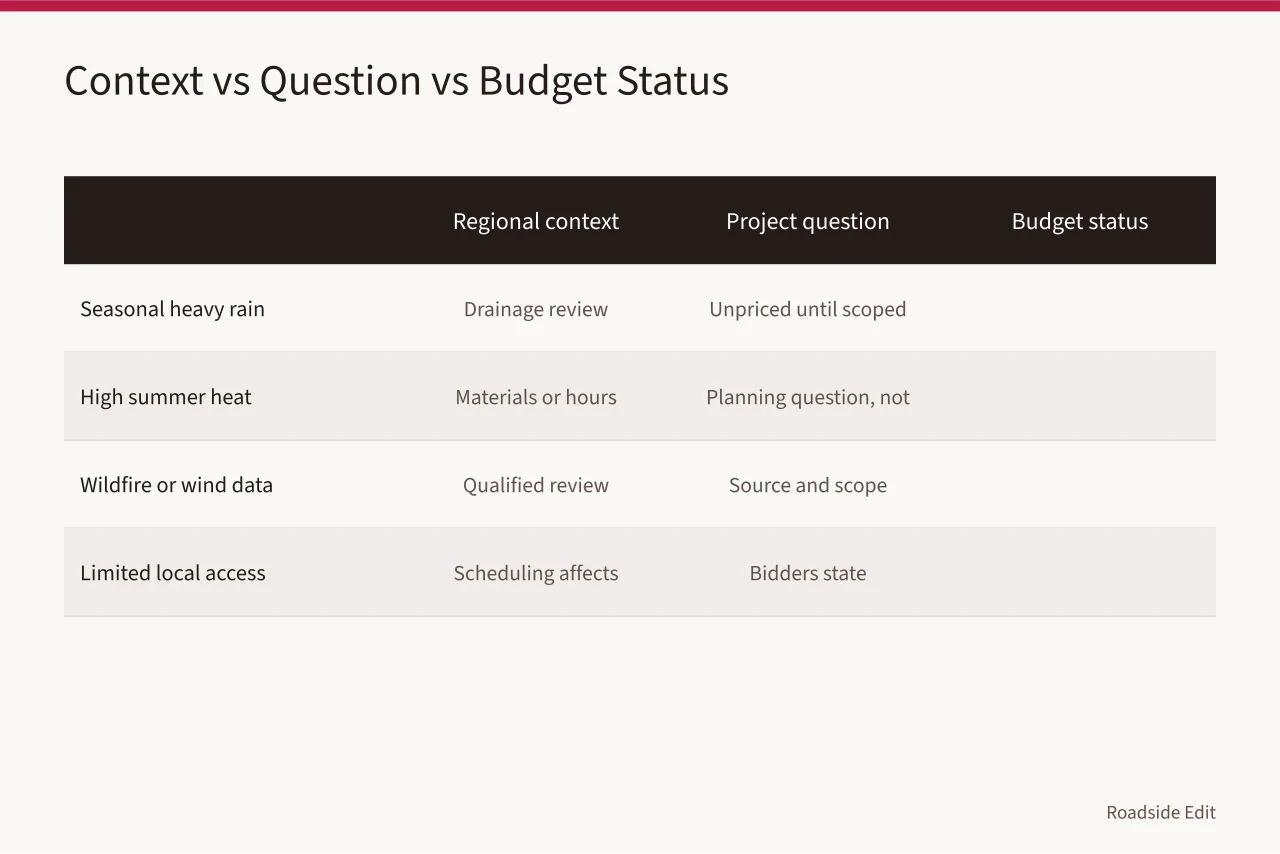
| Regional context | Project question | Proper budget status |
|---|---|---|
| Seasonal heavy rain | Does the site need drainage review? | Unpriced until scope is defined |
| High summer heat | Are materials or work hours affected? | Planning question, not a cost claim |
| Wildfire or wind data | Should a qualified review address a documented concern? | Source and scope required |
| Limited local access | Does scheduling affect a proposal? | Ask bidders to state the assumption |
FEMA's National Risk Index provides data and information about natural-hazard risk for communities. It is not a site inspection, design standard, or construction estimate. If an article uses a regional risk source, it should say that the source identifies a context for further review, not proof that a particular building faces a confirmed problem.
This difference matters in an editorial budget. A sentence such as "The area has a risk indicator, so the building needs a $40,000 upgrade" joins two claims that the source does not establish. A better note says that regional context led the project team to budget for a defined review, if a dated scope actually names that review.
Compare labor data without calling it a bid
Labor data are frequently used too aggressively. They can help an editor understand why regional comparison is difficult. They cannot reveal a contractor's overhead, equipment, crew mix, schedule, availability, travel, subcontracting, insurance, or the actual conditions behind one proposal.
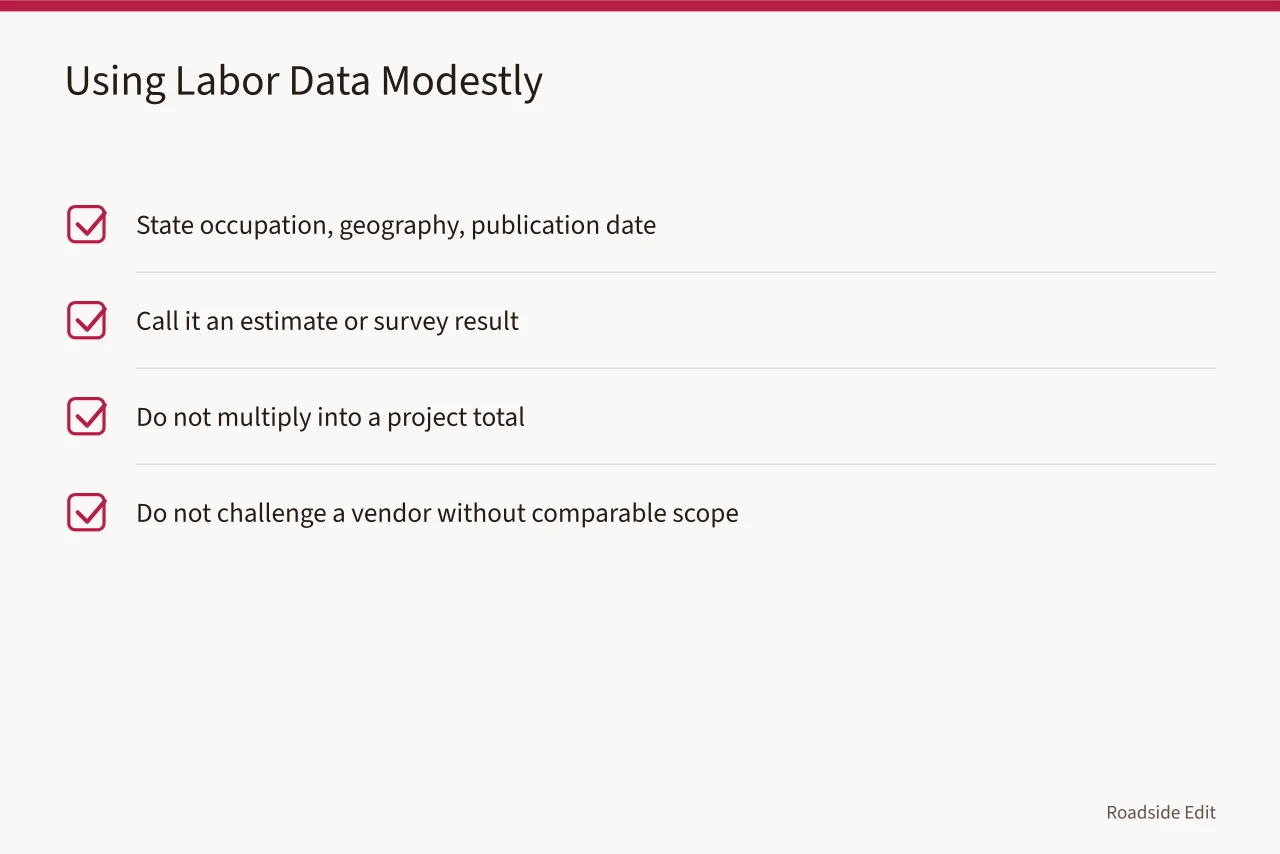
The Bureau of Labor Statistics Occupational Employment and Wage Statistics provides employment and wage estimates by occupation and area. It is not a construction-pricing catalog. The page supports labeling wage data as broad labor-market context, rather than presenting it as a local renovation rate or as evidence that one contractor's price should match another's.
If labor data appear in a background note, keep the wording modest:
- State the occupation, geography, and publication date.
- Identify the data as an estimate or survey result from the named source.
- Do not multiply it into a public project total without a responsible estimate.
- Do not use it to challenge a vendor's proposal unless the proposal scope is comparable.
An article can still help readers by explaining the limits. A rural project may include travel or limited crew availability. An urban project may have different access constraints or fee structures. Neither observation supplies a number until the project record identifies the actual work and its source.
Build a regional comparison record
When a project team compares options across places, use a record that makes non-comparable inputs obvious. The table below is designed for reporting, not for selecting a vendor.
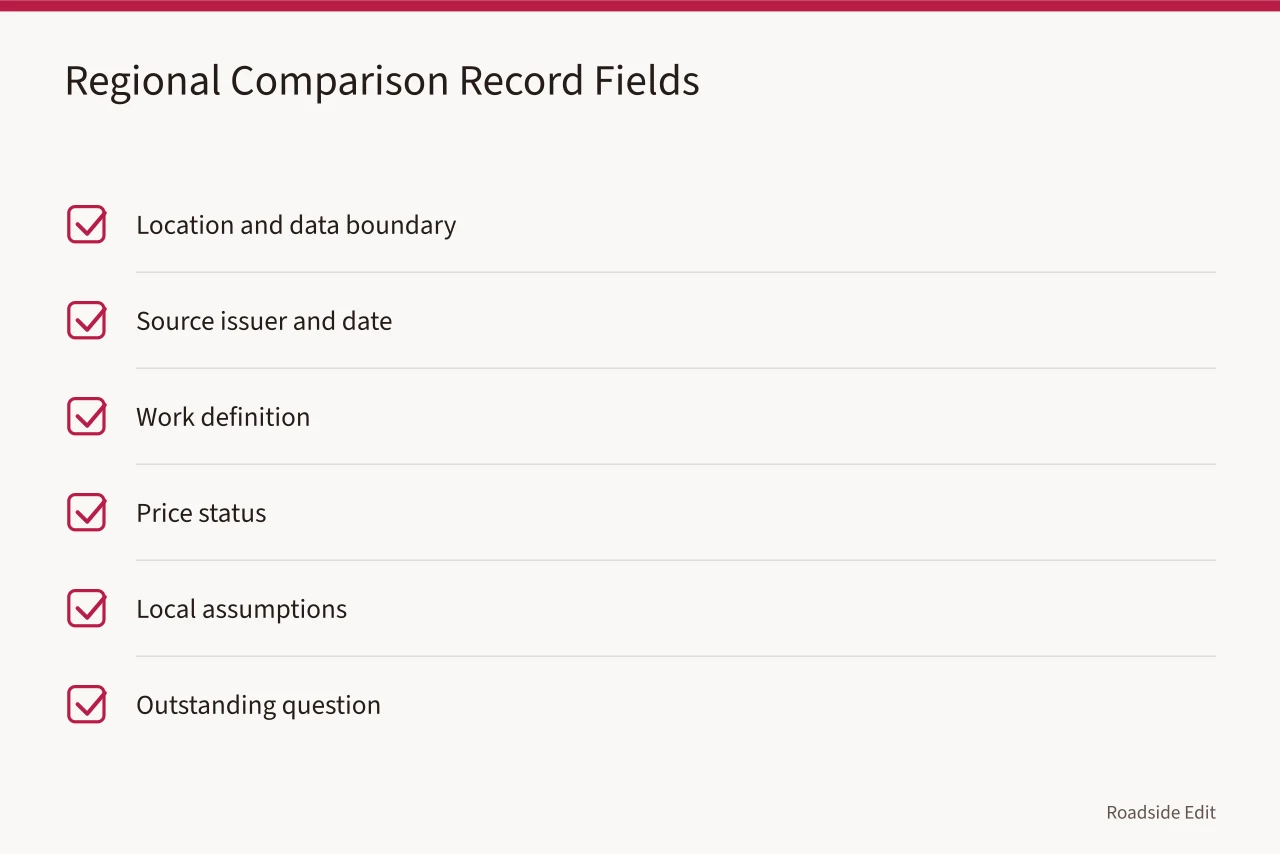
| Field | Why it matters |
|---|---|
| Location and data boundary | Prevents a county, metro area, and site from being treated as identical |
| Source issuer and date | Shows who produced the information and when |
| Work definition | Keeps a planning study separate from construction work |
| Price status | Distinguishes request, proposal, award, contract, and invoice |
| Local assumptions | Records access, season, permits, or known limits stated by the source |
| Outstanding question | Keeps an unknown from becoming an implied allowance |
The GAO Cost Estimating and Assessment Guide describes an estimate as needing a defined purpose, technical basis, assumptions, data, methods, and updates. It is written for government cost estimating, not for a small roadside renovation. Its useful rule for regional records is simple: comparison is only meaningful when the basis of each number is known.
For a public article, that usually means adding context instead of adding arithmetic. Explain that one amount is a local proposal for a named task and another is regional context with no direct price application. If only one local source exists, do not pretend that a national data point provides a second bid.
Write source dates into the public copy
Regional data become stale at different speeds. A climate-planning resource may remain useful as broad context. A contractor proposal can expire quickly. A public fee schedule may change without warning. Date the sentence that relies on each record and update the article when its decision basis changes.
Use a short update line when needed: "Updated after the local proposal date expired; the regional context remains background only." This tells readers why one number disappeared or why the article now lists a question rather than a figure.
Avoid language such as "typical regional cost" unless the article can identify what was measured, where, when, and how it matches the work at hand. A transparent gap is more useful than a tidy but unsupported benchmark.
Review before publishing
Read the article as someone deciding whether a number applies to their own place.
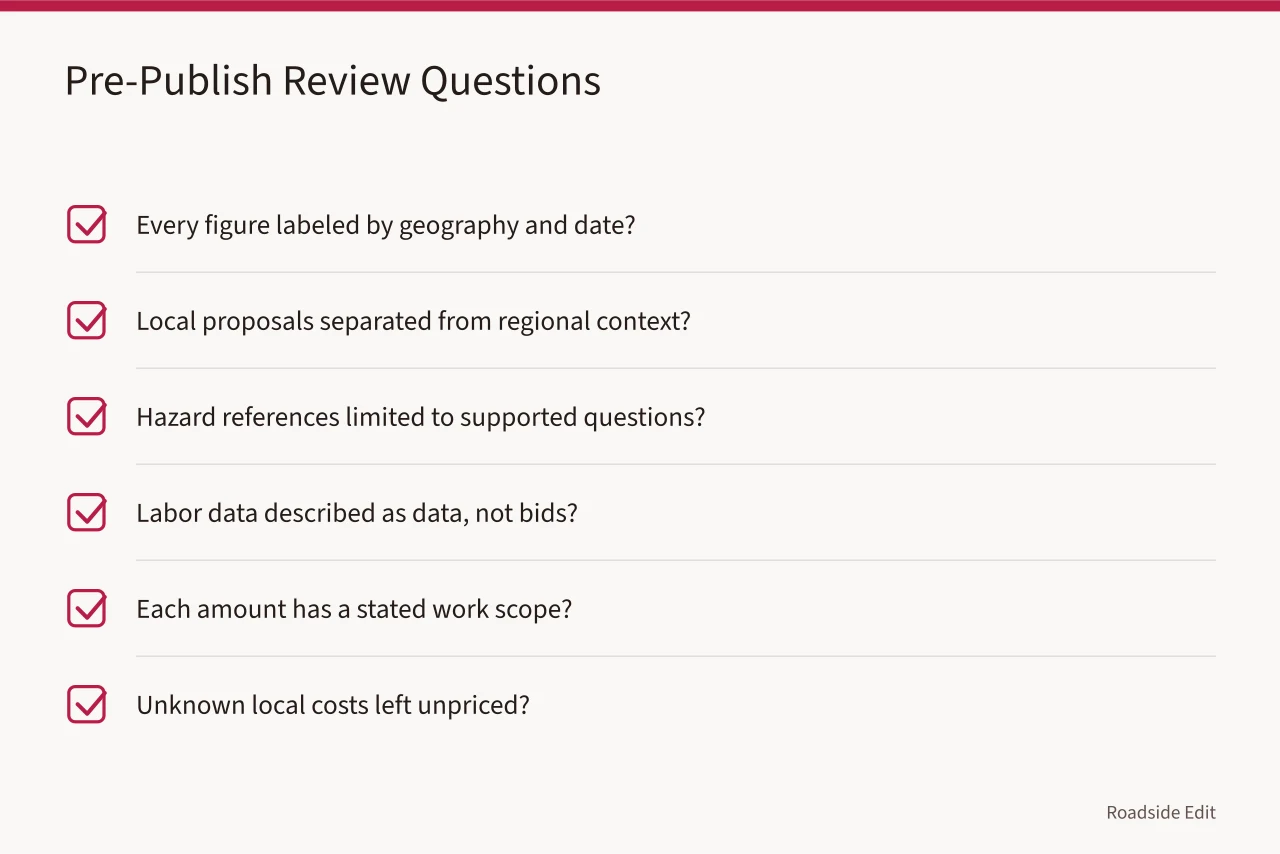
- Is every figure labeled by geography and source date?
- Does the article distinguish local proposals from regional context?
- Are hazard and climate references limited to the questions their sources support?
- Are labor data described as data, not bids?
- Does each estimated amount have a stated work scope?
- Are unknown local costs left unpriced?
Regional material earns its place when it helps readers ask better questions of current, local sources. It loses value when it pretends to be a substitute for them.
Common questions
Can regional wage data set a renovation budget?
No. Wage data can provide labor-market context, but a budget needs a defined scope and a current source for the work being considered.
Does a regional risk map prove a building needs work?
No. It can inform questions for review. It does not diagnose a condition at a specific property or establish a repair scope.
What if only one local estimate exists?
Report the estimate's date, scope, and limits. Do not turn broad regional data into a second local quote.