Guides
How to build a vintage diner interiors safety checklist without faking an inspection
A vintage diner interiors safety checklist works when it records dated evidence, names its limits, and routes every technical question to the authority that sets it.
A vintage diner interiors safety checklist is an editorial tool, not an inspection. It records what a dated source shows, states what that source cannot establish, and names the licensed professional or authority who can. This guide covers the evidence-record fields, the correction workflow, and the observation-versus-escalation line.
What to take away
- Every safety-adjacent claim needs four things: place, relationship, limit, revision.
- A photograph proves what was visible on its date, nothing about today.
- A diner booth laminate sample or a chrome-edge trim photo is evidence of material, not of clearance or code.
- Route electrical, structural, and hazardous-materials questions to the licensed trade and the AHJ, never to the article.
- Keep a written correction trail so a later editor can see why wording changed.
Give the checklist a narrow purpose
A sentence about an exit, a counter run, or a kitchen line can change how a visitor moves through a building or how an owner is judged. That is too much weight for a general-interest page.
So the page states only what its source establishes. It may report a dated public record, summarize a policy page, or attribute an owner update. It does not call a diner safe, unsafe, code-compliant, or in need of a particular repair.
Open with that boundary in one line: this page carries historical and editorial context, not an inspection or a safety plan. Readers then know the difference between reporting and advice, and an owner has a stated route to request a correction.
The evidence record, field by field
Build one record per claim before you draft the sentence. Four fields do the work: place, relationship, limit, revision. The table below adds source and date because a claim without them cannot be checked at all.
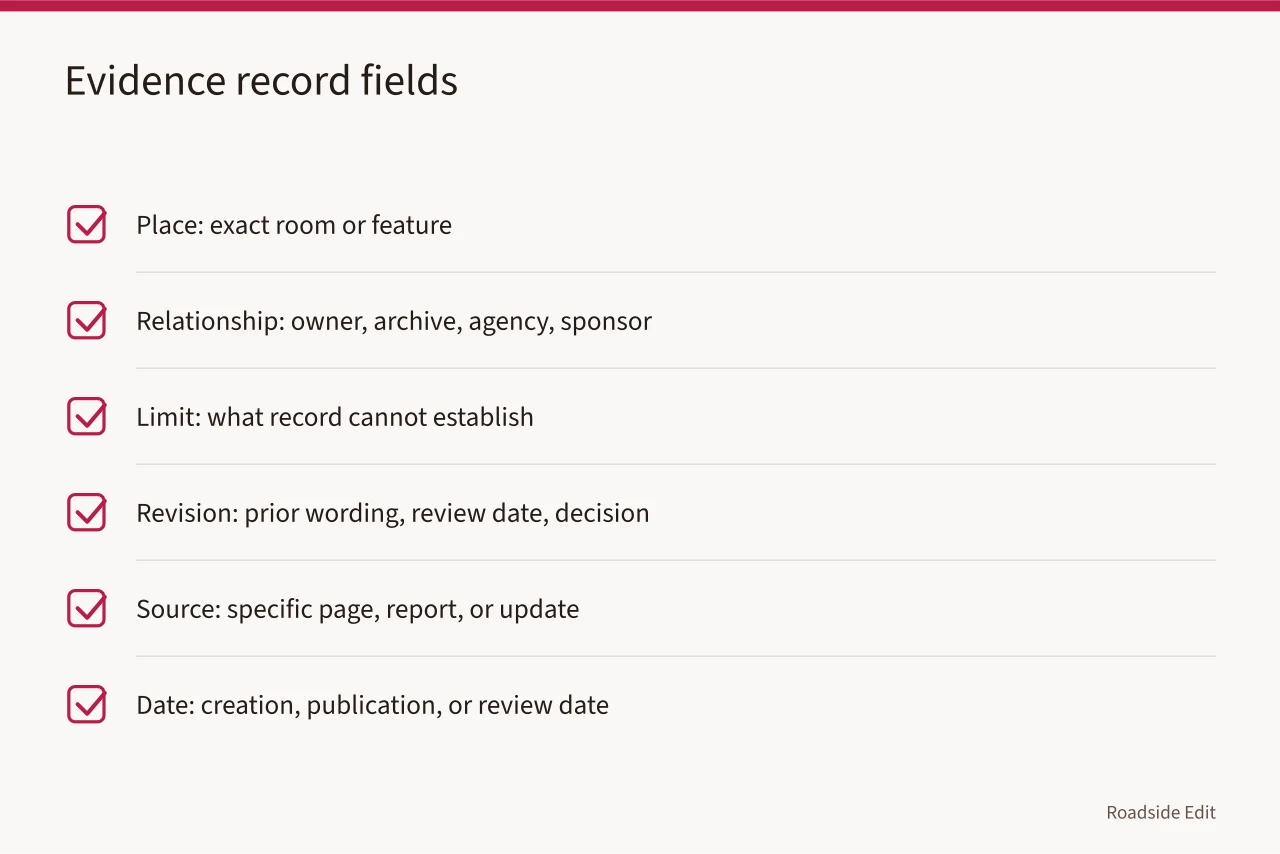
| Field | What goes in it | What fails |
|---|---|---|
| Place | The exact room or feature, such as the counter run or the entry vestibule | A statement about the whole property |
| Relationship | Owner, archive, agency, sponsor, or paid placement | A commercial tie left unstated |
| Limit | What this record cannot establish | A technical or legal conclusion |
| Revision | Prior wording, review date, decision | A silent change to a fact |
| Source | The specific page, report, or attributed update | A homepage offered as proof |
| Date | Creation, publication, or review date | Present tense borrowed from an old record |
A 1950s porcelain-enamel sign photographed in place is evidence of the sign and its date. It is not evidence of the wall behind it, the wiring that once fed it, or the condition of either now.
Reading a diner interior by decade and material
Interior fabric dates a diner the way a butterfly roof dates a motel. Booth laminate color and pattern, chrome-edge trim profile, counter stool bases, and ceiling treatment each point to a period, and each carries a documentation consequence.
- Porcelain-enamel panels, common on 1930s to 1950s roadside work, chip rather than flex. A chip is a material fact you can photograph and date.
- Plastic-faced box signs from the 1960s onward weather by fading and crazing. Fading is not a maintenance finding.
- Laminate booth tops from the 1950s and 1960s delaminate at the edge. The delamination is visible; whether it matters is not yours to decide.
- Neon tube diameter and transformer load are electrical facts. Record the tube diameter if you can measure it safely from a photograph; leave the transformer to a licensed electrician.
- Forecourt drainage and pump-island footprint belong to the site plan, and a change to either can trigger review you are not qualified to interpret.
Over-painting original enamel and swapping neon for LED are the two most common losses in this trade. Both destroy the evidence a later survey would have used. Document the material before anyone touches it, and route the decision to the State Historic Preservation Office or the local landmarks commission.
Observation versus escalation
The checklist earns its keep at this line. An editor can note that a public source describes a past renovation. An editor cannot decide whether a current feature meets fire, accessibility, health, or occupancy requirements.
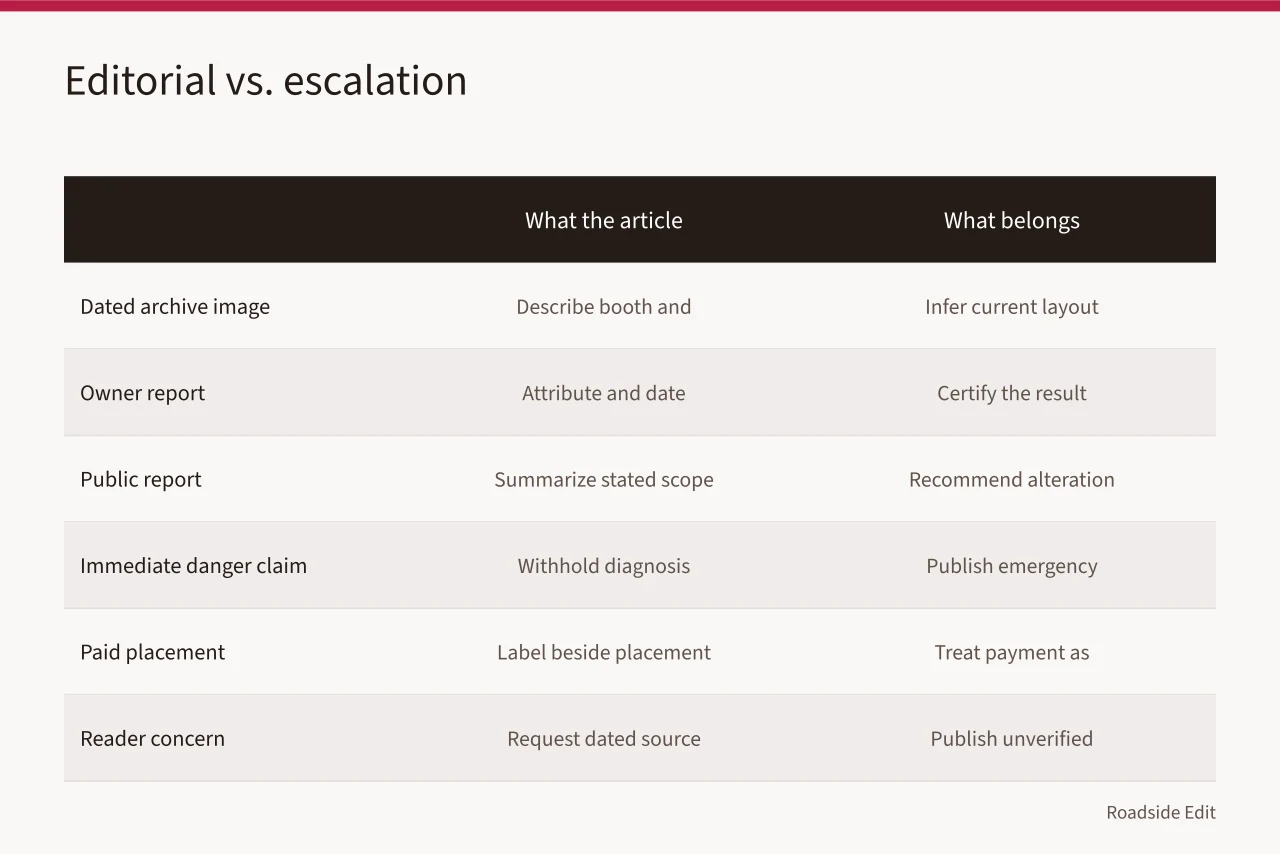
| Editorial question | What the article may do | What belongs elsewhere |
|---|---|---|
| Does a dated archive image show a booth? | Describe the booth and its date | Infer current layout or clearance |
| Did an owner report a project? | Attribute the update and date it | Certify the result |
| Does a public report name an alteration? | Summarize the stated scope | Recommend a similar alteration |
| Is a claim of immediate danger involved? | Withhold the diagnosis and contact the authority | Publish emergency or repair steps |
| Is a business paying for placement? | Label it beside the placement | Treat payment as validation |
| Does a reader report a concern? | Request a specific dated source | Publish an unverified finding |
| Is a feature described as accessible? | Describe what the image depicts | Rule on compliance |
Requirements vary by use, jurisdiction, scope of work, and the facts of the facility. Name the authority that sets the requirement and stop there. For a diner interior budget question, the arithmetic belongs in your own variables, and the cost planning notes show how survey days, travel, and fabrication split.
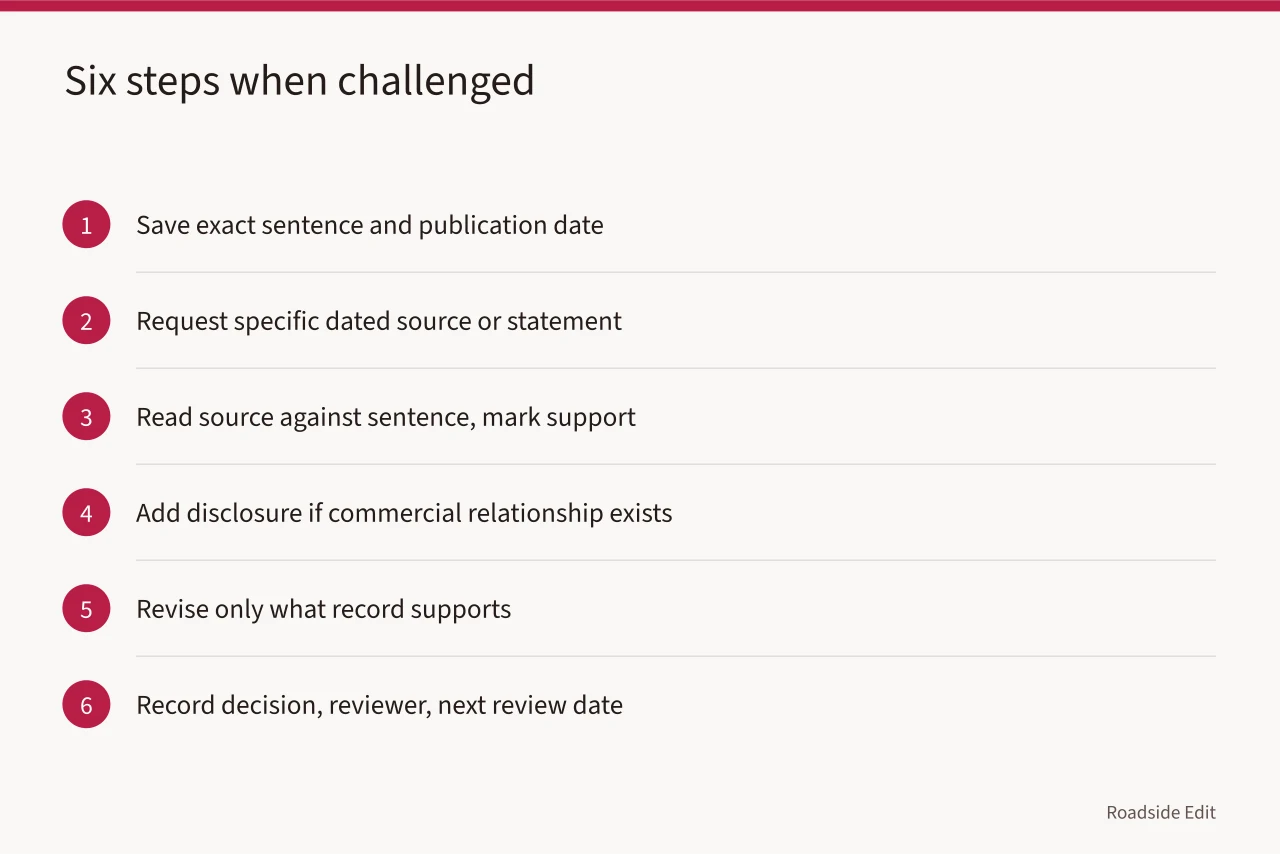
Six steps when a claim is challenged
- Save the exact sentence under question, with its publication date.
- Request a specific dated source or an attributable statement from the person raising it.
- Read the source against the sentence and mark what the source actually supports.
- Add a disclosure if the contributor has a commercial relationship to the property.
- Revise only the part the record supports, and leave the rest as written.
- Record the decision, the reviewer, and the next review date in the working note.
That note is what makes the process repeatable. A later editor can see that a caption was corrected, a claim narrowed, or a relationship disclosed, without re-reading the whole file.
Sponsor material and the disclosure line
Businesses, designers, local groups, and archives supply useful history. Label each contribution so a reader can weigh it. An owner statement is attributed. A paid placement is disclosed. A supplied photograph needs permission and a credit that stays with the file name in your notes.
Before publication, ask the contributor for the exact public record, the date, the room or feature involved, and their relationship to the property. If they cannot supply it, keep the wording at the level of what they reported. Promotional adjectives do not fill the gap.
The Federal Trade Commission's endorsement guidance supports a conspicuous label wherever a commercial tie could affect how a reader reads the page. The label identifies the relationship; it does not signal editorial approval.
Keeping the record usable
A correction path only works if the record survives staff changes. Keep the prior text, the source submitted, the review date, the decision, and any unresolved limit in one place. The National Archives records-management overview is the reference for retaining source and review detail on information that may need later correction.
The Library of Congress primary-source analysis guide separates observation from reflection and from further investigation. That is the same split this checklist asks of a diner photograph: publish what the dated image shows, and do not stretch it into a technical conclusion.
For a worked example of how that plays out across a full project file, the renovation case study records show the sequence from field notes to published claim.
Where the technical questions go
The National Park Service lists electrical malfunctions, kitchen activity, heating systems, arson, and misused stoves or chimneys among recurring fire concerns in historic structures. Its historic-building fire prevention article supports one limited reporting point: conditions are specific to a building and its use. It says nothing about any diner you are writing about.
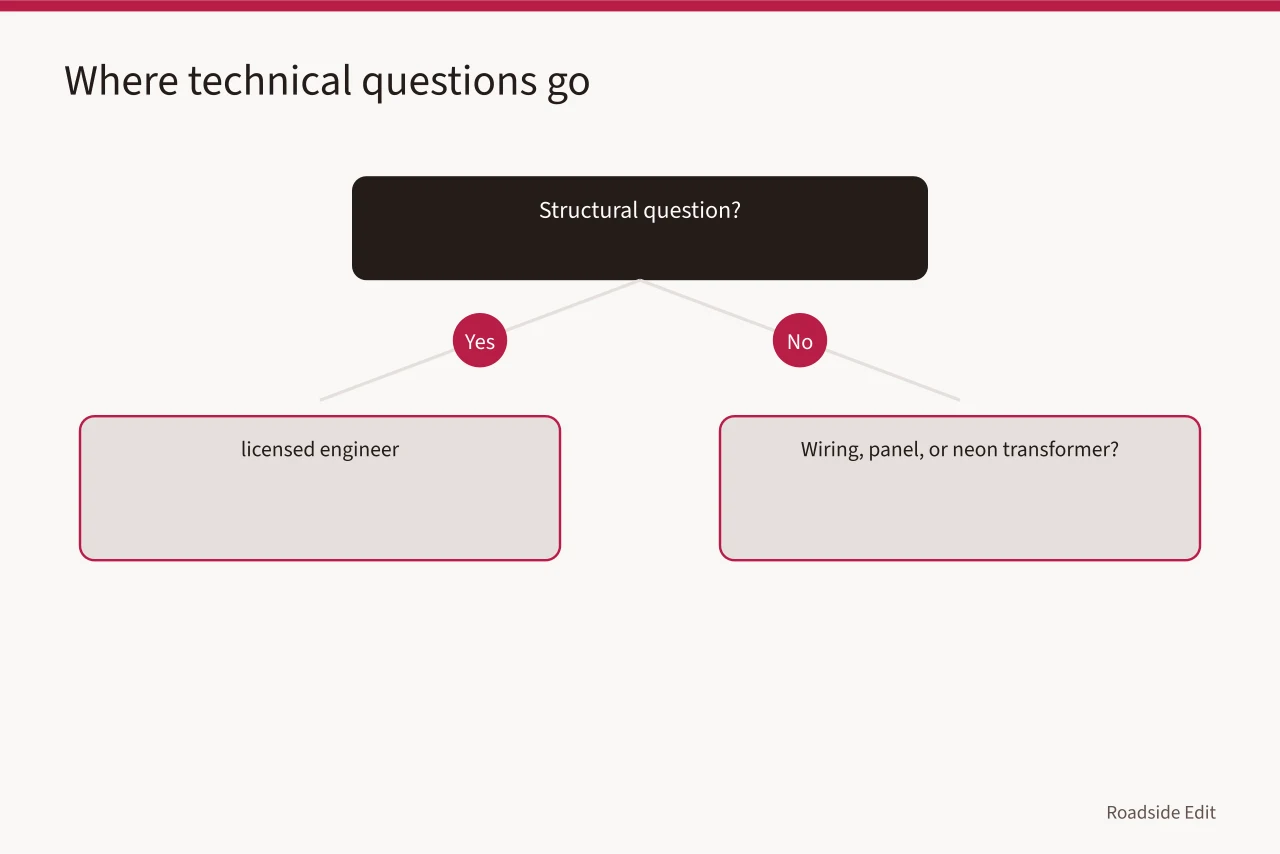
A structural question goes to a licensed engineer. A wiring, panel, or neon transformer question goes to a licensed electrician and the AHJ.
An underground tank or hazardous-materials question goes to the environmental authority for that state.
An easement, tax credit, or cross-border import question goes to one of three professionals:
- an attorney
- an accountant
- a customs broker
The relevant statute or agency is cited rather than paraphrased.
Canopy soffit and dry-stand pipe inspection, transformer load, and tank status are not editorial subjects. They are licensed work with a named responsible party, and the gas station preservation case studies show how other sites have handled that handoff in print.
What to check before publishing
Run the same standard across a feature, a directory entry, and a sponsored placement. Start with the claim, not an assumption about the property. Find the exact source page, confirm its date, and read the sentence beside the source.
Then ask whether the wording quietly added a current condition, a cause, a legal conclusion, or an instruction. If it did, cut the addition. Check the caption too: mark an image as historical or illustrative where that is true, and never let it imply a customer route, an employee practice, or an equipment status at another diner.
For a listicle, record the inclusion basis for every entry. A place may qualify through an archival record, a public designation, a documented project, or a disclosed paid placement.
Those bases are not interchangeable, and a paid placement must never read like a safety award. The regional checklist conventions in the diner interiors regional checklist show how that plays out across states.
Common questions
Can an article say a historic diner is safe?
No. A page can report dated, source-backed facts, but a safety determination belongs to the licensed professional and the authority that sets the requirement. Keep the article on the evidence side of that line.
Does an archival image prove a current entrance is usable?
No. It documents the scene on its stated date. It cannot establish today's route, condition, or compliance status, and the caption should say so.
How should a paid listing be handled?
Label it clearly, record the inclusion basis, and keep payment out of any claim about quality, access, or safety. A reader should be able to tell a placement from a finding at a glance.
What happens when a reader reports a concern?
Request a specific dated source, compare it against the published sentence, and correct only what the record supports. Do not publish an unverified finding, and log the decision for the next review.
Who decides whether a feature meets code?
The authority having jurisdiction, working from the adopted ordinance and the scope of work. The diner interiors budget notes cover how survey and documentation costs are separated from that determination, and the motel safety checklist guide applies the same boundary to lodging properties.
In this guide
- Vintage diner interior safety checklist: how to check evidence before wordingA vintage diner interior safety checklist for editors: which records to publish, which to attribute, which to omit, and how to log an urgent report.
- How to write vintage diner interior safety budget notes without projected costsBudget notes for a vintage diner interior record dated, attributed amounts and label what each one covers, so no reader mistakes a figure for a safety finding.